• Blog
  • Shop
  • Podcast
  • Resources
  • About
  • Archive
  • Contact
  • Cart
  • Sign In My Account
Menu

The Gentleman Stationer

Vintage Living in the Modern World.
  • Blog
  • Shop
  • Podcast
  • Resources
  • About
  • Archive
  • Contact
  • Cart
  • Sign In My Account

Pen Review: PenBBS 308 Fountain Pen

October 9, 2019

What does less than $20 get you these days in a fountain pen? Well, on the one hand, you have the so-called “kids’ pens” that many people use but which are plainly geared towards the education market (the Pilot Kakuno and the Pelikan Pelikano Jr., for example), as well as quasi-disposable pens like the Platinum Preppy. Otherwise, the pickings are fairly slim from the “traditional” pen companies. Platinum arguably leads the way with its upcoming Prefounte, as well as the excellent Plaisir. The Kaweco Perkeo is also a good choice for a very inexpensive fountain pen, as is the TWSBI Go, but my point remains: pickings are slim, and most of these pens look, well, kind of cheap.

I’ve asked the question before: At what point do Chinese pens enter the discussion as serious contenders on par with pens from European and Japanese companies? Believe me, I understand the skepticism. When I was starting out, I too got eBay burned by $1.99 Jinhaos, Baoers, and even Kaigelus, which had a reputation for a while as the “good” eBay pen. I even dedicated a post to my experiences. But it’s not just about $2 knockoffs anymore: Chinese companies such as PenBBS, Moonman, and KACO are releasing quality fountain pens in original designs, many of which start at or just below the $20 price point. I’ve reviewed several PenBBS pens, including a vacuum filler (Model 456) and a syringe filler (Model 355), and come away impressed with all of them, both as well-made, usable writing instruments and value propositions.

PenBBS manages to offer well-designed, functional writing instruments at a bargain price, AND make them attractive, to boot.

But what about the “entry level” PenBBS pen: the Model 308, a straight-up cartridge-converter fountain pen? To me, the real test of a pen brand is whether their lower-end models write as well as their higher-end pens. Is the nib scratchy? Does the converter allow for adequate ink flow, or is the pen a spotty, dry writer? Does it feel cheap in the hand?
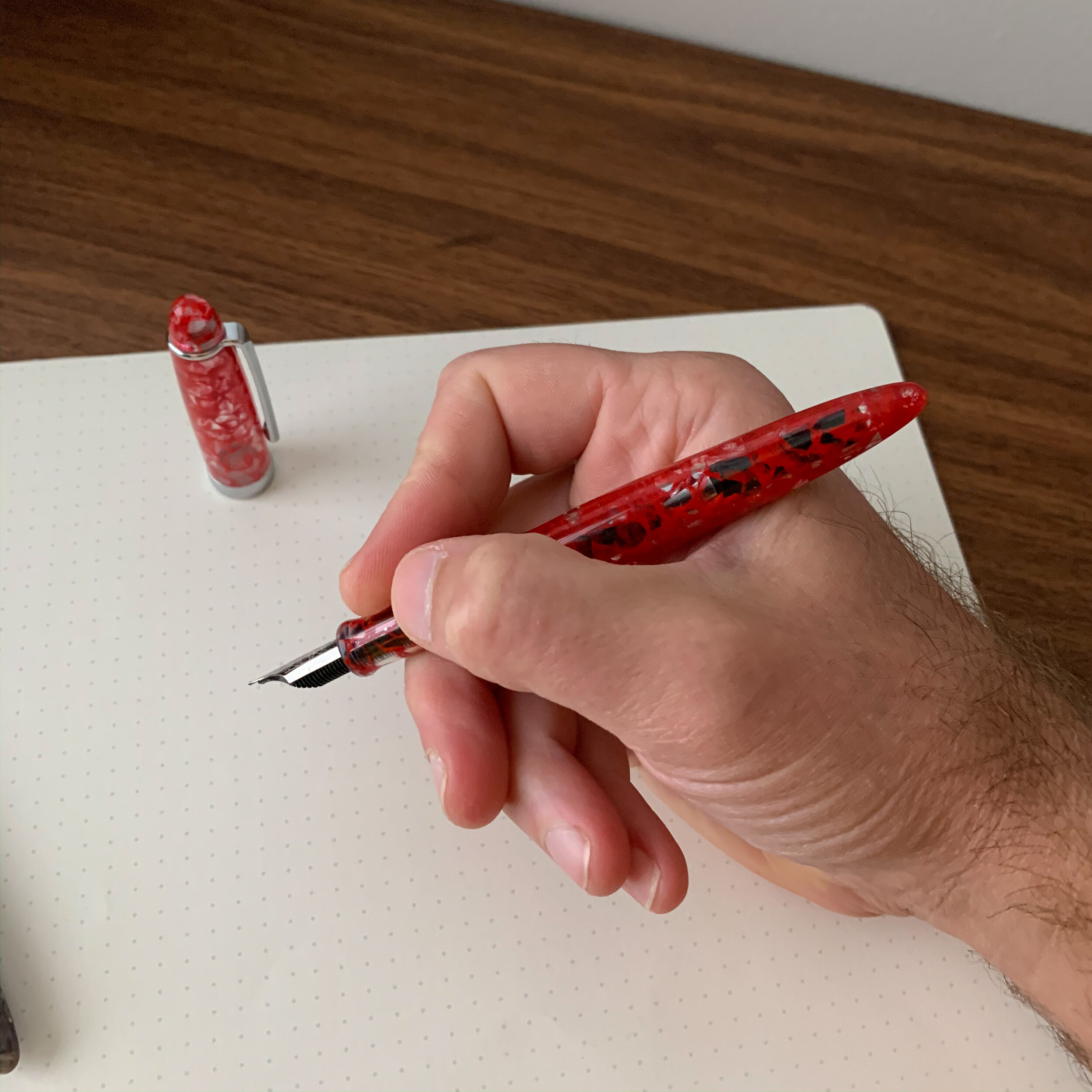
View fullsize PenBBS Model 308 Unposted
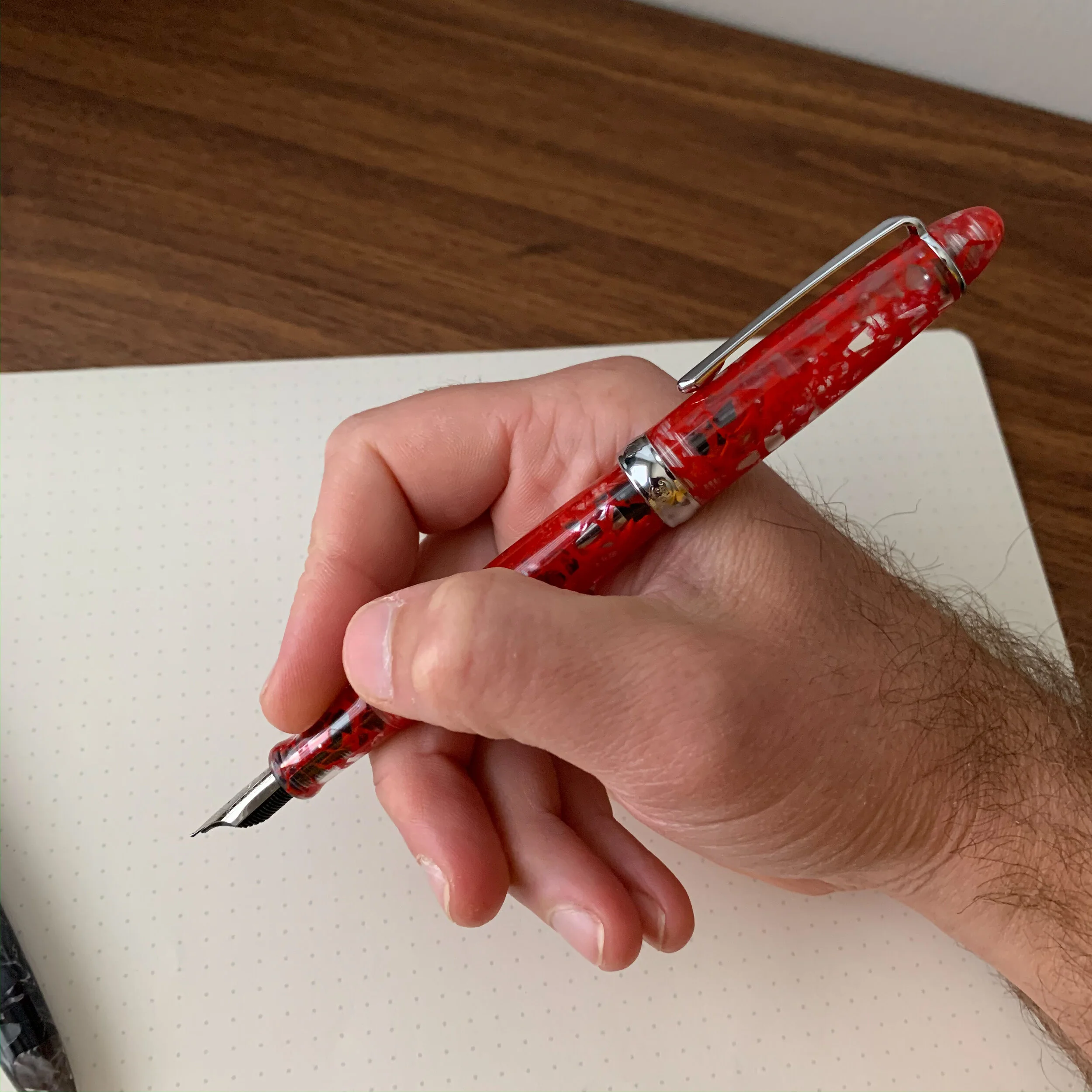
View fullsize PenBBS Model 308 Posted

As with every other PenBBS pen I’ve reviewed, the answer to all of these questions is “No.” The Model 308 comes fitted with the same slightly upturned nib as the other PenBBS pens I’ve reviewed, and both pens arrived writing exceptionally well out of the box. Again, if you’ve ever used a Sheaffer “dophin-style” nib that appeared on certain snorkels and touchdown fillers, you’ll understand how pleasant this type of nib is to write with. I also experienced no trouble with the converter, which supplied generous ink flow.

Nothing fancy - just the same high quality stainless steel nib that comes equipped on all PenBBS pens.

The Model 308 also comes fitted with an o-ring. I don’t see any reason why you couldn’t eyedropper this pen, if you wanted to, though you might lose the visibility of the Manjusaka’s red webbing.

The trim on PenBBS pens outperforms the price point. No thin, folded stainless steel here, but instead a rather substantial sword-style clip. Branding is simple with “PenBBS” engraved around the cap band in cursive script.

In terms of build, the Model 308 feels solid, with no hint of the thin, cheap acrylic that marks so many inexpensive pens. The materials themselves have quite a bit of depth. Typically, at this price point you are restricted to solid colors or and clear demonstrators, whereas with PenBBS you have available a wide variety of unique patterns, many of which I have not seen used in other pens. Case in point: the “99 Manjusaka” acrylic featured here, which is clear resin interspersed with what looks like red webbing. It’s gorgeous. The Model 308 is the second pen I’ve purchased in this material, with the first being my Model 469, the double-ended eyedropper. I have to say, as someone who loves red pens, I will probably purchase one of every pen that PenBBS releases in this material. It’s that good. (The silver pen pictured here isn’t too shabby either, with plenty of depth and different tones throughout. This particular material is a limited run called “Niangao Is A Cat,” which comes in both gold and silver trim.)

View fullsize PenBBS 308 "99 Manjusaka" Red Acrylic
View fullsize PenBBS Model 308 "Niangao Is A Cat" Limited Edition Acrylic

Takeaways and Where to Buy

In short, I consider the Model 308 another smash hit from PenBBS. My mind is spinning as I figure out how I’m going to rework my various “Best Pen” recommendations for 2020. Look for at least two PenBBS models to make the cut, probably in multiple categories.

From left, the PenBBS Model 456, the PenBBS Model 308 Niangao-Is-A-Cat, the PenBBS Model 309 Piston Filler (review coming soon), and the PenBBS Model 308 “99 Manjusaka”.

Lately I’ve been purchasing all of my PenBBS pens directly from the PenBBS Etsy store, which is where I have seen the best pricing. The Model 308 cartridge/converter pens range from $13.99 (an absolute steal) to $29.99 for some of the more limited acrylics. The red “99 Manjusaka” pen featured here is currently available for $19.99, and the limited edition silver “Niangao Is A Cat” pen sits at the higher $29.99 price point.

Disclaimer: I purchased the pens featured in this review with my own funds, for my own use. This post contains affiliate links, which I use to support the blog. Please see our Privacy and Cookie Policies for additional information.

In Pens Tags PenBBS 308, PenBBS, Pen Review, Fountain Pen, Chinese Pens
2 Comments

From left, Franklin-Christoph Model 20 in Maya Blue, Vintage Green, and Winter Pine.

Pen Review: Franklin-Christoph Model 20 Marietta

October 5, 2019

Although Franklin-Christoph pens rotate through my pen case regularly, and I’ve been a customer of the company for years, their pens have not appeared on the blog as frequently as I would have liked. That changes now. Today I want to talk about my favorite Franklin-Christoph fountain pen: the Model 20 “Marietta.” 

I tend to pick one or two models within a brand and stick with them as my daily users. There’s an easy explanation for this:  Once I find a pen that fits my hand and meets my needs as an everyday writer, there’s not much incentive to go looking elsewhere. With Leonardo, of course there’s the Momento Zero. With Lamy, I prefer the Lamy 2000 and Lamy Studio and rarely use much else. With Montblanc, it’s the 146. Parker, the Sonnet, another great “unsung hero.” For Franklin-Christoph, it’s the Model 20. 

The top of each cap is engraved with the understated Franklin-Christoph logo.

Inspired by vintage flat-top pens from the fountain pen “golden age” of the 1920s and 1930s, the Model 20 is a mid-sized pen notable for its friction-fit slip cap, and ability to easily convert from a cartridge-converter filling system to an eyedropper. I love the fact that this lightweight pen posts deeply, without adding much weight or length to the barrel. Though some might find the design too understated, or a bit plain, I regard it as an example of classic vintage-inspired penmaking, where the purpose of the pen is not just to create an objet d’art but rather to focus on the pen as a tool for writing.   

My Winter Pine Model 20 posted. The cap on the Model 20 posts securely, and I’ve never had issues with it coming loose posted or capped.

One thing I appreciate about Franklin-Christoph is that they share a lot of information about their pen design on the website, which is always helpful for answering questions people may have about the various models. On the Model 20, I frequently get questions about the slip cap - namely “How does it stay on?” and “Won’t the cap develop cracks around the lip, like so many vintage slip cap pens do?” Well, I can’t vouch for how this pen will hold up 100 years from now, but I can say two things: 

  • I’ve never had a Franklin-Christoph pen lose the cap in a pen case. F-C goes so far to say on their website: “When capped or posted properly it is impossible to sling the cap off, so [it] can be securely used in a shirt pocket or pen pouch.” Strong words, and they hold up. 

  • I’ve never had a Model 20 crack, and in the unlikely event it did, (1) it would most likely be my fault because I did something stupid; and (2) Franklin-Christoph would fix it. 

Though I don’t use this pen unposted, the Model 20 is still a comfortable length.

Another thing to note is that the design of the Model 20 has been refined and optimized to solve a problem that seems to plague slip-cap pens: ink being drawn into the cap by the vacuum that occurs when the pen is uncapped, particularly when the pen is eyedroppered. (See my recent review of the Karas Kustoms Vertex.) Franklin-Christoph notes that “[t]he interior of the cap has a feature that releases air pressure to eliminate the vacuum,” which I assume is a machining trade secret. Anyway, it works. I’ve not had any issues with Model 20 fountain pens leaking into the cap, even when I (rarely) eyedropper them. 

“Maya Blue” might be my favorite color in the standard Franklin-Christoph lineup. Note the smooth section, free of any threads to interfere with your grip comfort. A key benefit of a slip-cap pen.

Franklin-Christoph Nibs

I should probably write a stand-alone article about Franklin-Christoph nibs, and I go back and forth on whether they are better known for their nibs than their pens at this point. All Franklin-Christoph pens accept either No. 5 or No. 6 JoWo nibs, are available in steel or gold, with standard nib widths or specialty grinds, and are tuned in-house prior to shipping. If you visit Franklin-Christoph at a pen show, they will tune the pen for you in person, and you will have the opportunity to sit at the table and provide live feedback as the nib is adjusted to your personal preference. I’ve never received a bad nib on a Franklin-Christoph pen. 

A 14kt Franklin-Christoph JoWo No. 6 with a Masuyama Fine Cursive Italic.

Specialty grinds include the S.I.G. (Stub Italic Gradient), a stainless steel nib ground to a cross between a stub and a cursive italic, which offers the line variation of the latter with the smoother writing experience of the former. Audrey Matteson has taken over primary S.I.G. duties from the late Jim Rouse, who developed the grind, and under her stewardship the S.I.G. has become my preferred Franklin-Christoph nib. Other options include a “Fine Flex,” a 1.9mm Music Nib, as well as needlepoint, cursive italic, and stub grinds by Mike Masuyama.   

On my Model 20 in “Winter Pine” that I acquired at this year’s D.C. Pen Show, I opted for a medium S.I.G. in the “Shadow” nib. It looks great and Audrey did an exceptional job tuning. This pen has the potential to become a favorite!

On my Model 20 in “Winter Pine” that I acquired at this year’s D.C. Pen Show, I opted for a medium S.I.G. in the “Shadow” nib. It looks great and Audrey did an exceptional job tuning. This pen has the potential to become a favorite!

Takeaways and Where to Buy

I guess you could say that I have the beginning of a “mini-collection” of Franklin-Christoph Model 20s, with a high likelihood of picking up more in the future. The F-C table is one of my first stops in the morning at most pen shows, because the prototypes go fast! 

Franklin-Christoph only sells their standard line direct to customers on their website. Currently, the Model 20 is available in Classic Black, Diamondcast Green, Vintage Green (pictured here), Maya Blue (pictured here), and Tiger Red. An excellent reason to visit a pen show is to have the opportunity to pick up Franklin-Christoph pens in various “prototype” materials, like the “Winter Pine” Model 20 that I purchased at the 2019 D.C. Pen Show. Occasionally, you can find special runs of unique materials in The Stock Room section of the F-C website. All Model 20 pens are priced at $165 for a standard steel-nib pen, with additional charges for specialty or gold nibs.

If you are looking for a smaller pen, consider the “Pocket 20” (currently listed as the “Model 20p”), which is priced at $145 but takes the same No. 6 JoWo nib. Back in 2015, I reviewed the Pocket 66 and Model 65 Stabilis Eyedroppers. While those two pens did not work for me over the long-term, and I’ve gone all-in on the Model 20, they are also great options and you may find the review of interest.

Franklin-Christoph also offers more than just pens, having recently expanded into watches, bags, and other luxury accessories. I’ve previously reviewed their leather Covered Pen Tray, and plan to review their “Penvelope” series of cases in the near future. Let’s just say I’m following their Initial Watch Offering closely….

Disclaimer: I purchased the pens featured in this review with my own funds, for my own personal use.

In Pens Tags Franklin-Christoph, Franklin-Christoph Model 20, Franklin-Christoph Model 20 Marietta, Fountain Pen, Pen Review
Comment

Notebook Review: Endless Recorder Notebook

October 2, 2019

Back in the day, when I still wrote on lined paper and didn’t prefer graph or dot grid, my hardbound notebook of choice was the Quo Vadis Habana, which at the time did not come in a dot grid format. For whatever reason, that notebook became difficult to find, and I moved on to other things, but the format always stuck in the back of my mind - a slim, A5-ish notebook with a leatherette cover, elastic closure, and exceptionally fountain pen friendly paper. I used several Habanas as my personal journals over a multi-year period, and still have them on my shelf.

The Endless Recorder, the product of a relatively new company based in India called Endless Works, has updated this format by incorporating 187 numbered pages of 68 GSM Tomoe River dot grid paper into a compact notebook with a similar faux-leather cover. The notebook comes in four colors: black, blue, red, and green, each with a sky blue elastic closure.

The specs of the Endless Recorder. The only possible complaint I have is that I wish the elastic were a bit tighter. I have some concern that it will loosen up over time.

The Endless Recorder feels well-made, and lays flat - a relatively uncommon feature in a notebook this thin. As for the paper, this is my first experience with 68 GSM Tomoe River. Most “Tomoe River” notebooks use the lightweight 52 GSM paper, which handles fountain pen ink quite well but which I’ve personally found less durable and subject to tears. If you put a lot of ink on the page, you can also experience extremely long dry times, in addition to the “crinkling” effect which I personally dislike. Though I have several 52 GSM Tomoe River notebooks that I use regularly, I do wish that this 68 GSM version would receive more attention and make its way into more products. The heavier paper is more absorbent, allowing ink to dry quicker, and also has a bit of tooth to it, which I prefer over the glassy-smooth texture of “standard” Tomoe River paper. (Added texture is one of the reasons I enjoy Baron Fig’s paper so much.) While the 68 GSM Tomoe River isn’t quite that toothy, it’s still very pleasant to use with pencils. Many pencil aficionados dislike the 52 GSM variant because it’s too smooth and doesn’t offer enough feedback when writing with graphite.

You don’t sacrifice the signature thinness of Tomoe River notebooks by opting for the heavier 68 GSM paper. Shown here (bottom) compared against the Baron Fig “Gather” Review Journal.

It’s relatively uncommon to find a smaller bound notebook that lays completely flat without breaking the spine or holding it open, much less one with 187 pages (16 of which are perforated).

Takeaways and Where to Buy

I’m impressed with the Endless Recorder, and plan on picking up a couple to use for work. Given the slimmer profile and general absence of bulk, these notebooks would also make excellent travel journals. Since the pages are numbered, this notebook could also easily be converted into a bullet journal.

You can purchase the Endless Recorder directly from Endless via their online shop. Pen Chalet also carries the standard journal, priced at $22.95, as well as a Pen Chalet special edition in “Rust”, currently priced at $17.99.

Disclaimer: Many thanks to Endless for sending me this notebook to review, free of charge. This post contains affiliate links.

In Notebook Review Tags Endless Recorder, Endless Works, Notebook Review, Tomoe River
Comment

Picking a "Workhorse": How To Choose A Fountain Pen for an Everyday Writer

September 28, 2019

By far the most common question I receive from readers, as well as other people in my everyday life who know that I love pens, is how to choose a fountain pen to use as an everyday writer. Sometimes, they even specify that this will be the only pen they plan to own/use! I basically write for a living, both here and at my day job, so I don’t take this question lightly and it’s also a difficult question to answer, because so much depends on personal preference, not to mention financial circumstances. The truth is that there are a variety of excellent options if what you are looking to do with the fountain pen is actually write. The best choice for you, however, depends upon your particular preferences and circumstances. This post offers my thoughts on different factors you should consider when selecting a pen you plan to use every day.

First, Budget

Be honest with yourself, and don’t feel pressure to stretch financially, because in today’s fountain pen market there are going to be viable options at any price point, even on the extreme low end of the pricing scale. If you are willing to spend as little as $25 you can purchase a reliable pen and avoid serious quality control issues. In any event, even if you have more flexibility, I would think hard before spending more than $200, since using a pen as a daily writer does bring with it the increased risk of loss, theft, and damage.

PenBBS has absolutely blown me away this year. You don’t need to spend a lot of money to get a reliable writer that holds a ton of ink.

Filling System

From the perspective of a writer, a fountain pen’s filling system is more important than many people make it out to be. If I’m busy at work, I can burn through a cartridge or a converter in an afternoon. If I’m in a place where I can’t refill, or don’t want to carry multiple pens, I need a pen that holds a lot of ink. My personal preference is a piston or vacuum filler, since these hold significantly more ink than a converter. Eyedroppers are another option, but for daily use I would highly recommend a Japanese-style eyedropper that uses a valve to prevent ink spilling or burping into the cap when the pen is not in use, especially if the pen will be carried in a briefcase, backpack, handbag, etc. where it’s going to get jostled around.

For those who don’t write a dozen pages or more a day, a cartridge-converter pen should work perfectly well for daily use, and you may find it more convenient to have the cartridge option if the pen runs out of ink at work. Just be aware that many brands (specifically Pilot, Sailor, Aurora, Lamy, and Platinum) take proprietary cartridges, so you will be limited to cartridges and ink colors made by that specific brand, unless you want to refill the cartridges yourself using a syringe or bottle-fill from the converter.

Piston fillers or cartridge-converters? Again, you have multiple options, and the best choice for a daily writer depends on how often you need to refill, and the most convenient option for refilling on the go. From left, the Pilot Custom 74, Lamy 2000, and Pilot Custom Heritage.

Weight and Balance

Once you’ve narrowed your budget and decided what type of filling system you want, the most important consideration becomes how the pen feels in your hand. Remember, you’re going to write with this thing every day, so while looks are important, comfort is key. Two of the most important things I look for in a pen are weight and balance. The two concepts are related, but distinct. By weight, I’m referring to how heavy the pen is. Certain types of pens (particularly metal pens made of copper, stainless steel, or brass) are better suited, in my opinion, for shorter notes and pocket carry, because their heft can make your hand quite tired after several pages. There are exceptions, but I’m dealing in general rules-of-thumb today.

I’ve tried a lot of pens, and none feel better in my hand than the Lamy 2000, which is made of Makrolon, a type of polycarbonate. It’s quite lightweight.

Balance is a different issue, and relates to where the weight of the pen sits. Do you post your pens, like me? If so, make sure that the cap isn’t too heavy because it will back-weight the pen and make writing awkward, even if the pen isn’t that heavy overall. Front-weighted pens (i.e., those with metal sections), typically don’t pose the same problem, since many people, myself included, prefer a pen in which the weight is shifted to the front, which keeps the nib on the paper and offers an additional degree of control over your handwriting. Because weight and balance are such a key consideration, it’s important to be able to either hold a pen in person prior to purchasing, or purchase from an online retailer that permits returns, especially if you’re shelling out a lot of money for a higher-end pen.

Nib Choice

Is the nib the most important part of the fountain pen? Yes and no. If you have a pen that feels great in your hand, but has a crummy nib, the pen isn’t usable, so the nib IS important. However, a bad nib can usually be improved through tuning and/or smoothing. On certain models of pens (TWSBI, Pelikan, Kaweco, among others) you can even switch out the nib and substitute one that’s a different size or even a specialty grind. For that reason, I tend to prioritize the weight, balance, and overall “feel” of a pen over the nib. Unless the nib is absolutely god-awful, it can be adjusted. The size and heft of the pen can’t.

I’ve had great experiences with the nibs on the Leonardo Momento Zero. They’re nothing fancy, but all of mine have arrived well-tuned and they certainly get the job done.

With respect to nibs, what’s most important is choosing the right type of nib for the work you want to do. If you write very small, and your day job (like mine) involves annotating or marking up documents that are often printed on the cheapest recycled paper available, you will likely want to choose something in the extra-fine to medium range and be particular about which inks you use. Those with larger handwriting, and who don’t need to write on cheap paper, have more flexibility to go with a broader nib or even a stub as their daily driver. Unless your day job involves calligraphy, however, I generally advise people to avoid super “soft” or “flex” nibs for everyday writing, as they tend to write far too wet.

Recommendations

Hopefully this short guide is helpful. Readers of this blog won’t be surprised to know that after considering all of the factors above, my own preferred “workhorse” pen is the Lamy 2000. I have several of them, and in addition to the fountain pen regularly carry the rollerball, ballpoint, and 4 Color Ballpoint (multi pen). From a fountain pen perspective, I love the Lamy 2000 because (1) it’s perfectly balanced for my hand; (2) it holds a lot of ink; and (3) I love both the way the hooded nib writes AND how it “disappears” in a crowded meeting room, where you don’t want to be that guy writing with a distracting fountain pen.

When I find a pen model I like, I go all out. Hence my collections of Lamy 2000s and Leonardo Momento Zeroes (pictured here)!

But what works for me may not - and in fact, probably won’t - work for you! While I maintain an annually updated list of pen recommendations, I’ve never published a “ranked” list of “Workhorse” fountain pens because the criteria are so subjective. I won’t rank pens here either, but I will provide several suggestions within particular price brackets. Everything listed here is a pen that I enjoy using and either regularly carry or would have no issues doing so. Where possible, I’ve linked to my own reviews, and otherwise to a retailer I trust.

  • $20-$50:

    • Platinum Plaisir. I’ve come to believe that the Plaisir might be the best “cheap” pen on the market, especially for one that you plan to use regularly.

    • PenBBS 308 or PenBBS 309. The 308 is a cartridge-converter pen; the 309 is a piston filler. The time has come for PenBBS pens to start appearing on recommendation lists alongside TWSBIs. They’re that good.

    • PenBBS 456. PenBBS’s vaccum-filling model, for around the price of a TWSBI Eco.

    • Faber-Castell Essentio. Faber-Castell makes the best bargain-priced steel nibs on the market.

    • TWSBI Eco. If people ask me for a TWSBI recommendation, I often recommend the Eco over the 580 because (1) it posts; and (2) it’s hard to beat the combination of price, availability, and reliability.

    • Kaweco Sport (Standard). If you don’t mind a shorter “pocket pen,” Kaweco Sports are inexpensive, reliable, and come in a wide array of colors. If you prefer chrome trim, check out the “Skyline” model. You can also swap nibs.

  • $50-$100:

    • Faber-Castell Loom. I prefer the Loom to the Essentio because it posts better. It’s only slightly more expensive and uses the same excellent nib.

    • TWSBI 580. If you want a TWSBI that uses interchangeable nibs, opt for the 580 series. If you want a TWSBI with interchangeable nibs that posts, opt for the TWSBI Diamond Mini.

    • Opus 88 Koloro or Opus 88 Picnic. The only eyedroppers I recommend, because they have the Japanese-style valve system that helps prevent “inkcidents.” Be aware that the Omar and “Demo” pens are very large.

  • $100-$200:

    • Lamy 2000. See above. My personal workhorse.

    • Pelikan M200/M205. Another relatively inexpensive piston filler, which comes in a wide array of different colors and patterns, including special and limited editions. Pelikan pens are reliable and will stand up to years of use.

    • Leonardo Momento Zero. A recently released pen out of Italy, available in some exceptionally pretty materials. Lightweight and reliable writers.

    • Pilot Custom 74. An underrated cartridge-converter pen with an exceptional nib. These pens don’t get nearly as much attention as they should. If you absolutely want a piston filler the Custom Heritage 92 is an option for more money.

    • Platinum 3776 Century. A pen that attracts a lot of attention for the collectibility of the limited editions, but also excels as a daily writer. Platinum offers a wide range of nib options for this pen.

  • OK, I want to blow it out ($200+)

    • Sailor Professional Gear (“Pro Gear”). My pick for a high-end cartridge converter pen. Sailor nibs are exceptional, and the Pro Gear is a well-balanced writing instrument, especially posted.

    • Pilot Custom 823. A vacuum-filler that posts well and makes for an comfortable writer despite the larger size.

    • Montblanc 146. Many people won’t carry a Montblanc because they find the branding pretentious. While I agree these pens have become a bit of a status symbol, they’re still great pens, hold a good amount of ink, and despite what people say, the standard Meisterstuck pens aren’t ostentatious.

    • Pelikan M400, M600, or M800. Personally, I think the Pelikan M400 and M600 make better everyday writers because they are much lighter than the M800.

    • Conid Bulkfiller. If you want the ultimate “ink tank” and cost is no object, get a Conid. Bulkfillers come in a wide array of shapes and sizes to suit any preference.

Again, I hope this is helpful! Please reach out through the comments or “Contact Me” link if you have any additional questions, or would like to share any additional information you take into account when choosing your daily writers.

In Guide, Editorial, How To, Workhorse Pens Series Tags Editorial, Workhorse Pens, How To, Pens
12 Comments

Notebook Review: Baron Fig Gather Review Journal

September 25, 2019

Baron Fig ended their quarterly limited edition subscription program a few years ago, but continues to release special editions of their Confidant notebook at regular intervals. The Gather “Review Journal” is the latest in a string of special-purpose notebooks issued by Baron Fig that they call “Guided Editions”, including the well-received Clear Habit Journal (a habit tracker), the Grow Daily Journal (designed to help you “form and keep a journaling habit”), the Savor Recipe Journal (self-explanatory), and the Wander Dream Journal (dream tracking). While each of these latter notebooks was a bit too specialized for me, and I took a pass, “Gather” intrigued me because, well, I spend a large part of my time reviewing products, and a notebook structured to help you track your notes on whatever it is you may be reviewing - pens, movies, books, music, wine, beer, etc. - struck me as potentially useful.

I love the olive green fabric, and wish Baron Fig would sell the standard Confidant in this color.

How I Intend to Use the Gather Review Journal

As I work to grow The Gentleman Stationer and ensure that I maintain a steady flow of content that people want to read, I’ve made an effort to improve my systems - namely, keeping better track of notes and thoughts on the various products I’m using and other topics that I want to write about. Gather intrigued me because I immediately saw the case for a structured notebook that I could use to collect my notes on different products at various stages of the review process. Overall, I can see this working out, and not just for pen reviews. I purchased a couple Gather journals, and I’m also considering dedicating one to keeping a logbook of other things, probably books I’ve been reading because I’d like to do a better job of retaining what I’ve read.

My only quibble is that I would have preferred either narrower ruling or a dot grid. There’s not much space to write your reviews, and I will probably end up using two pages for some products.

A Note on Paper Performance

Baron Fig has made my preferred “daily use” paper over the past few years, given it’s relatively low cost (at least in the standard Confidant), it’s reasonable performance with most pens and inks, and the texture, which I absolutely love for both pens and pencils. Paper is a highly personal preference, and what works for me may not be the best choice for you. Lately I’ve read a couple of comments about inconsistency in Baron Fig’s paper quality. While I’ve not personally noticed any significant drop-off over the past year, I would note that I don’t believe Baron Fig (or their manufacturer) single-sources their paper, so there may be slight batch variations in notebooks. For the most part, I would compare the performance of Baron Fig’s paper to something like Leuchtturm 1917 - it’s fine for most people, but you will start seeing some feathering and bleed-through if you use broader nibs, particularly wet-writing stubs or flex pens. Due to the slight texture, I find Baron Fig paper especially pleasant to use with pencils, and have since the beginning.

Takeaways and Where to Buy

Like all Baron Fig Confidants, the Gather Review Journal is a well-made hardcover notebook, and Baron Fig designed this particular release with a specific purpose in mind. While I have a use-case for this notebook, I do question how broad the appeal will be for this layout, and whether it’s playing too much into the current trend of encouraging everyone to “track” everything, from money to habits to, now, hobbies. I’ve always been a tracker and list-maker, but sometimes I wonder whether it might be better to just sit back and enjoy things without trying to quantify or “review” them.

You can purchase the Gather Review Journal directly from Baron Fig’s online store. This “Guided Edition” Confidants start at $24, with a 5% discount if you purchase two and a 10% discount if you purchase three. The pricing represents a markup over the standard $18 Confidant, but it’s understandable given the additional work that went into designing and producing a special purpose notebook with a custom layout.

You can read my initial review of the original Baron Fig Confidant, titled “Perfect Paper for Pencils? Agreed” here. It’s hard to believe Baron Fig has been around for nearly five years!

Disclaimer: I purchased the notebook featured in this review with my own funds, for my own use.

In Notebook Review Tags Baron Fig, Baron Fig Guided Edition, Baron Fig Gather Review Journal
Comment
← Newer Posts Older Posts →
Store Hours and Events
Shop T.G.S. Online
Updated 2026 "Best Pens" Guide
No results found
On The Paper Trail: Live In Nashville Event Tickets Now Available!
TGS_25 Roterfaden Restock Notification
Hierarchies of Fountain Pen Friendly Paper

Join Our Patreon!
Subscribe to the TGS E-mail List

Featured Posts

Featured
Everyday-Stationery-Bags
July 25, 2026
What's the Best Everyday Stationery Bag? My Own Considerations and 5 Options for Pen Show Season
July 25, 2026
Read more →
July 25, 2026
Graphilo-Kobeha-Paper.jpg
July 11, 2026
Paper Review: Graphilo by Kobeha
July 11, 2026
Read more →
July 11, 2026
Pilot-Custom-Heritage-92.jpg
June 6, 2026
Workhorse Pens: Pilot Custom Heritage 92 Fountain Pen
June 6, 2026
Read more →
June 6, 2026
The Gentleman Stationer RSS

View Cart

© Digital Divide Media, LLC, 2014-present.

All content is the exclusive property of Digital Divide Media, LLC, d/b/a The Gentleman Stationer, including “The Gentleman Stationer” website and trademark, and should not be reproduced without express written permission.  All rights reserved.

All content containing paid advertising, affiliate links, or sponsored content will be plainly disclosed by a disclaimer when/if featured.

Contact Information

Website Terms and Conditions

Store Shipping Policy and Return Policy

Privacy Policy and Cookie Policy

Accessibility Statement

Powered by Squarespace