• Blog
  • Shop
  • Podcast
  • Resources
  • Archive
  • FAQ
  • About
  • Contact
  • Sign In My Account
Menu

The Gentleman Stationer

  • Blog
  • Shop
  • Podcast
  • Resources
  • Archive
  • FAQ
  • About
  • Contact
  • Sign In My Account

Pen Review: Nahvalur Nautilus Ebonite Fountain Pen

October 5, 2022

Last week, I looked at the Nahvalur “Original Plus,” the updated vacuum-filler version of the Nahvalur “Original” fountain pen, and this week I’ll turn my attention to what is fast becoming Nahvalur’s “flagship”: the Nautilus fountain pen. Originally released under the Narwhal branding - with some current models still featuring the “Narwhal” engraving and logo on both the nib and cap band - the Nautilus has been around for a few years but recently has gained traction following a series of special editions and pen show exclusives in unique ebonites. The two pens I’m looking at in this post include a pen show exclusive that I received in Atlanta (the blue striated limited edition, numbered 205/400) and the “Stylophora Berry” release that I picked up in D.C. at the Nahvalur table.

Two different ebonites: striated blue (left) and “Stylophora Berry” (right).

Design and Build Quality

The Nautilus has received quite a bit of attention since its release due to its distinctive looks, which are plainly inspired by its namesake, the famed submarine from Jules Verne’s 20,000 Leagues Under the Sea. (RIP best Disney ride ever.) Nautical motifs predominate, including a torpedo/submarine shape, an engraved “waves” pattern on the cap band, and three “porthole” ink windows, which I consider more of a design flourish than anything else. The “portholes” can sometimes struggle to let in enough light to offer great visibility on the ink supply, but it’s still a cool visual touch nonetheless.

The porthole ink window and engraved cap band (still showing Narwhal branding, as this pen was released prior to the rebrand).

By far, my favorite aspect of the Nautilus fountain pen is Nahvalur’s use of premium ebonite in striking striated patterns. Why do I enjoy ebonite as a material for fountain pens? For starters, it feels solid in the hand - lightweight yet sturdy, with a warmth that acrylics and resins sometimes lack. You get a lot of visually interesting variation in the material that exudes some of the vintage vibe you get from celluloid or cellulose acetate without the price premium that those materials command.

Writing Experience

Given its shape, the Nautilus obviously doesn’t post. Nonetheless, this is a well-balanced pen that’s incredibly comfortable to write with, even for extended periods of time. Like the Original Plus, the nib on the Nautilus is smooth and requires very little pressure to write. The dark blue Nautilus pictured here initially featured a round double-broad (BB) nib with a lot of tipping - not usually my cup of tea - and while it wrote well out of the box, I chose to have it ground to a “Mini-Naginata”-style nib by C.Y. of Tokyo Station Pens. It’s of course now an excellent writer. My Stylophora Berry Nautilus (the purple pen) has a standard Nahvalur fine nib, and while it definitely writes on the broader side for a “fine”, the consistently wet line makes for a pleasant writing experience.
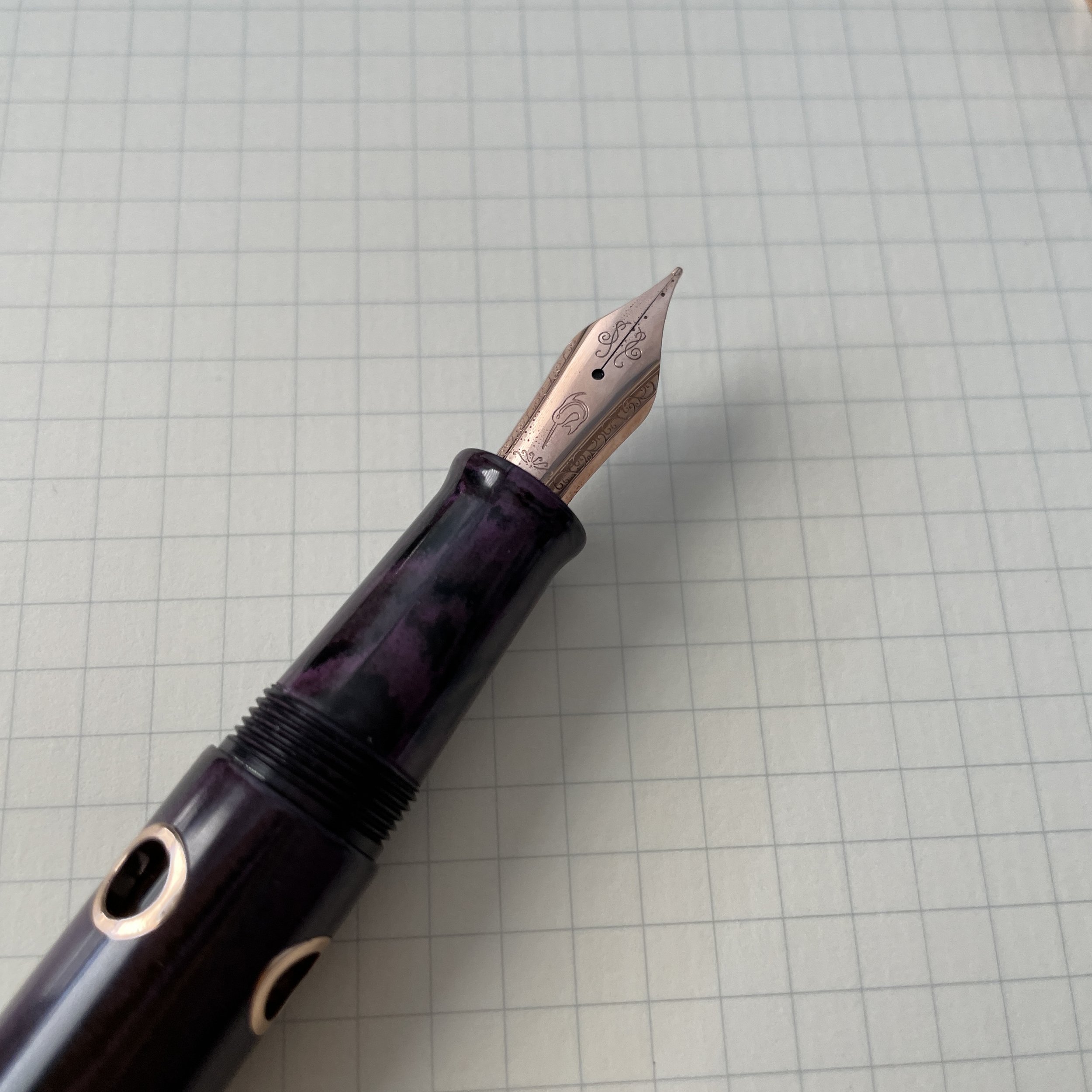
Nahvalur Nautilus Nib

The engraving on the nib is the same as on the Original Plus, though both of these Nautilus pens have rose gold nibs and trim. As a general observation, Nahvalur fountain pens tend to feature a fair bit of tipping, making them excellent platforms for nib customization (especially in the “B” and “BB” nib widths).

Since it’s a piston filler, the Nautilus holds a lot of ink, making it a writer’s workhorse. I’ve had one of these pens in rotation at any given time since late Spring, and I’ve especially enjoyed using them in my journals for longer sessions at night and early in the morning. Larger, unique pens like the Nautilus tend to be a bit too “conversation-piece-y” for my office environment, but I have taken them to work with me, and there’s absolutely no reason why you couldn’t rely on this pen as your daily driver. I will note that for whatever reason, I’ve found that ebonite pens don’t necessarily travel well in that they tend to burp ink in response to air pressure and temperature changes more than other types of pens. If you’re looking for a pen to take on an airplane, go with the Original Plus, which features a shutoff valve.

Writing samples for the Nahvalur Nautilus standard fine nib (top) in Wearingeul Metamorphosis, and custom-ground BB nib (bottom) in Anderillium Colossal Squid Dark. The Anderillium “Cephalopod” ink series seems like a great match conceptually for these pens. Writing sample is on Life Noble Note paper in grid layout.

Takeaways and Where to Buy

One reason why I love the Nautilus is that there’s nothing quite like it currently on the market. If I had to choose a “peer” pen, I would compare it to something like the Opus 88 Jazz or Omar (with a slight price increase to account for the piston and the premium ebonite), and the standard Leonardo Momento Zero with a steel nib. I would avoid calling any of these pens direct “competitors,” because they are extremely different aesthetically, and Nahvalur pens definitely have their own unique visuals and writing feel.

You can really see the unique pattern in the ebonite on the sections of both pens.

As Nahvalur has grown as a company and expanded its retail presence, the Nautilus lineup has likewise expanded and can now be found at most Nahvalur retailers. The T.G.S. Curated Shop currently stocks the Nahvalur Nautilus in the aubergine “Stylophora Berry” ebonite pictured here, priced at $160. There will be more versions joining in the near future. As I’ve mentioned before, one of the major things I look for when deciding to bring new items (and especially pens) into the shop is value, and after six months of regular use, the Nautilus continues to impress at this price point. Any time a company releases a unique-looking ebonite piston filler under $200, they have my attention, and I look forward to seeing what Nahvalur has in store for this particular model in the future.

A size comparison, showing two Nahvalur Nautilus fountain pens with, from left, the Nahvalur Original Plus in Gold Ocellatus, a TWSBI 580, and a Schon DSGN full-size.

Disclaimer: The T.G.S. Curated Shop is an authorized retailer of select Nahvalur Fountain Pens, including the Nahvalur Original Plus and Nautilus “Stylophora Berry” pictured here. While I acquired the Stylophora Berry with my own funds, I did receive the blue “Pelagia Noctiluca” for review purposes, free of charge. This post does not contain third-party affiliate links.
In Pens Tags Nahvalur, Nahvalur Nautilus, Fountain Pens
1 Comment

New colors of the Mark’style Tous Les Jours!

In the Shop: Mark'style Tous Les Jours Ballpoint and Traveler's Ballpoint Restock

October 4, 2022

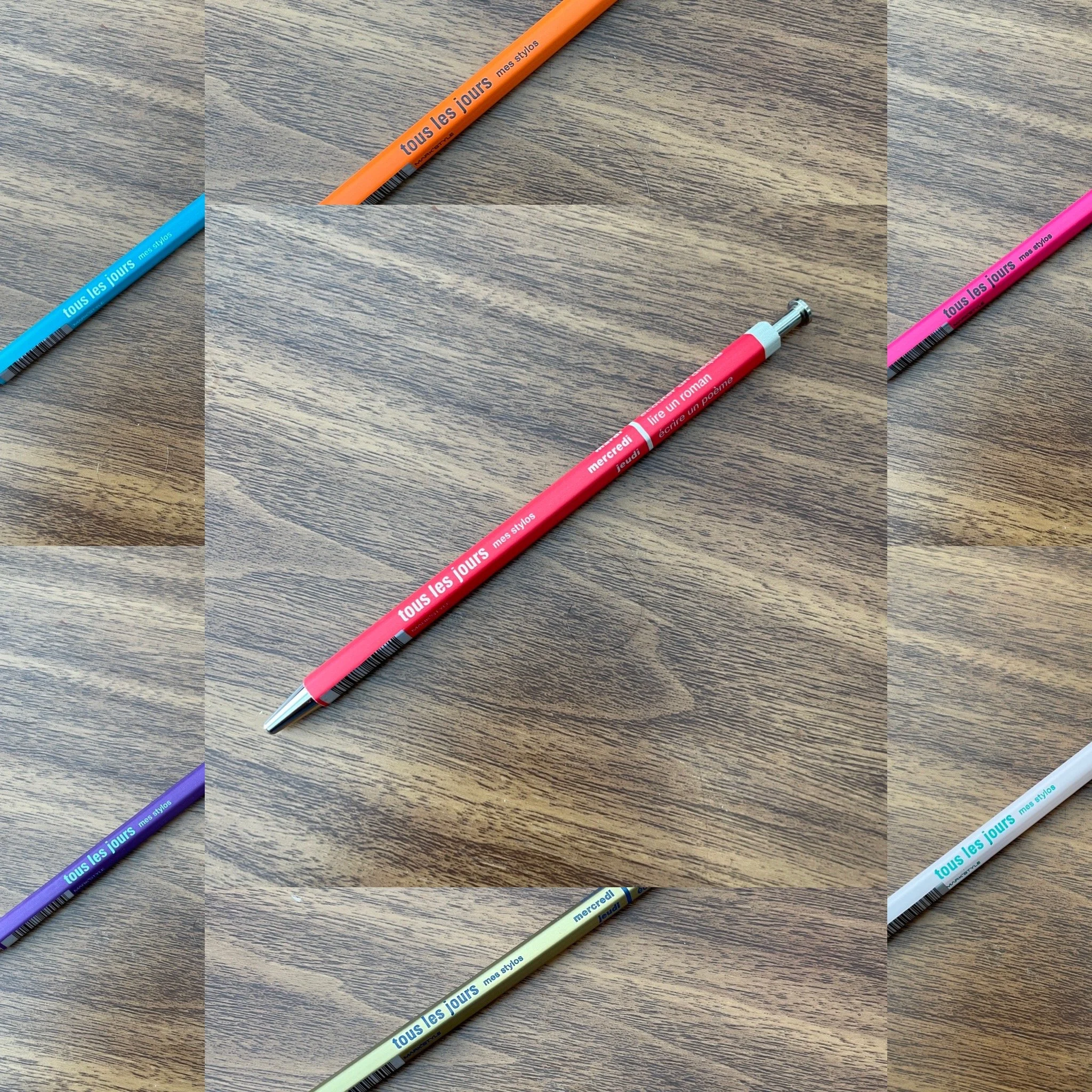
Those of us who are partial to marginalia and annotation tend to have strong preferences regarding the tools that we use, and in my case it’s the needle-tip ballpoint pen. Whenever I travel, the Traveler’s Company needle-tip ballpoint is usually found clipped to the cover of the book I’m reading or notebook that’s accompanying me, and when I’m at home, I either opt for a woodcase pencil or one of the Mark’style Tous Les Jours ballpoints, which use an Ohto Needle-tip refill similar to that found on the Traveler’s Company pen. We’re happy to announce that both pens are now back in stock and available for purchase, with the Mark’style pens available in 14 different finishes!

The T.G.S. Curated Shop is an authorized retailer of all brands sold, including Traveler’s Company and Marks. The Gentleman Stationer is supported entirely by purchases from the T.G.S. Curated Shop and pledges via the T.G.S. Patreon Program.

In TGS Curated Shop Tags TGS Curated Shop, Pens
Comment

I spent the past week with Nahvalur Pens and Notebook Systems!

Sunday Reading for October 2, 2022

October 2, 2022
  1. Gravitas Sentry Big Dropper & Delrin Fountain Pens (via Pencilcase Blog). I had the pleasure of meeting Ben Walsh and handling some of the Delrin and “Big Dropper” models at this year’s D.C. Pen Show. I was impressed with all of them and need to bring some in for review soon.

  2. 2022 Dallas Pen Show Recap (via Pen Addict - Kimberly). I’m happy to see a good overall review of the Dallas Pen Show, and heard great things from many attendees. There needs to be a strong lineup of smaller, regional shows.

  3. Newsflash: Cosmo Air Light (via Well-Appointed Desk). Daryl at Musubi broke the news last week that Cosmo Air Light paper was being discontinued.

  4. Kokuyo Auxiliary Hardcover Notebook (via Blake’s Broadcast). Kokuyo makes excellent hardcover notebooks, and these bound ledger-style notebooks look very interesting.

  5. Semikolon Grand Voyage Notebook (via Fountain Pen Blog). I’ve always loved the look of Semikolon notebooks but in the past the paper has not worked well for me. I’m excited to see that the paper in this particular notebook got good reviews.

  6. Diamine Monboddo’s Hat on Midori MD (via Inkredible Colors). Monboddo’s Hat is often recommended as a substitute for the coveted Lamy Dark Lilac, FWIW.

  7. Do You Ever Regret Getting a Custom Nib Grind (via Chicana Writes). Early on, absolutely, but I’ve since accepted that sometimes I just made a bad choice and have passed those pens along to others. These days I try to keep a wider range of custom and standard grinds on hand since I know my preferences tend to change and I do different kinds of writing.

  8. Endless Stationery Recorder Notebook Deep Ocean with 80 gsm Regalia Paper (via Rants of the Archer). Endless has moved away from Tomoe River 68gsm (presumably for supply reasons) and has substituted their own in-house paper.

  9. Lamy Charged Green (via Dapprman). Reviews of this ink are few and far between, especially given how prevalent it was (as in, it was a difficult color to sell when Lamy issued it). Those who like bright green inks for annotation and possibly highlighting may want to consider it?

  10. Troublemaker Grand River Sunset (via Mountain of Ink). I’ve recently discovered Troublemaker Inks, another brand from the Philippines that specializes in shading/sheening/shimmer/you-name-the-special-property.

In Case You Missed It…

This week on the blog, I reviewed the Nahvalur (formerly Narwhal) “Original Plus” Fountain Pen, which is Nahvalur’s revamped version of their inaugural pen from 2019, featuring a vacuum-filler fountain pen and redesigned materials. I also published Part III of my ongoing series on Notebook Systems, this week focusing on Traveler’s Notebook and what I refer to as “modular” notebook systems.

New This Week in the Curated Shop

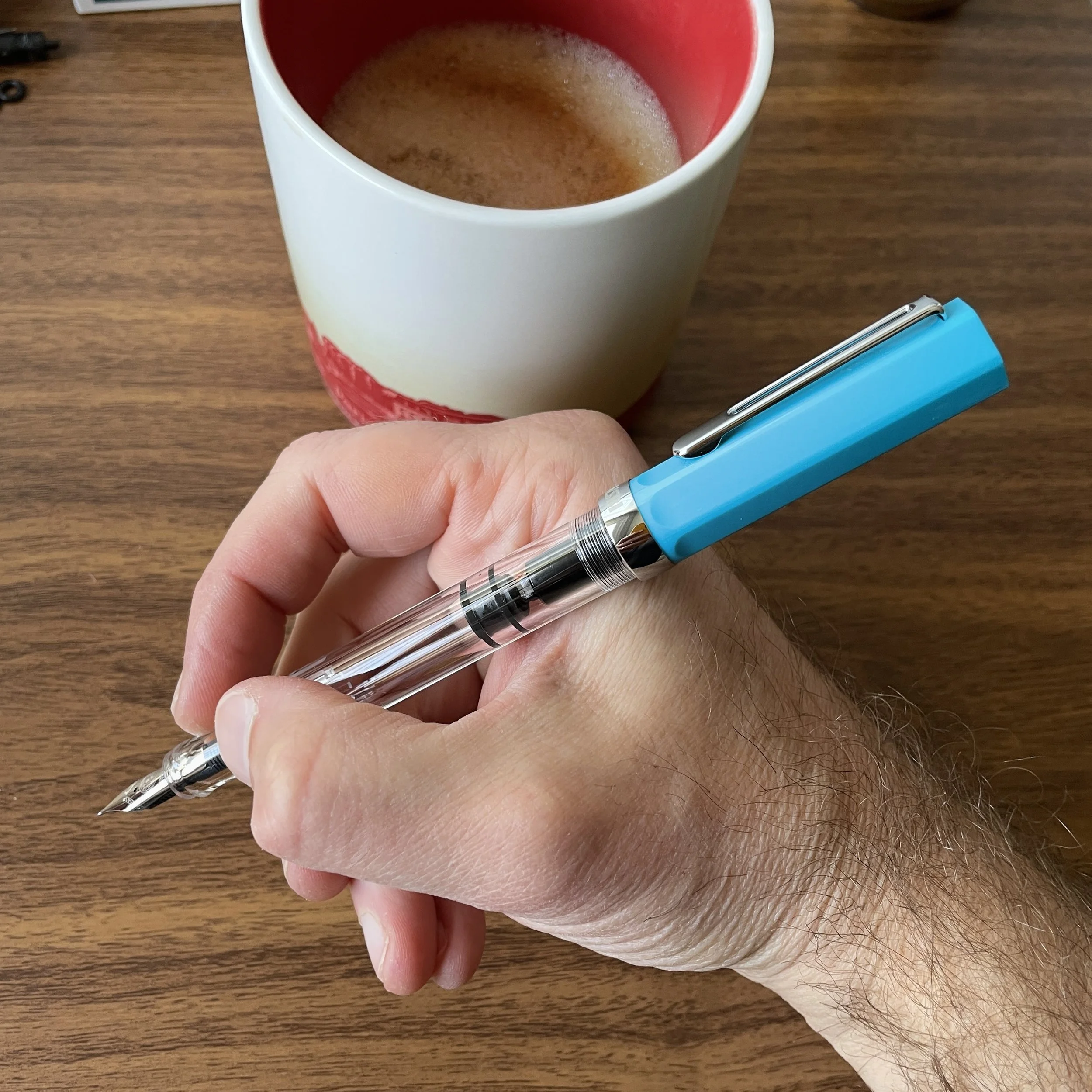
This week saw the arrival of the TWSBI ECO in Cerulean Blue, an eye-popping deep-sea blue that I would actually describe as a more vibrant turquoise. We also restocked on the glow-in-the-dark TWSBI ECO Glow fountain pen, and launched Anderillium Inks as a new brand, so that you now have additional ink choices to pair with fountain pens purchased from our shop. Finally, the Mark’style Tous les Jours Needle-tip ballpoint is back in stock, in nearly a dozen different colors. These needle-tip ballpoints are a personal favorite. The refills last forever and will soon be sold separately (they use an Ohto cartridge).

TWSBI
TWSBI
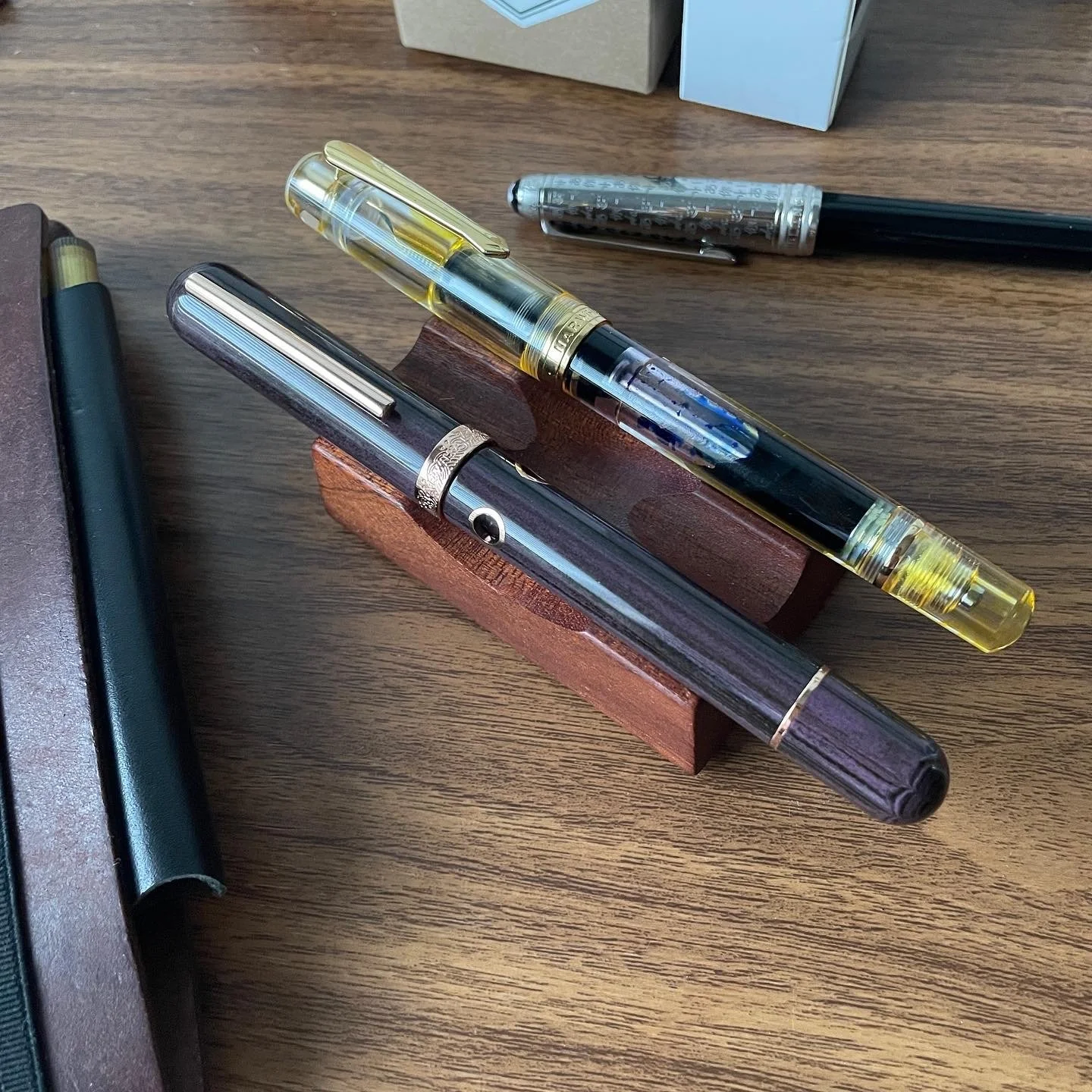
Nahvalur
Nahvalur
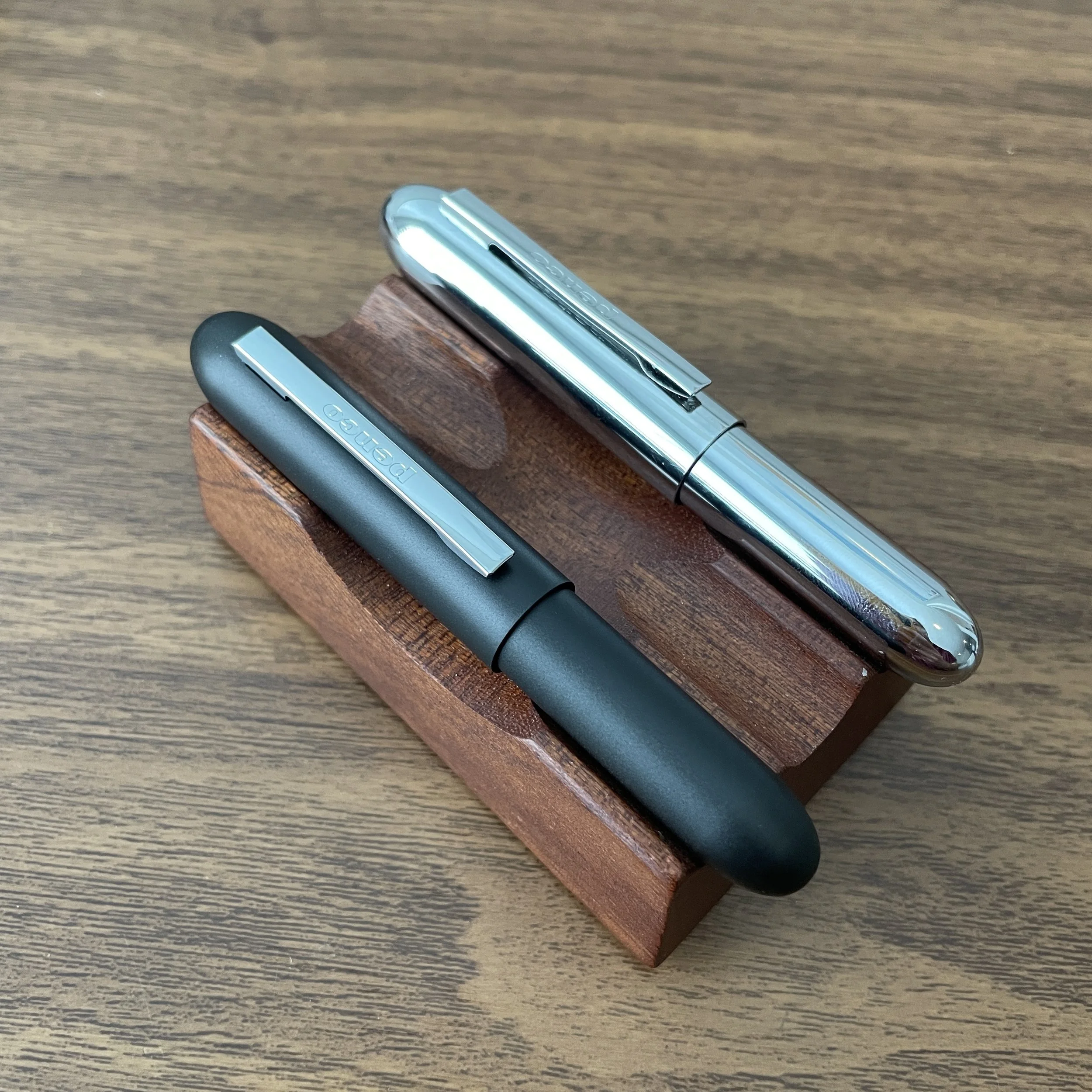
Penco
Penco
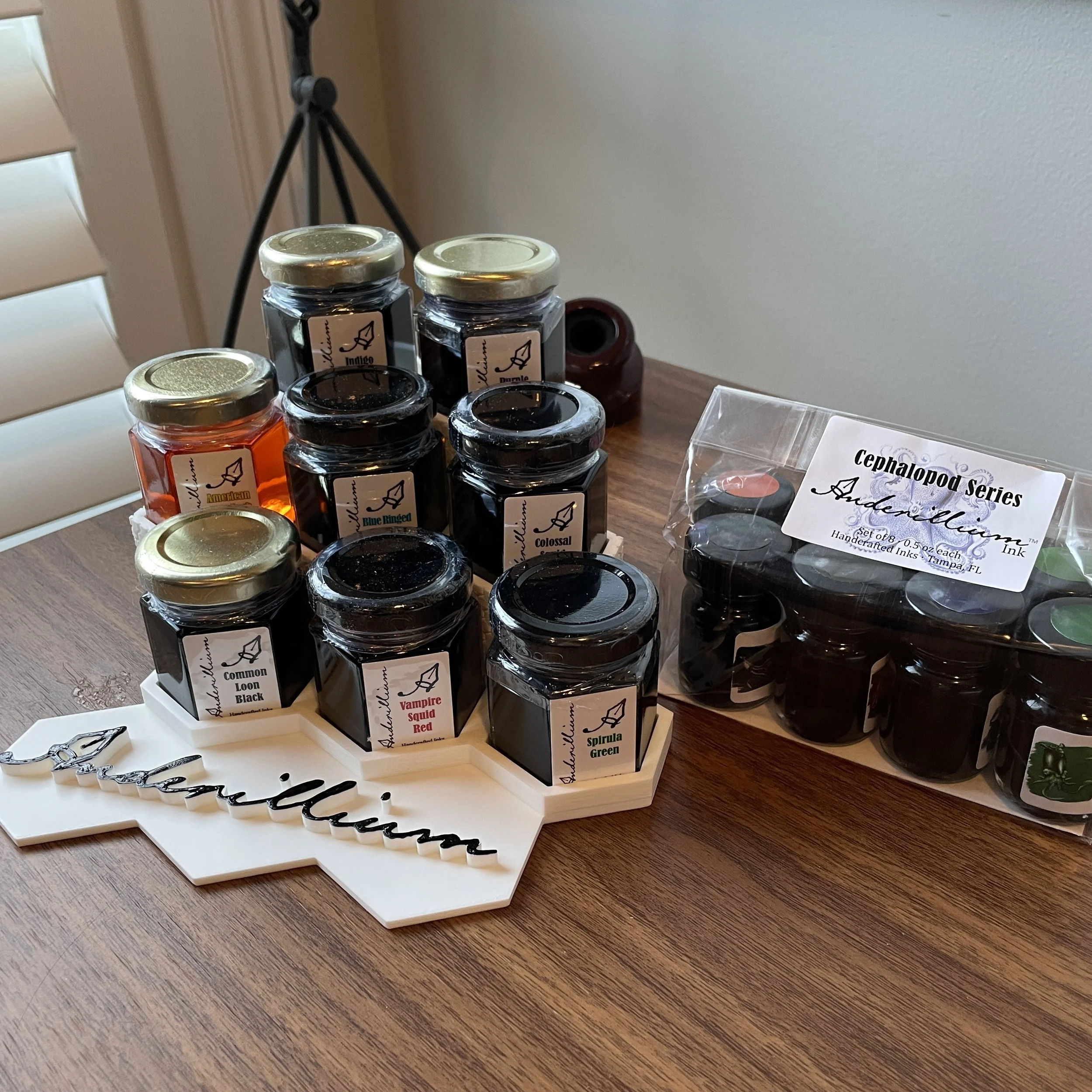
Anderillium
Anderillium

Many Thanks for Your Shop Support, and Please Consider T.G.S. Patreon!

We’ve been surprised at the level of enthusiasm and support for our curated retail strategy over the past couple of months, and after careful consideration are beginning to build out our inventory with more brands and product categories. I love managing this aspect of T.G.S., as it offers me the opportunity to directly put great stationery - including brands I feel are underappreciated and underemphasized - into your hands. For those who want to support T.G.S. without necessarily adding to their accumulation, the Patreon Program offers two options for tiers of support: $3 and $5, and plan on making monthly meetups, pen show events, and periodic exclusive content the primary benefits. Of course, Patreon members will continue to get first access to periodic sample sales, with right of first refusal on gently used pens. (Reminder that those pens which made it through Patreon are now available to the general readership!)

In LInks Tags Links
Comment

Guide to Notebook Systems, Part III: Traveler's Notebook and the "Modular" Approach

October 1, 2022

Welcome to the third Saturday installment of my “Guide to Notebook Systems” Series! Today we’ll be talking about Traveler’s Company, a brand I’ve actually written about a lot, since it’s been on the market for many years, and the Traveler’s Notebook, which represents one of the longest-standing items in my stationery toolkit. The Traveler’s Notebook falls into what I would call the “notebook cover plus modular refill” category of notebook systems, meaning that the central component is the leather cover starter kit, which you can customize by adding different refill booklets and functional accessories, all held in place with elastic cords. The main difference between these types of systems and a “System Techo” like Plotter is, of course, that you have to operate at the “notebook level” rather than with individual pages.

My two Traveler’s Notebooks, which contain both my pen show journal (top) and work notebook (bottom).

The Traveler’s Notebook is versatile, and I’ve used it in many different ways over the years as my needs have changed. When I first started out, I used it as a traditional paper planner. The Traveler’s Company undated “Weekly + Memo” planner refills usually lasted me a little over six months, and if you prefer the day-to-a-page format, the “Free Diary,” lasted around three. These days, I don’t use a paper planner to keep a calendar, so my Traveler’s Notebooks have morphed into more of a “journal”. Here’s what I mean:

  • For work (as in, my day job), I like to keep a written record of what I work on each day. My current writing setup isn’t a Traveler’s Notebook refill, but rather a cut-down Stalogy half-year journal that I’ve combined with these Midori MD Calendar stickers and section divider stickers to create some sort of “planner”-BuJo (bullet journal) hybrid. Essentially, I’ll use 2-3 pages for a week and write brief summaries of how I’ve spent my time and what I’ve accomplished on each day, while also including important meeting notes and tracking longer term tasks. At the back of my “work” Traveler’s Notebook, I’ve included a standard blank refill that’s essentially used as scratch paper.

  • I also keep a second “personal” Traveler’s Notebook that I recently added, which is one of the “Traveler’s Hotel” 2022 limited editions. I’m more of a hotel enthusiast than an aviation or train buff, so the choice was fairly easy. For 2022, this notebook has become my “pen show” journal, and it contains stickers, photos, writing samples, and personal notes from all of my pen show travel. I’m honestly not sure what I will use this for in 2023, or whether I will consolidate my Traveler’s Notebook carry under a single cover as I rely more on Plotter.

Traveler’s Company undated planner refills are insanely versatile. The Weekly+Memo Refill is a favorite.

So who is this sort of notebook system for, and what are its advantages and disadvantages?

  • Someone who likes to journal, especially creatively. The major advantage to these modular systems, and especially established ones like Traveler’s Notebook, is that there is a wide array of existing refills and accessories for pretty much any use case. Would you like to watercolor in your journal? There’s a refill for that. Prefer thicker drawing or sketch paper? Ditto. There are even kraft paper refills for scrapbooking.

  • Someone who travels a lot (hence the name) and doesn’t want to carry multiple notebooks with them. With modular systems, you can carry your planner, journal, and sketchbook all in a single cover yet in separate “notebooks”. There are a variety of pouch and folder accessories to carry things like printed tickets, itineraries, and receipts. The Standard Traveler’s Notebook has a tall, narrow format that’s easy to slip into a bag, and the smaller Passport version is even more compact. If you prefer something that uses larger refills with more writing surface, both the Lochby Field Journal and the Roterfaden covers operate on a similar principle (though Roterfaden uses clips instead of cords).

  • Someone who doesn’t need to move around, file, or dispose of individual pages of notes. This is what makes the Traveler’s Notebook system difficult for me to use for things like meeting and research notes, and why I will likely lean more heavily on “System Techo” ring-based systems in the future for these purposes. But if you have fairly specialized job responsibilities, or don’t need to segregate your notes by a large number of clients or projects, a Traveler’s-style system may work just fine.

If the “tall narrow” notebook format isn’t your thing, Lochby (shown here) and Roterfaden both make A5 modular covers capable of holding multiple refills (or even multiple full-size notebooks).

Further Reading and Retail Options

I’ve previously written several different posts on the Traveler’s Notebook system, which describe various layouts I’ve used over the years, how I went about cutting down the Stalogy half-year notebook, and a short guide on how to attach multiple refills and literally stuff the notebook to the gills. In short, there’s a lot out there if you’re curious. (Pro Tip: These notebooks are capable of holding MUCH more than two refills, and I can’t emphasize enough the versatility of the system. The benefit of having a large established community of users is that you can run a simple internet search and immediately discover dozens of ways to set up the notebook.)

I do have to admit, I’m biased towards this system because I love the aesthetic, the spirit behind it, and the “go-anywhere” functionality. When I started up the T.G.S. Curated Shop, one of the products on my shortlist of things I wanted to carry was the Traveler’s Notebook, and Traveler’s Company was kind enough to immediately approve me as a retailer even though I was small and just starting out. I’m glad so many people seem to agree that this is a wonderfully versatile system that can bring you years of enjoyment even as your needs evolve over time. If this system interests you, you can check out the full range of Traveler’s Notebooks and Accessories in our curated selection of goods.

This post is part of a larger ongoing series on Notebook Systems. If you missed the first two installments, you can get caught up starting with Part I, which gives a general overview of Notebook Systems and System Techo in general, and Part II, which specifically discusses the Plotter ring-based system and how I’ve been using it. This post does not contain third-party affiliate links or paid sponsorships, as the Gentleman Stationer is supported entirely by purchases from the T.G.S. Curated Shop and pledges via the T.G.S. Patreon Program.

In Editorial, Notebook Review Tags Notebook Systems, Traveler's Notebook, Guide
Comment

A Review Sort-of Revisited: The Nahvalur Original Plus Fountain Pen

September 28, 2022

I say “sort-of-revisited” because I previously reviewed the “original” Narwhal Original, and in the three years or so since publication Narwhal fountain pens has not only introduced a new version of the pen with a different filling mechanism, but has rebranded with a new name and logo, and will be known as Nahvalur Pens going forward. Nahvalur made the announcement at this year’s D.C. Pen Show. Apparently “Nahvalur” is the Icelandic word for “Narwhal,” and the choice was made for unspecified branding/trademark purposes. I don’t necessarily find this aspect of the pen industry all that interesting or exciting, though there has been much discussion elsewhere about the rebrand and “other matters.” I prefer to focus on the writing experience, but I will say that I like the new Nahvalur logo, and the new “Original Plus” fountain pen continues to move the company in the right direction.

We have yet to see the new Nahvalur logo and branding on the pens themselves, as the rebrand was only recently announced. Therefore, the current stock of Nahvalur pens still bear the name “Narwhal” on the box and cap band. (Hey - it could increase the collectibility if the design changes in the future, right?)

“Original” vs. “Original Plus”: What’s the Difference?

In terms of functionality, the biggest change is that on the Original Plus, Nahvalur switched the filling system from a piston to a vacuum-filler. More on that below. Aesthetically, the two pens share a lot of the same design language, with a few key distinctions. As I mentioned in my “Original” review, the bright swirled acrylic used in the first pen didn’t speak to me. As in, at all. Here, the look is much more subtle, as Nahvalur opted for a more transparent material that offers excellent visibility into the barrel while keeping swirls of the four signature colors: purple, yellow, green, and blue. It’s a subtler look that I believe will ultimately appeal to a wider audience.

Those who own both the “original Original” and the “Original Plus” will note that the band has been moved from the body of the pen to the cap, probably to accommodate the change in filling system.

Build Quality and Filling System

The first thing I remarked when I picked up the Original Plus is how solid the pen feels in the hand. At the sub-$100 price point, and especially at the sub-$60 price point, one of the first things I look at is whether or not the pen feels flimsy or insubstantial, and whether I think it will hold up to true “workhorse” use as a daily writer. Here, the Original Plus easily feels as well-built and durable as the pens I consider to be its peers, the PenBBS 456 and the TWSBI Vac700R. All of the components feel tightly threaded, with no rattling or loose parts. The longer section is comfortable to hold, and the cap quickly deploys with 2.5-3 turns.

The advantage of a vacuum filler is that it uses the entire barrel as an ink reservoir, and here the more transparent material allows you to easily see your ink supply.

As I noted, the major design change is to the filling system. Nahvalur chose to substitute a vacuum-filling system for the piston, and I commend them for doing so. Though a vacuum filler can appear intimidating to new users, they’re fairly simple to use and hold a ton of ink. To fill the pen, you unscrew the blind cap at the end, extend the plunger, place the nib into an inkwell or ink bottle, and press down. The negative pressure will suck ink into the barrel, and you can repeat once or twice more to increase capacity. Even with one fill, however, you will typically get much more than your standard piston filler and certainly more than your standard cartridge-converter pen. Note that like a Japanese-style eyedropper, a vacuum filler has a “safety valve” that engages when the blind cap is screwed all the way down, which helps prevent leaks and makes these great pens for airplane travel. At some point, however, with the valve closed the feed may run dry, and you will need to slightly unscrew the blind cap to allow more ink to flow from the barrel to the nib. If I’m using a vacuum-filler for a longer writing session, I’ll go ahead and open the valve before I get started.

The Nahvalur Original Plus unposted. While the cap technically posts on the barrel, the pen ends up being so long that I can’t imagine anyone would be able to use it that way.

Overall Writing Experience

Those who enjoy smooth nibs will enjoy Nahvalur pens. Nahvalur/Narwhal has performed a lot of tuning on their nibs and feeds in-house, resulting in what I would characterize as a “glassy smooth” writing experience that requires very little pressure. As a result, the nibs write a slightly broader line than their designation and there is no “extra fine” nib option. (Even the “fine” writes more like what I’d consider a “fine-medium”.) Despite the smoothness, I’ve found Nahvalur’s nibs to perform well, and of the four different Nahvalur nibs I’ve used over the past few years, I’ve not experienced any skipping or other symptoms of “over polishing” (i.e., a baby’s bottom).

I really do hope that they keep the “leaping Narwhal” logo on the nib - it’s a charming touch.

A writing sample with a comparison between a medium and fine Nahvalur nib. Pro Tip: The broader Nahvalur nibs, and especially the “BB” option available in the Nautilus model, have a fair bit of tipping and therefore make excellent platforms for nib customization.

Takeaways and Where to Buy

With a cool vacuum filler system and priced at only $55, the Nahvalur Original Plus is a worthy successor to the Narwhal “Original,” and - at least in my opinion - improves upon the company’s original release. I personally prefer the more subtle look of the new pen, and for me the vacuum filling system is an upgrade. Of all the different fountain pen filling systems out there, vacuum-fillers seem to be the least represented, and while the Original Plus fountain pens have only been available for a short while, they seem like reasonably priced, reliable high-capacity workhorse options comparable to the TWSBI Vac700R and the PenBBS 456.

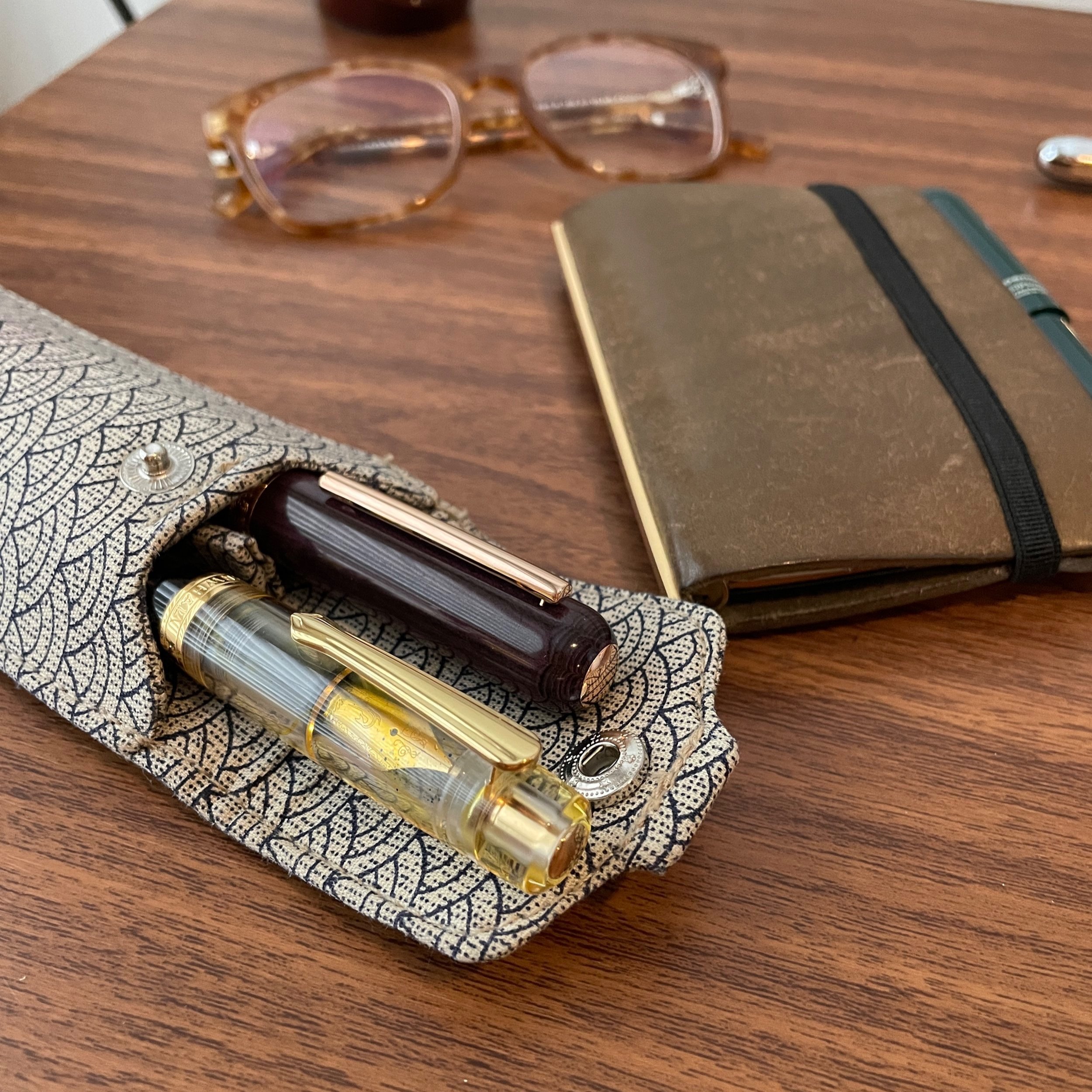
My two personal Nahvalur fountain pens that I’ve been carrying recently: the Nahvalur Nautilus in “Stylophora Berry” ebonite (left) and the Original Plus in “Gold Ocellatus”.

The Gentleman Stationer recently became an authorized retailer of Nahvalur Pens, as we expand the number of brands we can offer you directly. You can therefore purchase the Nahvalur Original Plus directly from the T.G.S. Curated Shop, in each of the four color options, priced at $55. Through the end of this week, we are running a promotional offer in which you will receive a complimentary 4ml ink sample with the purchase of any Nahvalur fountain pen. No coupon code is necessary to take advantage of this deal!

Disclaimer: The T.G.S. Curated Shop is an authorized retailer of Nahvalur Pens.

The four colors of the “Original Plus,” from left: Ocellatus Gold, Azureus Blue, Altifrons Green, and Melacara Purple. From the photos, I thought the gold/yellow would be my runaway favorite, but it turns out that they all look even better in person and I had a hard time picking. (Ultimately, “yellow pen” won.)

In Pens Tags Nahvalur, Narwhal, Fountain Pens, Pen Review
3 Comments
← Newer Posts Older Posts →
Check Out Our New Online Shop!
Store Hours and Events
Updated 2026 "Best Pens" Guide
No results found
On The Paper Trail: Live In Nashville Event Tickets Now Available!
TGS_25 Roterfaden Restock Notification
Hierarchies of Fountain Pen Friendly Paper

Join Our Patreon!
Subscribe to the TGS E-mail List

Featured Posts

Featured
10-Fountain-Pens-Favorite-Inks
August 22, 2026
Three Keeper Inks: Choosing Inks for 10 Fountain Pens
August 22, 2026
Read more →
August 22, 2026
Everyday-Stationery-Bags
July 25, 2026
What's the Best Everyday Stationery Bag? My Own Considerations and 5 Options for Pen Show Season
July 25, 2026
Read more →
July 25, 2026
Graphilo-Kobeha-Paper.jpg
July 11, 2026
Paper Review: Graphilo by Kobeha
July 11, 2026
Read more →
July 11, 2026
The Gentleman Stationer RSS

© Digital Divide Media, LLC, 2014-present.

All content is the exclusive property of Digital Divide Media, LLC, d/b/a The Gentleman Stationer, including “The Gentleman Stationer” website and trademark, and should not be reproduced without express written permission.  All rights reserved.

All content containing paid advertising, affiliate links, or sponsored content will be plainly disclosed by a disclaimer when/if featured.

Contact Information

Website Terms and Conditions

Privacy Policy and Cookie Policy

Accessibility Statement

Legacy Account Login

Powered by Squarespace