• Blog
  • Shop
  • Podcast
  • Resources
  • Archive
  • FAQ
  • About
  • Contact
  • Sign In My Account
Menu

The Gentleman Stationer

  • Blog
  • Shop
  • Podcast
  • Resources
  • Archive
  • FAQ
  • About
  • Contact
  • Sign In My Account

My Experience with the Drillog Metal Dip Pen: Hype vs. Reality

February 12, 2022

For those unfamiliar with Drillog, it’s a Japanese CNC-machined dip pen designed to look like a drill (hence the name) and advertised as being machined with “aircraft grade precision” (hence a hefty price tag). The pen launched last year on Kickstarter, and with as much hype as this product received, I couldn’t NOT back it. I’ve had my Drillog machined dip pen in hand for a few weeks now, and wanted to provide my initial impressions of this niche product that, while certainly interesting, I unfortunately can’t recommend until the manufacturer either works out the quality control issues or provides additional clarity on what ink and/or techniques need to be used to get the advertised performance.

As a preliminary note, I backed this product on Kickstarter and paid full price for it with my own money. I was not asked to review it or promote the Kickstarter in any way. You’re reading this as an unvarnished review from someone whose information comes from personal experience and the Kickstarter page, with no communications with the manufacturer.

My experience with dip pens and calligraphy is rudimentary at best, so I came to the Drillog as a true novice, and mainly saw this as a tool that could help me sample inks and experience writing with more “high-maintenance” formulations without having to worry about cleaning them out of a fountain pen. I was especially intrigued by Drillog’s claim that a single dip can “fill a sheet of A4 paper with writing lines”, even though I could never really see myself actually using it for that long of a session. So does Drillog live up to the hype and promise? In short, no.
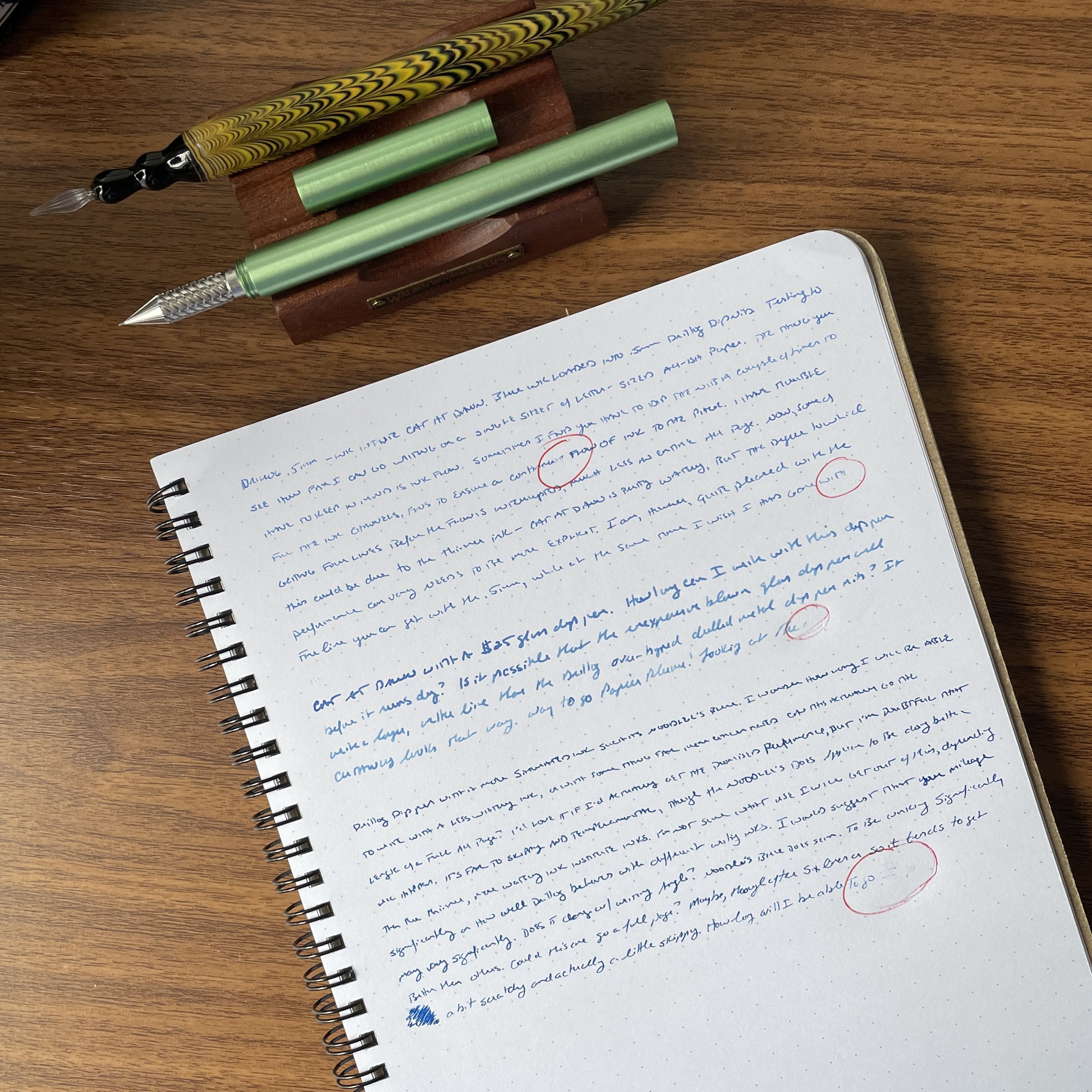
Drillog Dip Pen Writing Sample

The top two writing samples were done with Ink Institute’s “Cat at Dawn,” a shading ink that’s on the watery side. The top paragraph was written with the Drillog, and I circled in red the two points at which the nib ran dry and I had to re-dip the pen. The middle paragraph was written with a glass pen, using the same ink. The last paragraph was written with Noodler’s Blue, a slightly thicker, more saturated in that performed better, but I still didn't get close more than a quarter page.

“Ink Retention Structure for Uninterrupted Writing”: I’ll start here because this is what drew me to the Drillog in the first place. I write very small and like to take notes and make annotations in tiny handwriting, so there was something attractive about the (theoretical) ability to quickly switch inks and play around with different colors in my journals and notebooks without having to flush and refill multiple fountain pens. And to be honest, the Drillog does allow you to do that, to a point. My issue is that despite testing a half-dozen inks with this thing, I’ve never been able to get more than a quarter page of writing out of the .5mm Drillog, much less the full “A4 page” touted by Shion, the manufacturer. That’s similar to what I get out of a $25 glass dip pen, which writes a much wetter line and lays down more ink. I’ve also experienced consistent hard starts and other problems with getting my Drillog to write, often having to dip the pen multiple times to get it started. Upon close inspection, the tip of my pen appears ever-so-slightly bent or curved, and one side of the pen won’t write at all because ink doesn’t flow through the grooves. While I plan to reach out to Shion to request a replacement (or an explanation), I’m disappointed something like this made it through QC at this price point.

The drill-bit-like grooves in the nib are designed to hold a large volume of ink and, theoretically, allow you to write for a full A4 page before having to re-dip the nib. I’ve been unable to duplicate that in real life.

Ability to Use All Sorts of Inks and Easily Change Them. Drillog doesn’t expressly represent that the pen is intended to be used with fountain pen inks, but let’s be honest, that’s why many people ordered this pen and there needs to be more transparency around what users can reasonably expect. Jacob (writing at Fudefan) has done more extensive testing with the Drillog, and remarked that the nib appears to be sensitive to surface tension/ink viscosity, with certain inks performing better than others. Drillog also has a proviso on the Kickstarter page stating that “the area that can be written on may change due to the ink drying up.” I don’t know what they’re specifically referring to here, since there’s no context for the statement, but I suspect that because many fountain pen inks are water-based, with varying degrees of viscosity, surface tension, and saturation, thinner ink formulations may dry out on the nib before you have the chance to write the nib dry. This could be the source of the issues I’ve had with my pen, though I suspect that it has more to do with a manufacturing issue given the hard starts and scratchiness. Given the massive discrepancy between what I’ve experienced and what was advertised, I can’t get past that, especially where I can get similar performance in a less expensive product.
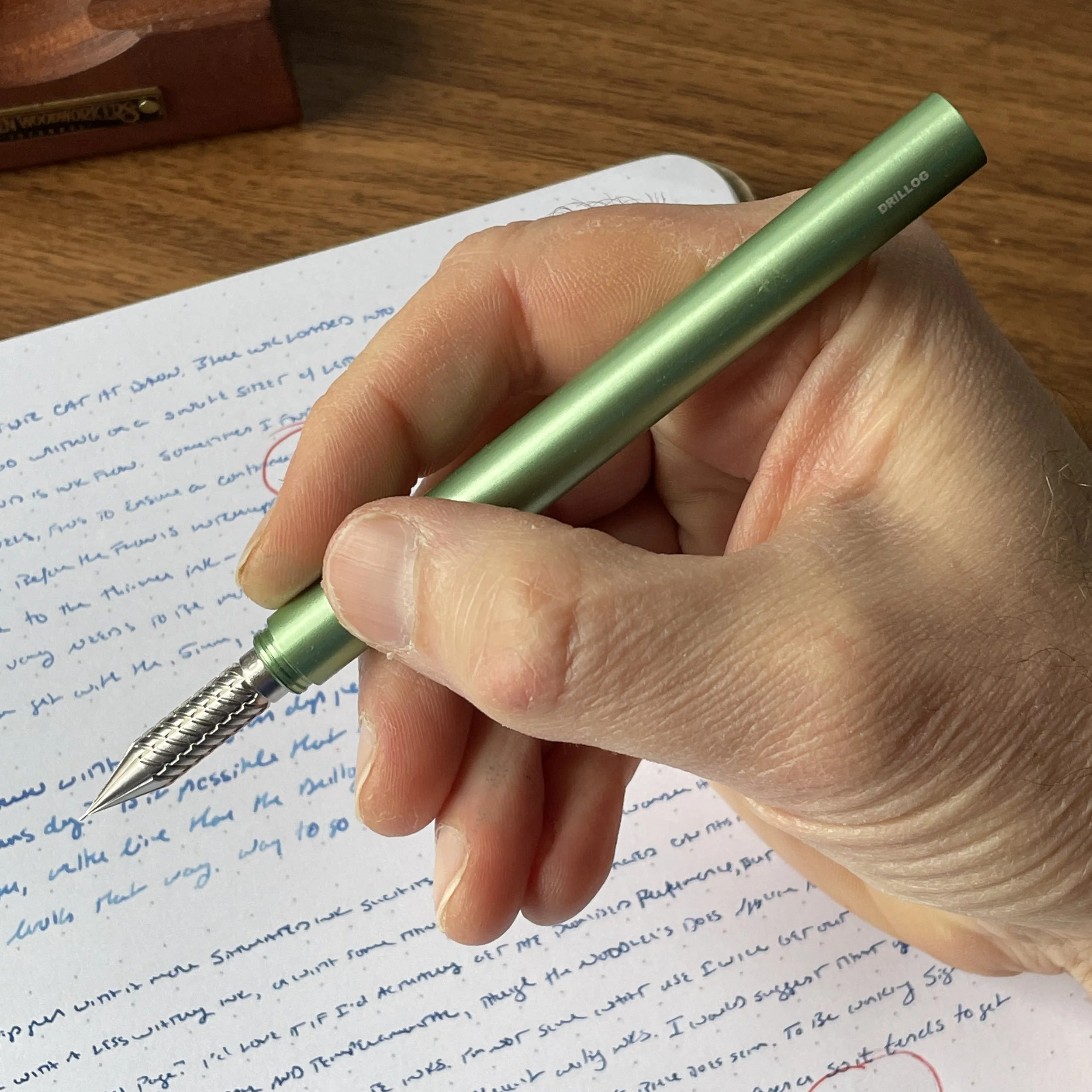
Performance aside, the Drillog is visually stunning, and a gorgeous piece of machining.

Comfortable and Convenient Nib Holder. I give credit where credit is due, and one area where Drillog did a nice job was the design of the nib holder. I opted for the longer round barrel, as opposed to the spiral or grooved designs, and I love the cap, which means that I can transport this dip pen easily to pen shows. Honestly, this is why I’ll probably hang on to the Drillog - so that I can sample different inks after hours in my pen show notebook. That said, you can find inexpensive capped glass dip pens by Moonman and other brands for much less money, and even if you have to buy a few to find one that works reliably, you’ll have spent much less money than on the Drillog.

Takeaway and Final Thoughts

I hate to say it, but I consider the performance of my Drillog dip pen to be unacceptable for the price. At ¥25,692, which equates to roughly $225 at today’s exchange rate, that’s a huge premium for a dip pen that promises performance based on precision engineering - the source of the astronomic price tag - but fails to deliver a writing experience consistently better than much less expensive options. If I paid $50 for this pen, I might say it was “ok” and recommend that people pick it up if they’re interested in using it for testing inks or are looking for a machined dip nib with a very small tip that might be advantageous for certain types of lettering and other artwork requiring a great degree of precision. That said, I’m not sure what this offers the typical writing and ink enthusiast over a glass pen or inexpensive traditional XXF calligraphy nibs, other than the Drillog will last much longer and comes with a capped holder (which is quite cool).

This purchase was intended as an experiment, and I went into it suspecting the Drillog would likely not live up to the lofty promises, having read a handful of online reviews and comments similar to my own. Still, I expected more than this. I’ve also had the opportunity to test a handful of early-release “tester” Drillogs sent to other bloggers and reviewers, all of which worked much better than the one I received. That leads me to suspect that these review units were subjected to a higher level of QC testing than the ones that ultimately went out the door to paying customers, which is disappointing. A quick scan of the comments on the Kickstarter page confirms that I’m not the only one who’s had problems. I’ll be keeping on eye on Shion and Drillog to see if there are manufacturing tweaks made to a “version 2.0”, and whether they offer to take back any malfunctioning pens. So far, I’ve not seen any outreach in the Kickstarter comments.

UPDATE: Following this review, Drillog reached out, confirmed that it looks like something is wrong with my pen from the writing sample, and offered to send a replacement. I plan to take them up on it and will report back on how the new nib functions.

Disclaimer: As noted, I purchased the product featured in this review with my own funds, for my own personal use. All opinions expressed here are my own. This post does not contain affiliate links, and I was not compensated in any way for this review.
In Crowdfunding, Pens Tags Dip Pen, Drillog, Kickstarter, Pen Review
7 Comments

Currently, my Harber London Leather Notebook Cover is being used with my Theme System Journal (separate review forthcoming).

Folio Review: Harber London Leather Notebook Cover

February 9, 2022

I have an extensive collection of leather notebook covers and folios that I rotate through semi-regularly, and even more have passed through my hands at one time or another for review purposes. Over the years, I’ve developed fairly strong instincts as to what I’m going to like or dislike, often before I ever have the product in my hand for review. Back in November, UK-based Harber London reached out to me to ask whether I’d like to review their Leather Notebook Cover, I initially hesitated, concerned that this particular product - though it looked very nice - might not be distinct enough from others I’ve reviewed to add to the conversation. Honestly, I’m glad I checked myself and went for the review, because this type of cover has a refreshing simplicity that gets away from the overcomplexity of many modern portfolio-style covers. As it turns out, I really liked it.

The biggest selling point, to me, is versatility. It’s easy to swap a wide variety of A5 and “A5-ish” notebooks into this cover. (Shown here with the Life x Kleid A5 notebook.)

Design and Configuration

As I mentioned above, I’ve used many different leather notebook covers and portfolios in various configurations, and I have a pretty good idea of what I like and what I think will stick long-term. This particular product has a LOT to offer, and there are several design choices that could make it work for me, including:

  • Strong Magnetic Closure. I’ve grown to dislike “zipfolios,” since they take a long time to open, the zippers tend to get stuck, and once they’re busted, well, your portfolio is more or less done unless the manufacturer will repair or replace it. It sometimes annoys me that the zippers also tear up the edges of your notebook, especially if you’re like me and try to push the limit of what the folio is designed to carry. The Harber London doesn’t have this issue, with two very strong magnets embedded into the front and back covers that keep the folio closed without having to work the zipper. It’s a design similar to the excellent Bellroy pocket notebook cover, only I a (much) larger size, and the pebbled cowhide leather is less stiff than Bellroy.

  • You Can Easily Change the Notebook. I have three or four different A5 notebooks in rotation at any given time, mainly project-specific books that I don’t work with every day, but I occasionally want to take to the library, a coffee shop, or to the office to doodle in on my lunch break. Because the Harber London cover fits so many different A5 (and A5-ish) notebooks, it’s easy to swap in whatever notebook you’re using at that particular moment.

  • The Cover Doesn’t Try to Do Too Much. So many modern portfolios have a multitude of pockets and loops ostensibly designed to allow you to carry everything from headphones to power cords to keys to batteries to — just stop. In an age when we’re already carrying far too many devices, gadgets and accessories with us wherever we go, I can appreciate a notebook cover/portfolio that executes its primary purpose well and doesn’t attempt to do more. An A5 notebook, a few notecards or a pocket notebook, some folded sheets of looseleaf scrap paper, and maybe a pen if your pen of choice is slim enough to fit in the pen loop/cutout - that’s more than enough for me, and honestly a bit refreshing.

The Baron Fig Squire is about as thick a pen as you’re going to fit here. It’s an interesting design, but I’d honestly prefer a traditional-style pen loop, or just go full-minimalist and omit a pen loop entirely.

Build Quality

The Harber London Leather Notebook Cover is made from full-grain cowhide leather and crafted in Spain (though the company itself is based in the UK). It immediately strikes you as a high quality product, with soft leather, consistent stitching, and no flaws in the finish. While I personally prefer softer leather, if I had to express any single “concern” regarding quality, it’s that this leather might scuff easily if you carry this portfolio/notebook cover stuffed in a bag. That said, for many people scuffs and dings only add to the character your leather goods accumulate via regular use. Overall, I’m impressed, and given the positive reviews other Harber London products (computer bags, luggage, etc.) have received, I’m looking forward to exploring the rest of their line.

The Harber London Leather Notebook Cover will even hold thicker notebooks such as the Cosmo Air Light A5 Folio from Atelier Musubi.

The magnets are strong enough to hold the cover closed, even with a thicker notebook like the Musubi Folio shown here.

Takeaways and Where to Buy

Harber London makes an excellent soft-cover leather folio. The leather is high quality, and the magnetic closure works much better than I expected, even with fairly thick notebooks. My primary critique would be the impractical pen loop, which I found didn’t really work for anything other than the slimmest gel pens and ballpoints. Since I don’t really use pen loops that often, and generally carry my pens in a separate pen case, this isn’t a huge issue for me personally but it could be for some people. I’d also love to see a larger A4-ish portfolio or pad holder in this same material.

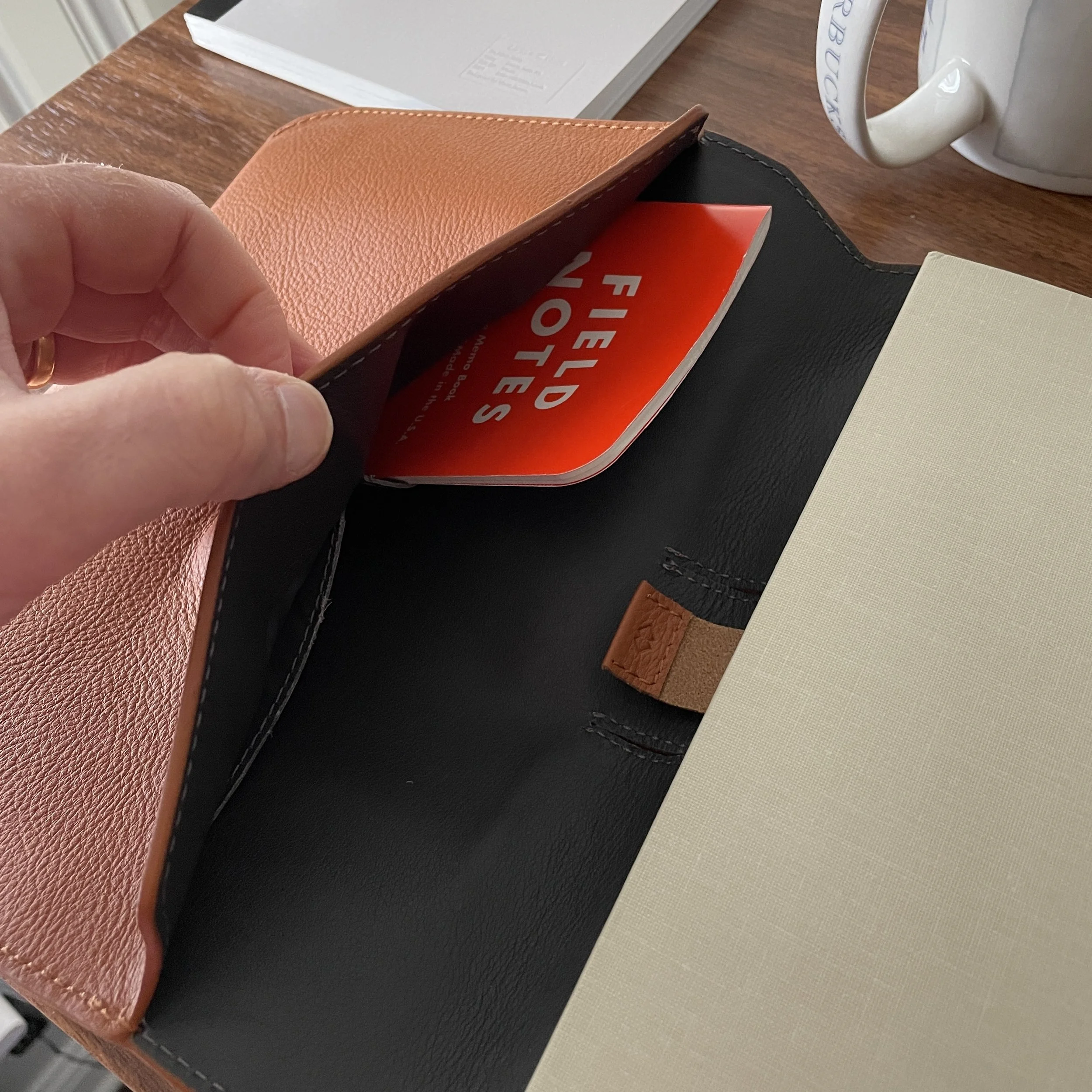
View fullsize Pocket Notebook Sleeve
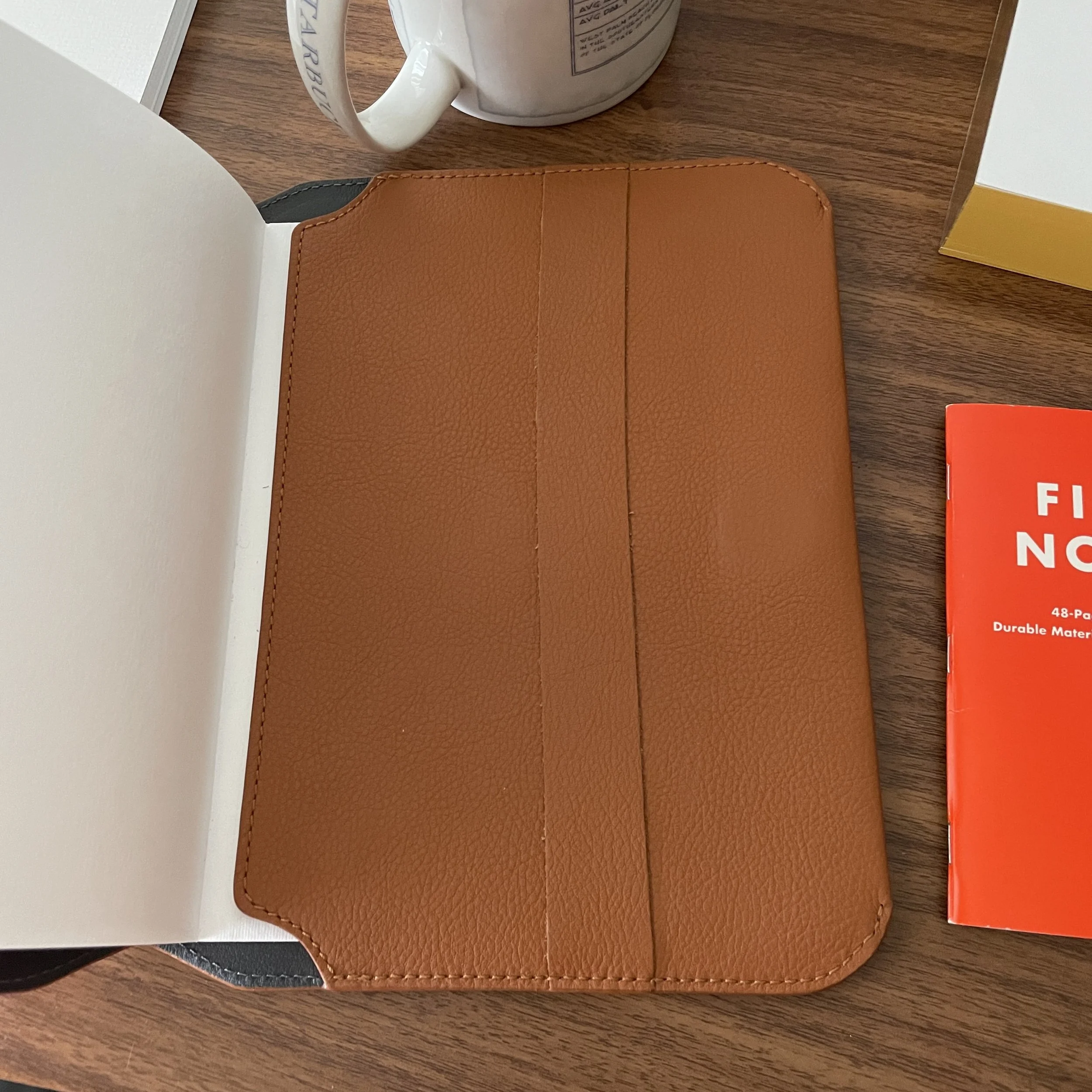
View fullsize Back Paper Flap

You can purchase the Leather Notebook Cover directly from the Harber Leather website. The A6 version is priced at £69.00, and the A5 version shown here is priced at £79.00. The price point surprised me, as I expected these to cost more. If you are looking for a leather cover that’s more polished than the rustic finish on alternatives from companies like Galen Leather, I would recommend you give Harber London a look. The company also has a wide range of briefcases, computer cases, luggage, wallets, and other accessories to choose from. Many thanks to Harber London for making this review possible.

This post does not contain paid third-party affiliate links. Harber London provided the Leather Notebook Case featured in this review free of charge, for review purposes. I was not otherwise compensated for this review. The Gentleman Stationer is supported by purchases from the T.G.S. Curated Shop and the T.G.S. Patreon Program.

In Portfolios, Notebook Review, EDC, Bag Reviews Tags Notebook Cover, Portfolio, Leather Goods, Harber London
3 Comments

My three favorites from the new entries in TWSBI’s 1791 series.

New TWSBI Inks: A Comparison

February 8, 2022

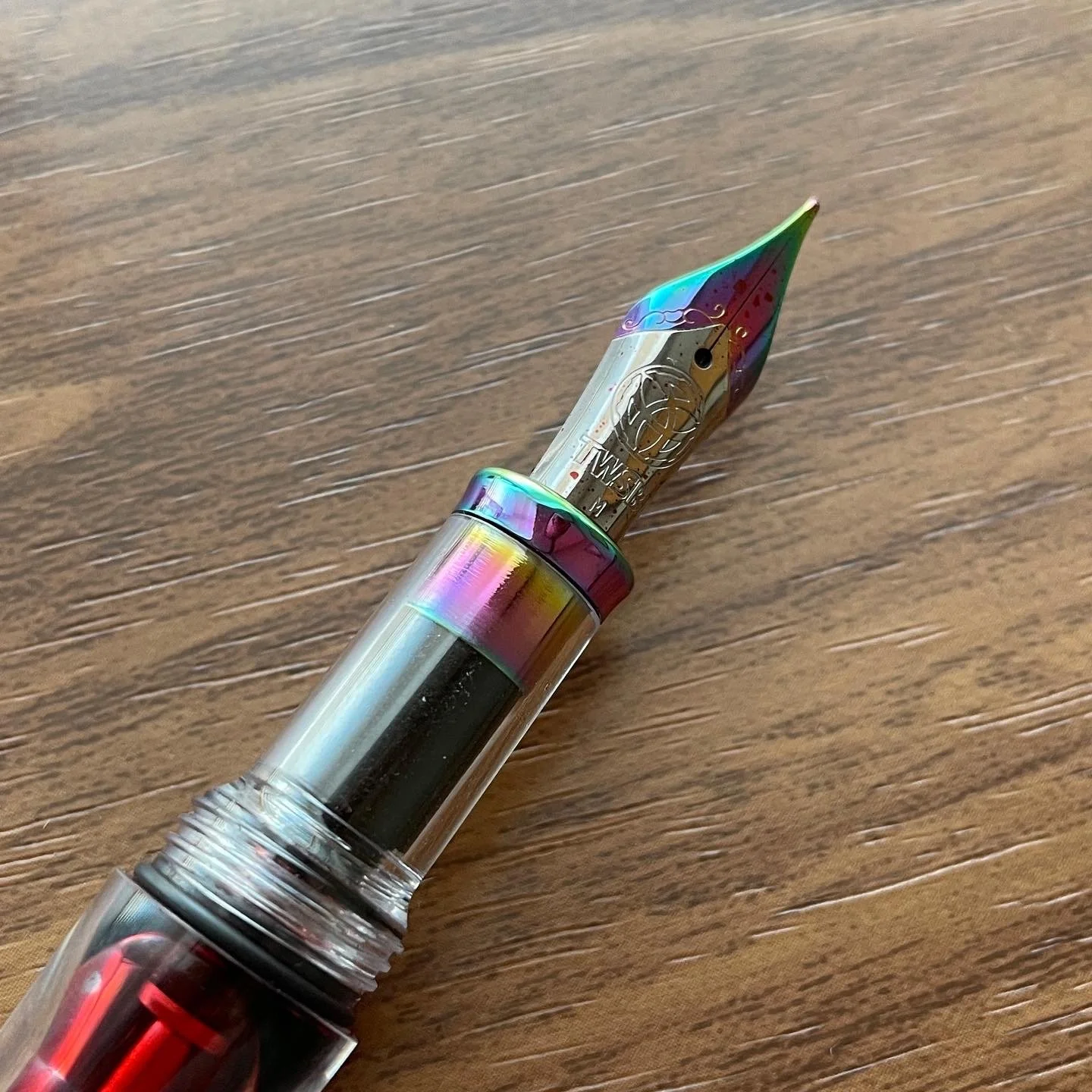
TWSBI recently released five new colors to round out its “1791” collection: Tangerine (Orange), Navy (Dark Blue), Grape (Light Purple), Forest Green (Dark Green), and Crimson (Red). The new inks nicely complement the existing six, so I thought I’d post a photo showing a comparison of all except the greens. (I’m low on those at the moment and didn’t want to crack open a bottle for sampling, but the new “Forest Green” is darker than the “Emerald", which has more blue in it.) Which is you’re favorite? I’m torn between the “Crimson,” which reminds me of Kaweco Ruby, and the “Tangerine,” which to me is a more traditional orange than the classic “Orange” that has a reddish tone. We stock the full line of TWSBI Inks in the Curated Shop, with the 1791 series starting at $6.50! We also recently received a shipment of TWSBI Fountain Pens, including the Vac700R “Iris” edition, the TWSBI Vac Mini, and the TWSBI Diamond Mini.

“Grape” was a pleasant surprise - it’s a mid-tone purple that’s lighter than the “Royal Purple,” and also shows some shading. New inks on the left, original on the right.

The T.G.S. Curated Shop is an authorized retailer of TWSBI and other brands we stock. By shopping with us directly, you are supporting original content, pen reviews, pen show events, etc. from The Gentleman Stationer. If you would like to support us even further, please consider checking out the T.G.S. Patreon Program, which offers access to online meetups, exclusive discounts and pre-orders, and more!

In TGS Curated Shop Tags TWSBI Inks, TWSBI, TGS Curated Shop
Comment

Sunday Reading for February 6, 2022

February 6, 2022
  1. Pen Show Report Card and Philly Pen Show Recap (via Pen Addict). Kimberly has a recap of the Philly Pen Show (which I was sad to miss) along with a new pen show “scoring” system to provide a more objective way to evaluate specific shows. I’m looking forward to seeing how this one plays out.

  2. Gravitas Pocket Pen Rainbow Skittle (via Dapprman). The “Skittles” finish on the Gravitas pocket pen is absolutely gorgeous. While I’m not sure that the pocket pen will work for my daily use, I need to try something in this finish ASAP.

  3. Leonardo Momento Magico Anima Nera Fountain Pen Review (via SBRE Brown). The Momento Magico is Leonardo’s fountain pen that features not only an integrated piston filler but an ink window. Now available in a matte black finish.

  4. No Grime or Raisin (via Quieter Elephant). From a blog I’ve been newly following, here are some thoughts on the Copper Ensso Italia as well as an overlay-style pen from Asvine.

  5. Tono & Lims White (via Fountain Pen Pharmacist). No, it’s not what you think. After 1,000 inks, maybe they just ran out of names? :)

  6. Snippets: Capillaris, Tibaldi, Dialogue CC, ECO Raden, and This Wonderful Community (via UK Fountain Pens). Anthony does a great job of having frequent reviews of up-and-coming brands and feature releases. If you need and ear to the ground on what’s ahead for 2022, you need to be reading UK Fountain Pens.

  7. Falling Out of Love With a Pen (via InkJournal). There are many reasons why we sell off portions of our collections/accumulations, and frequently it has nothing to do with the quality of the product itself.

  8. What is the Right Size for My Pen Collection? (via mnmlscholar). As we dive further into this hobby, we all accumulate more than we use at any one time. Yet we can easily get rid of some things yet persistently hang on to others. How many is “too many”? One size doesn’t fit all.

  9. Ink Review: Laban Inks (via Well-Appointed Desk). Laban’s “Mythology” Series of inks has been wildly popular, with five new colors recently released. I’ve seen several of these in person and find certain colors (Demeter Brown, Hera Green) subtly fascinating.

  10. Ink Line Preview: Monarca Stationery (via Well-Appointed Desk). I have samples of all Monarca Inks in for review at the moment, and will be working them through the rotation to get you my own thoughts as soon as possible!

In Case You Missed It

Back from vacation! From “balmy” 52 degree weather in North Florida to 25 degree weather in Tennessee, with a bonus ice storm! Anyway, it gave me the chance to knock a few things off my review list, including the Wingback Mechanical Pencil in brass, and two beautiful inks by Vinta in the Philippines: Aegean Armada and Leyte Sea Kelp.

New in the Shop This Week

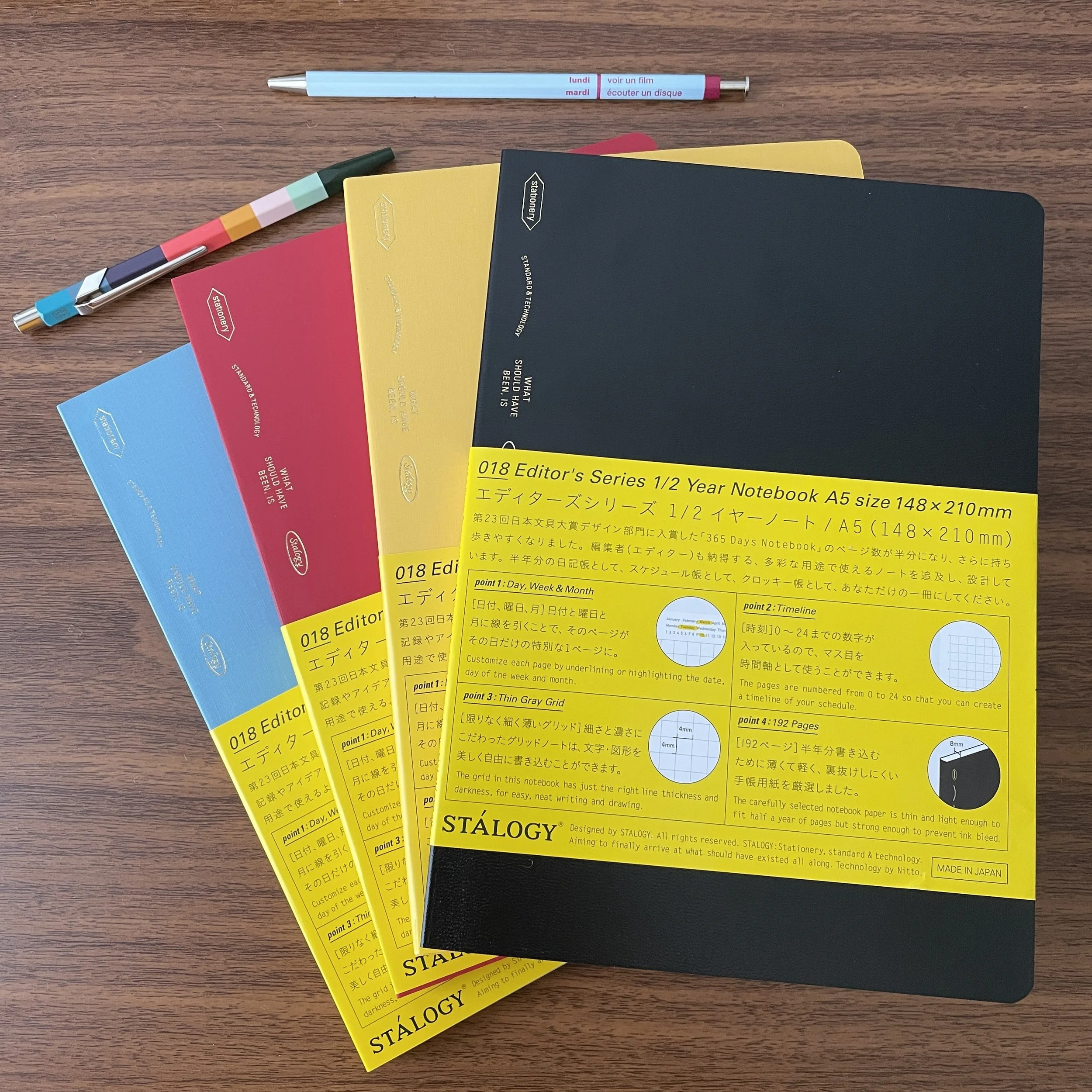
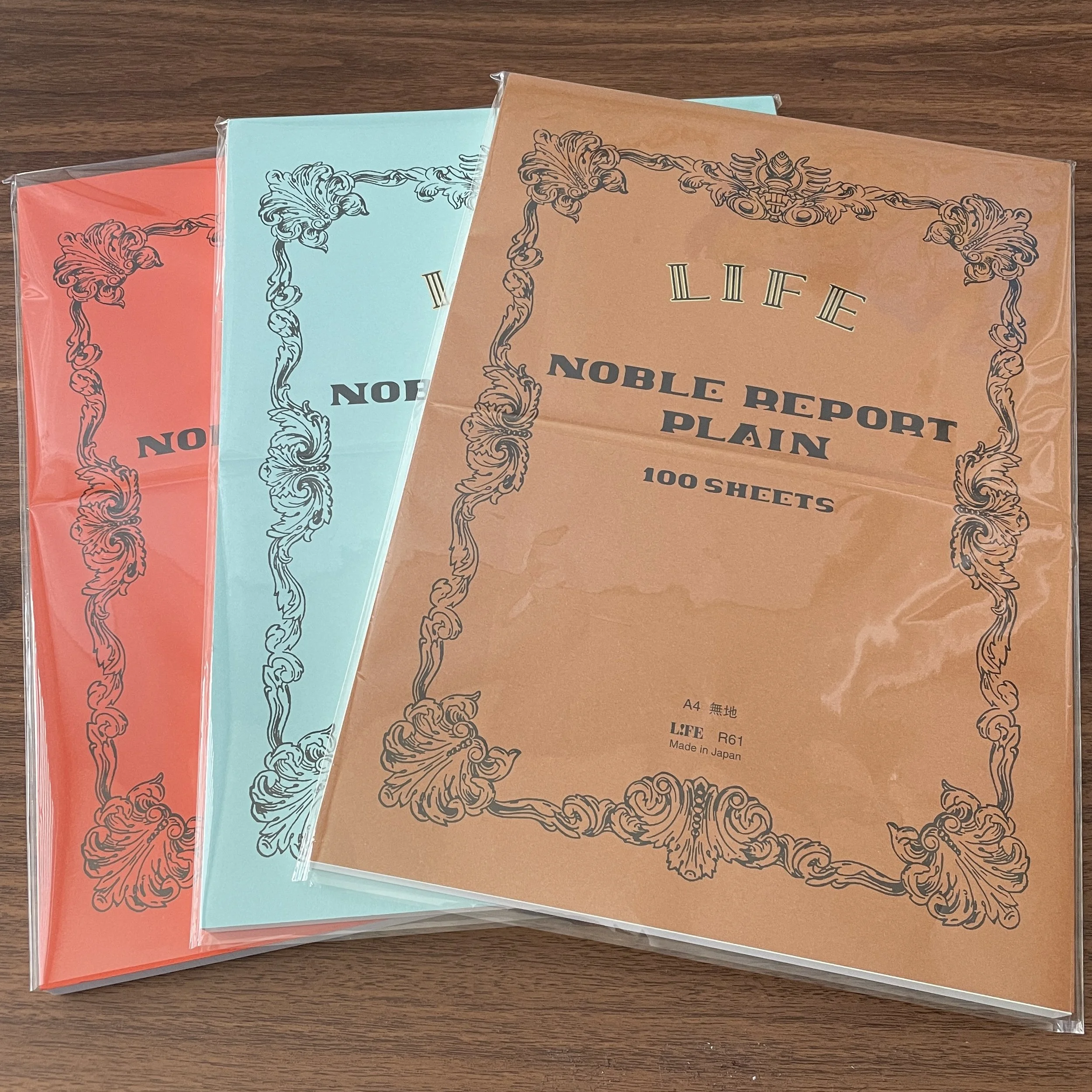
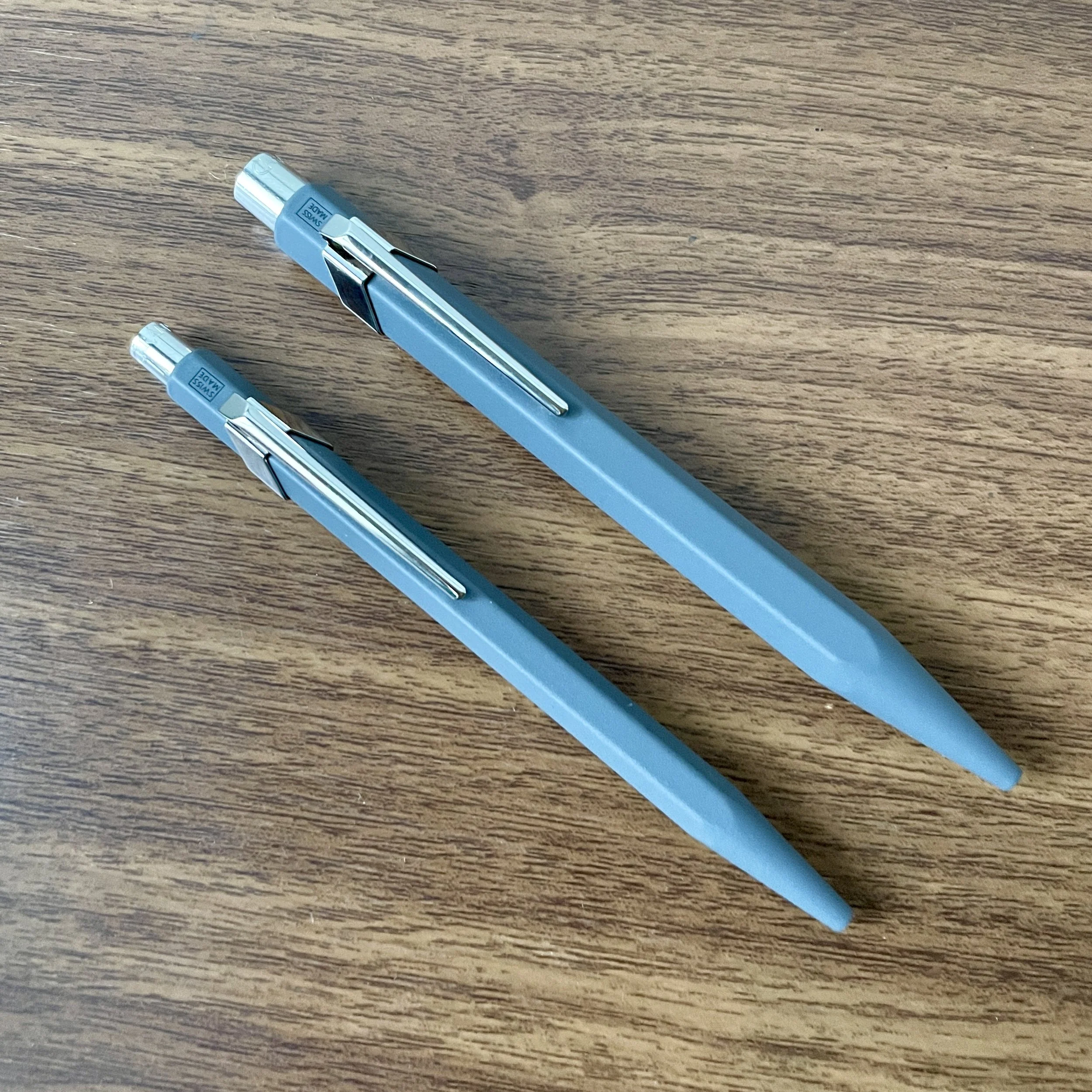
Monday saw the arrival of four new TWSBI models that we introduced to the Curated Shop: the Vac700R in the rainbow anodized “Iris” finish, the Vac Mini, the Diamond Mini, and the latest TWSBI ECO release in Jade. We also restocked on Midori MD Paper, including the MD Cotton Notebooks in the larger F3 and F2 sizes, MD Cotton writing pads, and dated and undated planner stickers. Plus, a few more:

TWSBI
TWSBI
Stálogy
Stálogy
Life Paper
Life Paper
Caran d'Ache
Caran d'Ache

Consider Joining TGS Patreon for Access to Monthly Meetups and First Dibs on Gently Used Stationery, Exclusive Products and More!

For some additional fun, and to help support the blog consider joining the Patreon program. Patreon supporters receive special pricing and early access to product releases and collaborations such as the T.G.S. x Sunderland pen, in addition to other benefits. You can read more about T.G.S. Patreon here. This year I’ve introduced monthly online meetups, which take place on Friday or Saturday and have been super enjoyable. The Patreon membership also has “first dibs” on my regular gently used stationery sales.

In LInks Tags Links
Comment

Ink Review: Vinta Aegean Armada and Leyte Sea Kelp

February 5, 2022

I included both Vinta and Ferris Wheel Press in my year-end review as favorite ink lines that I discovered in 2021. This was somewhat unusual for me - typically I avoid boutique inks, particularly those from non-pen manufacturers that focus on special properties such as sheen, shading, and shimmer. Not that these inks are dangerous to use in your pens - they hardly ever are - it’s just that they don’t usually work well for everyday writing, and I value inks that dry quickly and perform decently on cheap paper given the demands of my day job. Vinta seems to have found a sweet spot in their formulation, however, because nearly all of the inks I’ve tried not only work well in most fountain pens and on most papers, but they dry fairly quickly and, with respect to the “shaders”, remain legible even in extra-fine (and ultra extra-fine) nibs.

Vinta Aegean Armada

After avoiding the color family for the better part of my pen “career,” I’ve developed a bit of a thing for grey inks over the past six months. Currently, my two favorites are Scribo Grigio and the ink pictured here, Vinta Aegean Armada 1944. Inspired by the Battle of Leyte, the largest naval engagement in military history, Armada was designed to mimic the color of a fleet of ships reflected onto the sea, “which can transform its color from grey to blue to everything in between.” Armada shades beautifully - in finer nibs it will appear as a darker grey, and with broader nibs you will see some double shading that includes steel blue and even faint pink hues. Armada behaves very well on most papers, even cheap office paper as long as you use a finer nib.

Vinta Aegean Armada was one of the most difficult inks to photograph accurately - it’s hard to show the pinkish/reddish double shading that comes through as the ink dries, but you can sort of see it here.

If I had to pick an ink to which I could compare Armada, it would be Iroshizuku Fuyu-Syogun, only darker and with slightly more depth to keep it interesting. I’ve tried to love Fuyu-Syogun (“Old Man Winter”), but it’s just not quite legible enough for me to use in everyday writing.

All writing samples shown here (and in most of my recent ink reviews) are on Write Notepads bright white paper. The Leyte Sea Kelp writing sample was done with a JoWo No. 6 18k Gold Nib (in a Kasama Una fountain pen), and the Aegean Armada writing sample was done with a Lamy AL-Star medium steel nib.

Vinta Leyte Sea Kelp

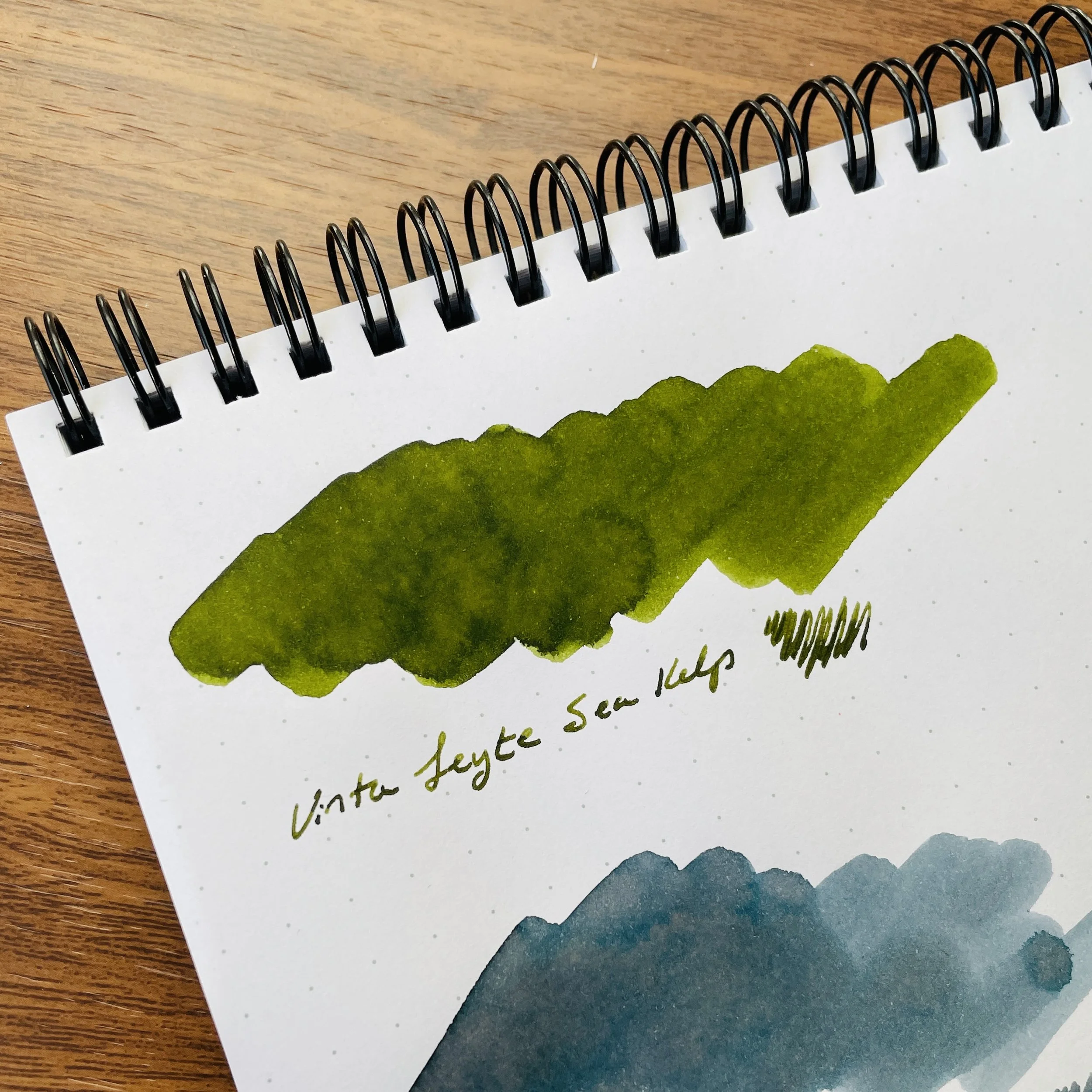
In another nod to Philippines history, Vinta’s Leyte “Sea Kelp” green pays tribute to not only the Battle of Leyte Gulf in 1944, but the area’s kelp industry. Leyte green is intended to evoke “the color of kelp as it floats in the bright clear seawaters of Leyte.” I’ve been looking for a solid mid-tone green ink, and this one perfectly fills that gap in the collection.

Vinta Leyte undergoes a bit of a color shift as it dries. In the first picture, it appears darker when wet, but as the ink dries it takes on a slightly more yellow-olive hue.

Takeaways and Where to Buy

Count me in as a big fan of Vinta Inks. I have three bottles in my current collection, as well as a handful of samples, so look for more reviews to come. Vinta regularly releases new colors and store collaborations, so keep an eye on their website and social media for updates.

I love the design of the Vinta Inks bottle and packaging.

You can purchase Vinta Inks directly from the manufacturer, located in the Philippines, or from authorized retailers around the world. Our friends at Vanness Pens stock the entire Vinta lineup, which is where I acquired the inks pictured here. Vinta Inks come in 30ml amber glass bottles, priced at $12.50, placing Vinta in the lower-middle price segment. In my opinion, they’re excellent value given the combination of quality and unique colors and properties they offer.

I purchased the inks featured in this review at Vanness Pens, with my own funds for my own use, though I did receive a discount on the purchase. This post does not contain paid third-party affiliate links, and I was not otherwise compensated for this review. The Gentleman Stationer is supported by purchases from the T.G.S. Curated Shop and the T.G.S. Patreon Program.

In Ink Reviews Tags Ink Review, Vinta Inks, Inks
Comment
← Newer Posts Older Posts →
Check Out Our New Online Shop!
Store Hours and Events
Updated 2026 "Best Pens" Guide
No results found
On The Paper Trail: Live In Nashville Event Tickets Now Available!
TGS_25 Roterfaden Restock Notification
Hierarchies of Fountain Pen Friendly Paper

Join Our Patreon!
Subscribe to the TGS E-mail List

Featured Posts

Featured
10-Fountain-Pens-Favorite-Inks
August 22, 2026
Three Keeper Inks: Choosing Inks for 10 Fountain Pens
August 22, 2026
Read more →
August 22, 2026
Everyday-Stationery-Bags
July 25, 2026
What's the Best Everyday Stationery Bag? My Own Considerations and 5 Options for Pen Show Season
July 25, 2026
Read more →
July 25, 2026
Graphilo-Kobeha-Paper.jpg
July 11, 2026
Paper Review: Graphilo by Kobeha
July 11, 2026
Read more →
July 11, 2026
The Gentleman Stationer RSS

© Digital Divide Media, LLC, 2014-present.

All content is the exclusive property of Digital Divide Media, LLC, d/b/a The Gentleman Stationer, including “The Gentleman Stationer” website and trademark, and should not be reproduced without express written permission.  All rights reserved.

All content containing paid advertising, affiliate links, or sponsored content will be plainly disclosed by a disclaimer when/if featured.

Contact Information

Website Terms and Conditions

Privacy Policy and Cookie Policy

Accessibility Statement

Legacy Account Login

Powered by Squarespace