• Blog
  • Shop
  • Podcast
  • Resources
  • About
  • Archive
  • Contact
  • Cart
  • Sign In My Account
Menu

The Gentleman Stationer

Vintage Living in the Modern World.
  • Blog
  • Shop
  • Podcast
  • Resources
  • About
  • Archive
  • Contact
  • Cart
  • Sign In My Account

Trying out Nespresso in its various forms.

Sunday Reading for May 16, 2021

May 16, 2021
  1. Progress Over Perfection: The Venvstas Magna CC (via UK Fountain Pens). Apparently the proverbial heads have rolled over at Venvstas, and there is new management in charge. The results? A much better pen. Check out Anthony’s reviews for details.

  2. Otto Hutt Design04 Wave White and Rose Gold (via Rants of the Archer). Otto Hutt is literally all over the place these days! I had not seen the Design04 compared against other pens, and it’s interesting to see that this particular model isn’t as small as I originally thought.

  3. Inkuisition - Birmingham Pen Company (via The Poor Penman). Birmingham Pen Company apparently has released a couple of different ink formulations that reduce dry times and supposedly work better on inexpensive paper. This article tests out a couple of those claims.

  4. Victoria’s Journals Smyth Fashion Flexy Dotted Bullet Journal (via Rants of the Archer). I only wish journals/notebooks like this were available in our local bookstore!

  5. Pineider Arco Blue Bee (via Dapprman). I absolutely love the look of this material, regardless of whether it’s true “Arco” or not. I did not personally experience quality control issues with my loaner “Quill” nib, but apparently they are out there. This thorough review is worth reading if you are considering a Pineider.

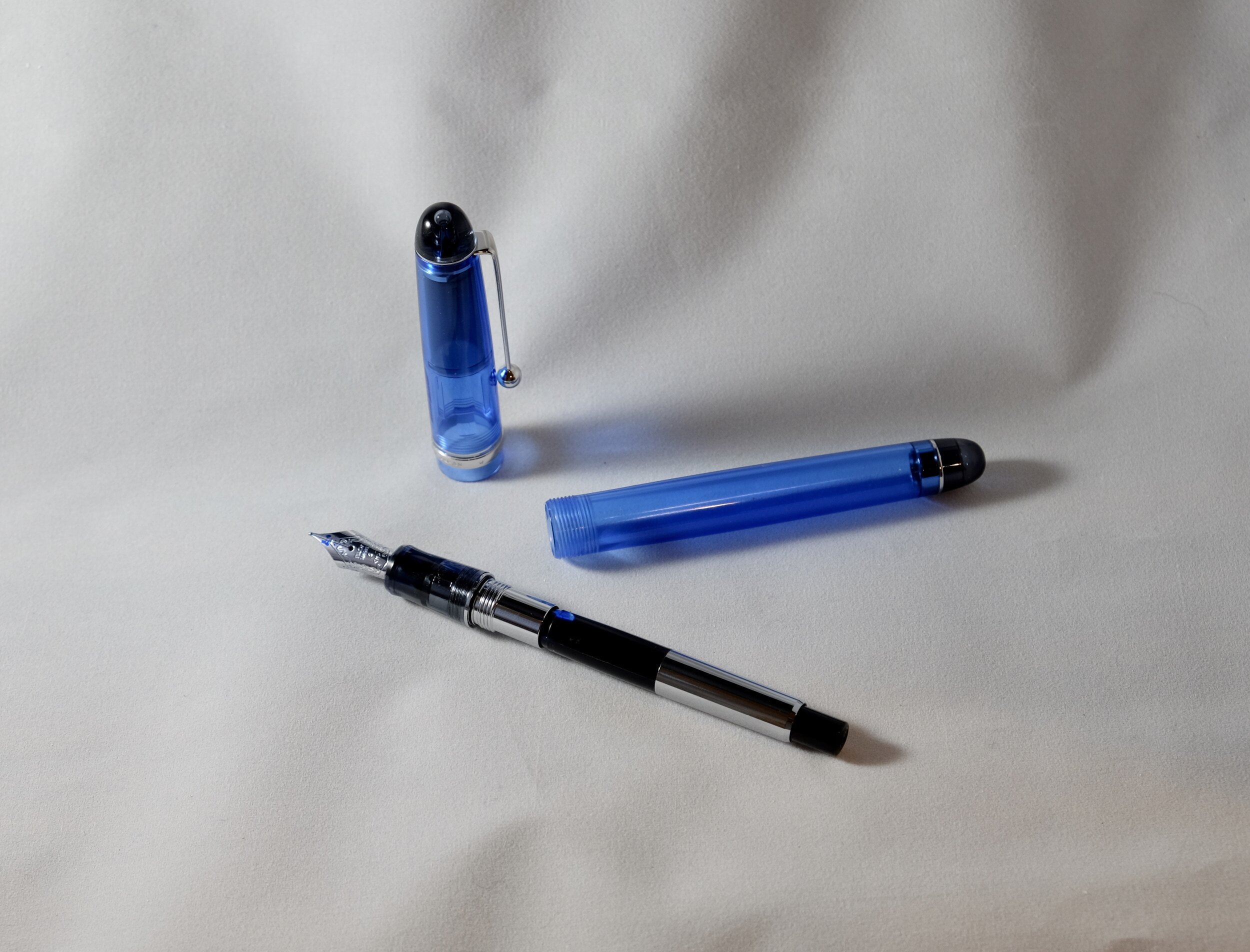
  6. Sailor Pro Gear Cocktail Kure Azur (via Pen Addict). Susan reviews this gorgeous transparent Pro Gear from Sailor’s “Cocktail” series - if only they could focus on keeping these exceptionally popular and well-designed colors in the main lineup.

  7. TRU RED Starter Journal (via Mountain of Ink). Kelli also takes a look at the TRU RED Starter Journal, from Staples and Staples.com affiliated brand TRU RED. For my own look at this product, check out the links below.

  8. Link Love: Cat(ch)-22 Edition (via Well-Appointed Desk). Ana’s discussion of Instagram here struck a chord with me, as I’ve been reconsidering my own commitment to the platform. I don't have a lot of time to devote to things like “Reels” and “Stories,” which makes it difficult to get any traction in the algorithm. Since my first love has always been writing and text-based interaction, I’ve tried to be more active on Twitter and now, Reddit, including r/fountainpens and the new r/gentlemanstationer. More on that below.

  9. Kunisawa Executive Ring Notebook - Fountain Pen Friendly! (via Gourmet Pens). I reviewed Kunisawa notebooks a couple of years ago, but found the paper inconsistent. That issue has since been remedied.

  10. Modern Fuel Adjustable Bolt Action Pen Prototype Preview (via Ed Jelley). Modern Fuel, makers of the Modern Fuel mechanical pencil, have been working on a bolt action pen that takes a wide range of refills. They’ve blown through their Kickstarter goals, apparently.

In Case You Missed It…

This week on the blog I published a post on some of my favorite ballpoint refills, and I already have a list of more pens to check out, based on your comments and submissions! I also reviewed the TRU RED Starter Journal, a product from Staples and Staples.com-affliated brand TRU RED. Finally, this week’s Deals & Drops spotlighted a new collaboration between Vanness Pens and Shawn Newton, as well as some ideas for accessorizing your office as many of us prepare to go back to work.

New This Week in the Curated Shop

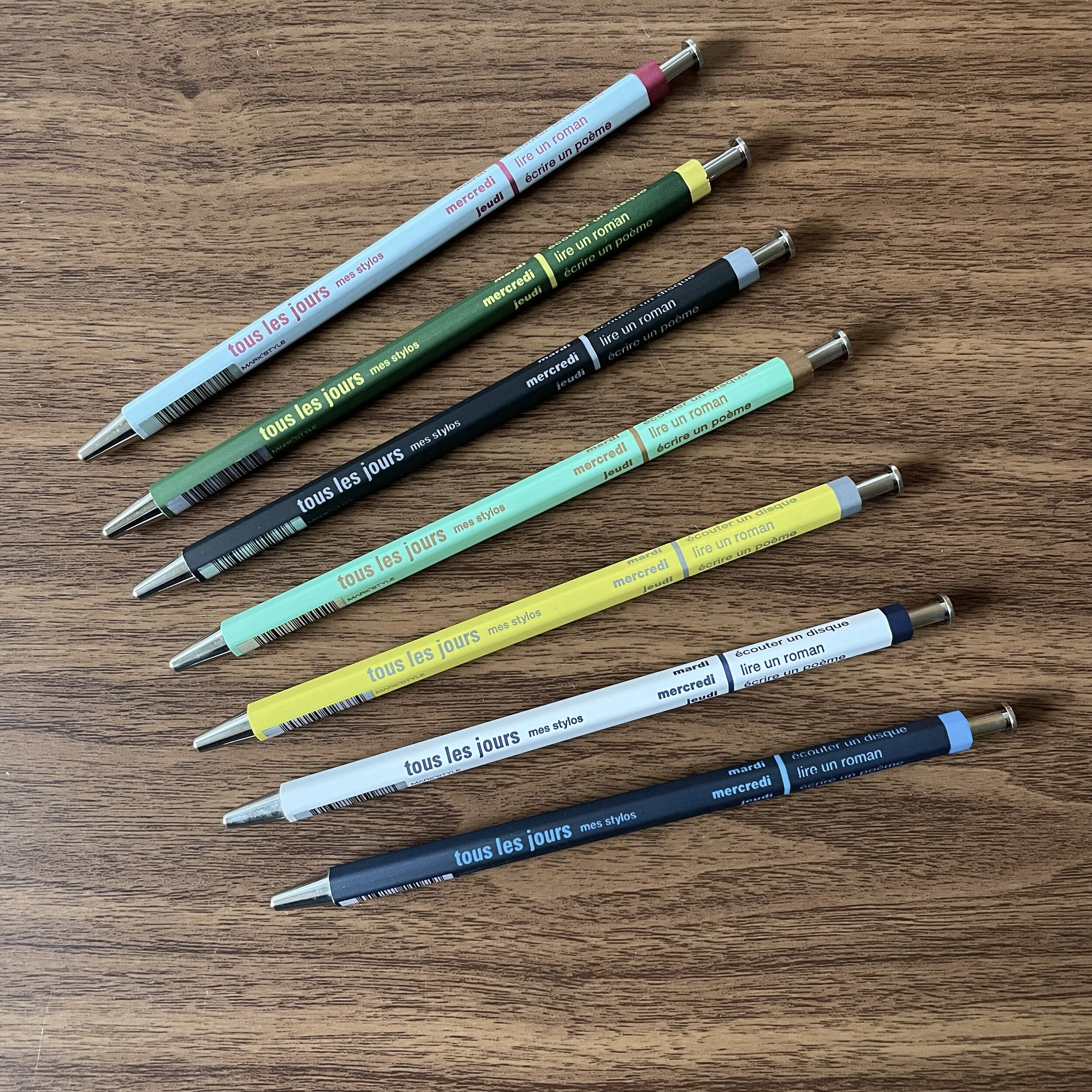
This week, I received new stock from Midori MD, including the blank/framed version of the MD Notebook Journal, as well as dot grid and blank MD Notebook Journal “Codex” versions! The latter features 368 pages of Midori MD paper - a page per day, if that’s how you choose to use it, and a lay flat binding. Note that this particular journal is not compatible with standard Midori MD Notebook covers.

View fullsize Hightide Sandglasses
Hightide Sandglasses
View fullsize Mark'Style Ballpoints
Mark'Style Ballpoints
View fullsize TWSBI
TWSBI
View fullsize Midori MD
Midori MD

Visit T.G.S. on Reddit, and Consider Joining TGS Patreon for Access to Monthly Meetups and More!

As I noted above, I’ve been trying to expand into social media beyond Instagram, due to my dissatisfaction with the direction that platform is taking. Currently, you can also engage with me on Twitter, Facebook, and now on Reddit. (Honestly, I’m active on Twitter and Reddit moreso than Facebook, but I do read all the Facebook comments, eventually.) Mainly, I’m doing this because of Instagram’s algorithm-driven approach that buries content unless you’re endlessly posting to their various formats (“Reels,” Stories, posts, etc.) and actively monitoring your account to where you’re basically having to respond to comments and DMs in real time. This is impractical, because as Ana points out, you end up spending all your time on their platform and not actually writing or running your business, and then most of this content is temporary (24hrs) and you have to jump on the “hamster wheel” again. Many people just want an easy way to receive updates on when I post new content to the blog. Twitter and Reddit allow me to do that reliably. I plan to continue using Instagram, because it can be fun. I just don’t intend on doing more to just “play the game.”

For some additional fun, and to help support the blog consider joining the Patreon program. You can read more about T.G.S. Patreon here. This year I’ve introduced monthly online meetups, which take place on Friday or Saturday and have been super enjoyable. We’ve discussed our thoughts on pen shows restarting, recent arrivals in our personal collections, and more. I will also continue with periodic “sample sales” of gently used review items, to which Patrons will have first access. The current sale is now live!
In LInks Tags Links
Comment

Notebook Review: Staples TRU RED Starter Journal

May 15, 2021

You may have noticed that Staples.com has been actively promoting a new range of notebooks, journals, and office supplies from the “TRU RED” line, which I first reviewed a couple of years ago. I’ve been seeing these products featured everywhere, and as expected, they eventually reached out and asked me to take a look! While my review package contained a couple packs of standard rollerball and gel pens, what truly caught my eye was the large hardbound journal dubbed the “Starter Journal,” from the TRU RED “Expert Notetaking Collection.” It didn’t disappoint.

The front cover of the Starter Journal includes a slot to hold business or index cards.

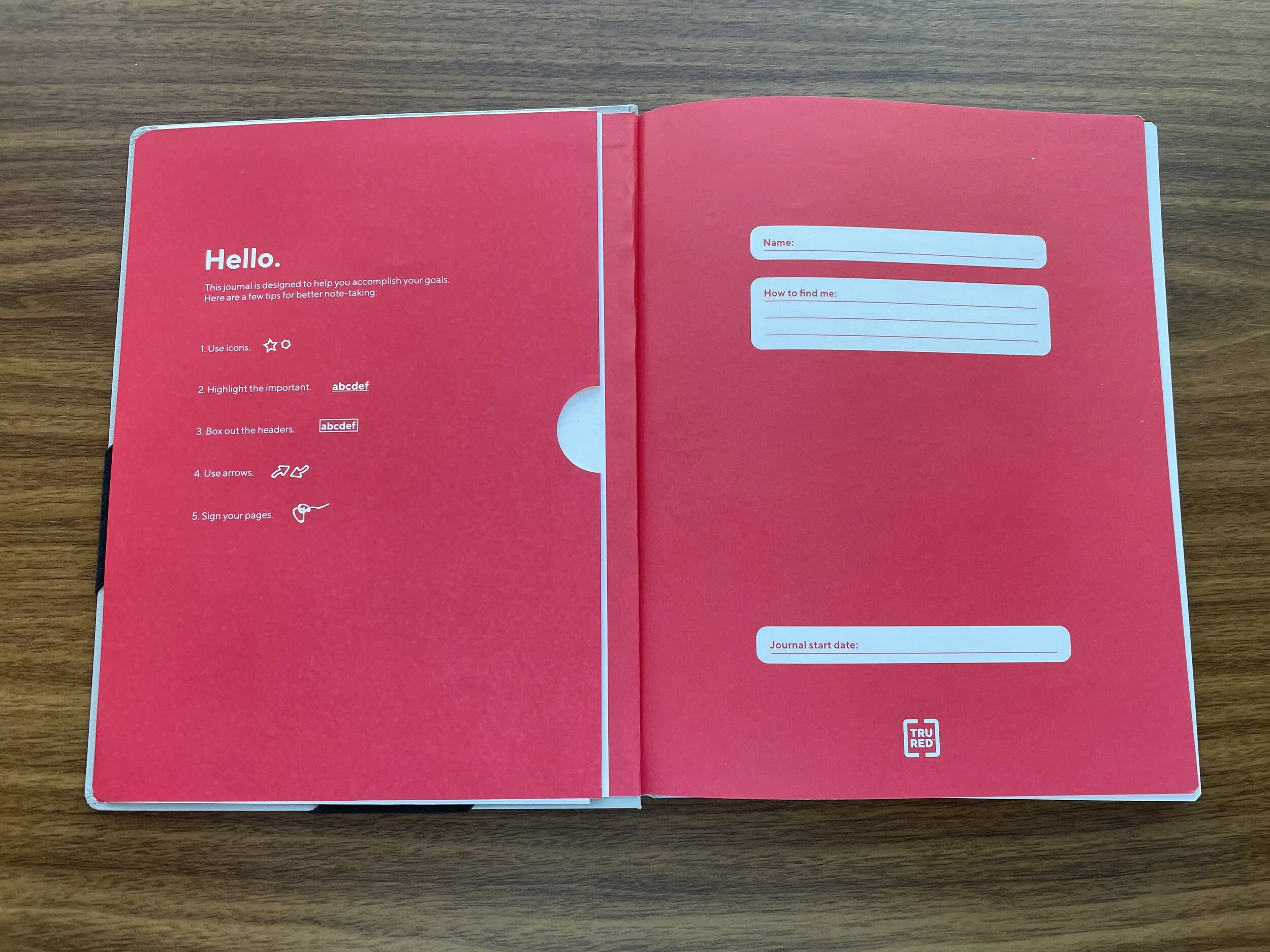
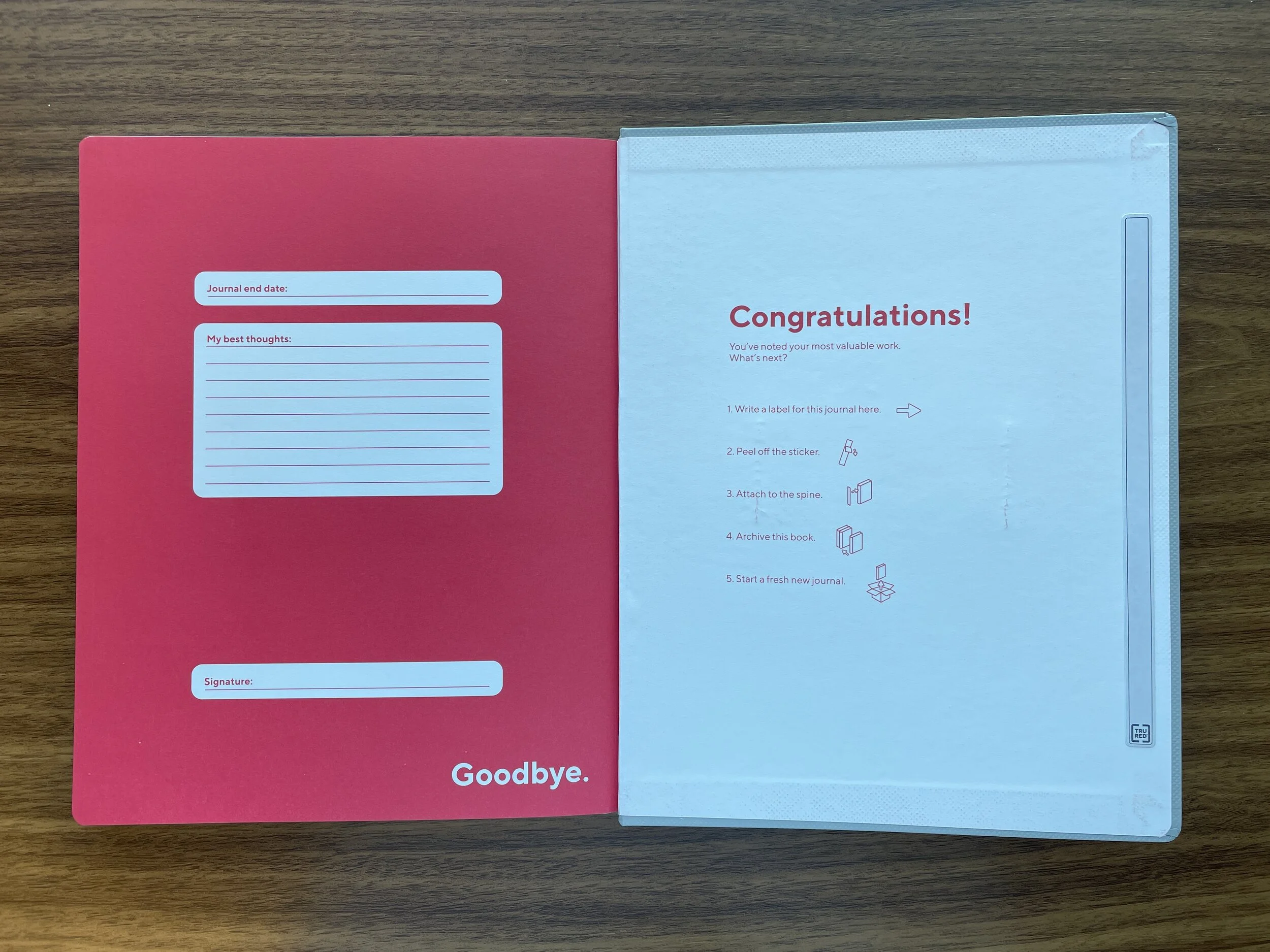
Quality hardbound (or casebound) notebooks are relatively difficult to find, especially at an accessible price point. While some people dislike them because they don’t lie flat, I appreciate the format because they offer a reliable, not to mention attractive, way to archive your notes and journals long-term: alongside your books on your bookshelf. When I saw that the Starter Journal actually included a peel-off sticker that you can use to label and organize your notebooks for posterity, I was intrigued.

Other features include a sturdy elastic band to keep the notebook closed, as well as another loop to hold folded paper, tickets, etc., and a pen loop.

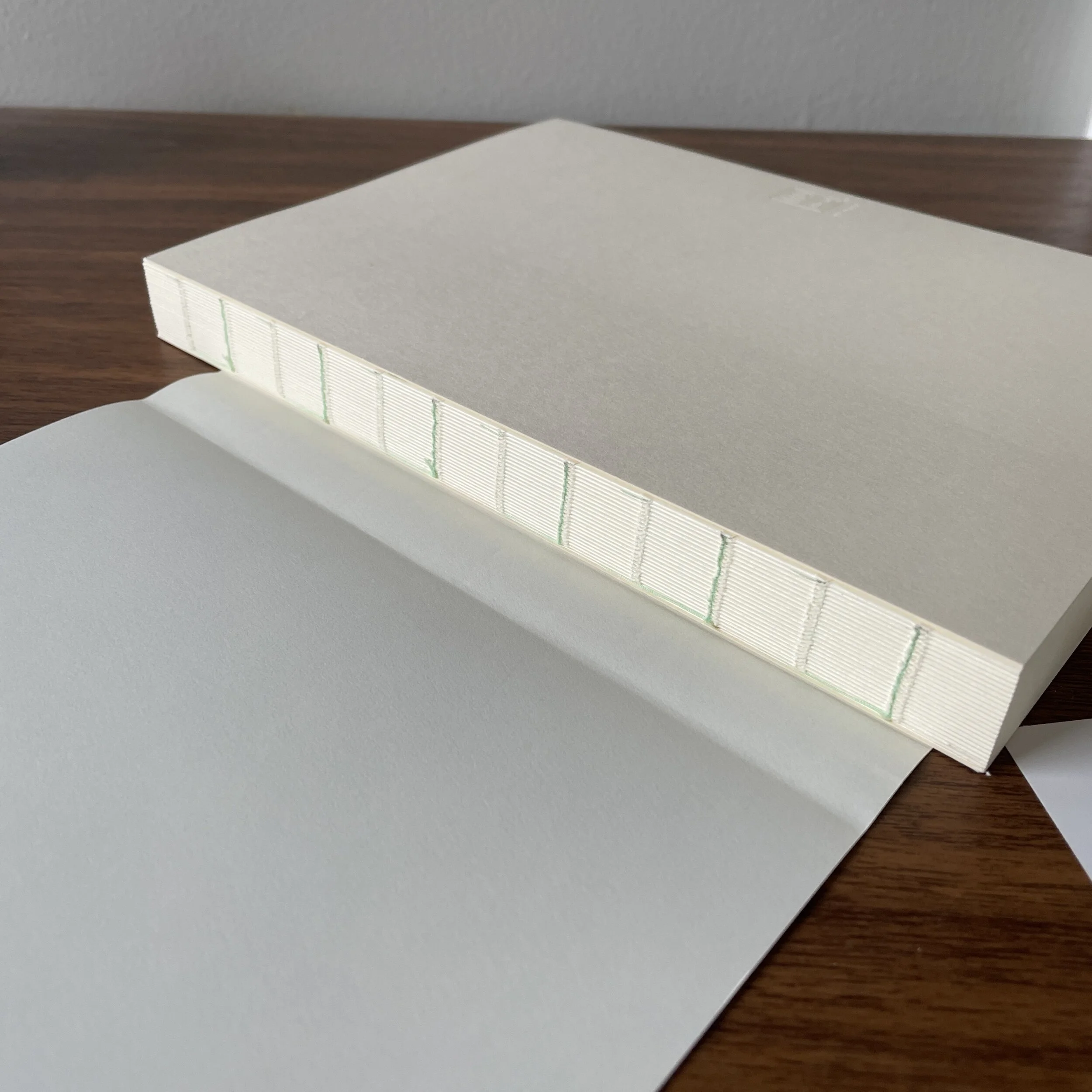
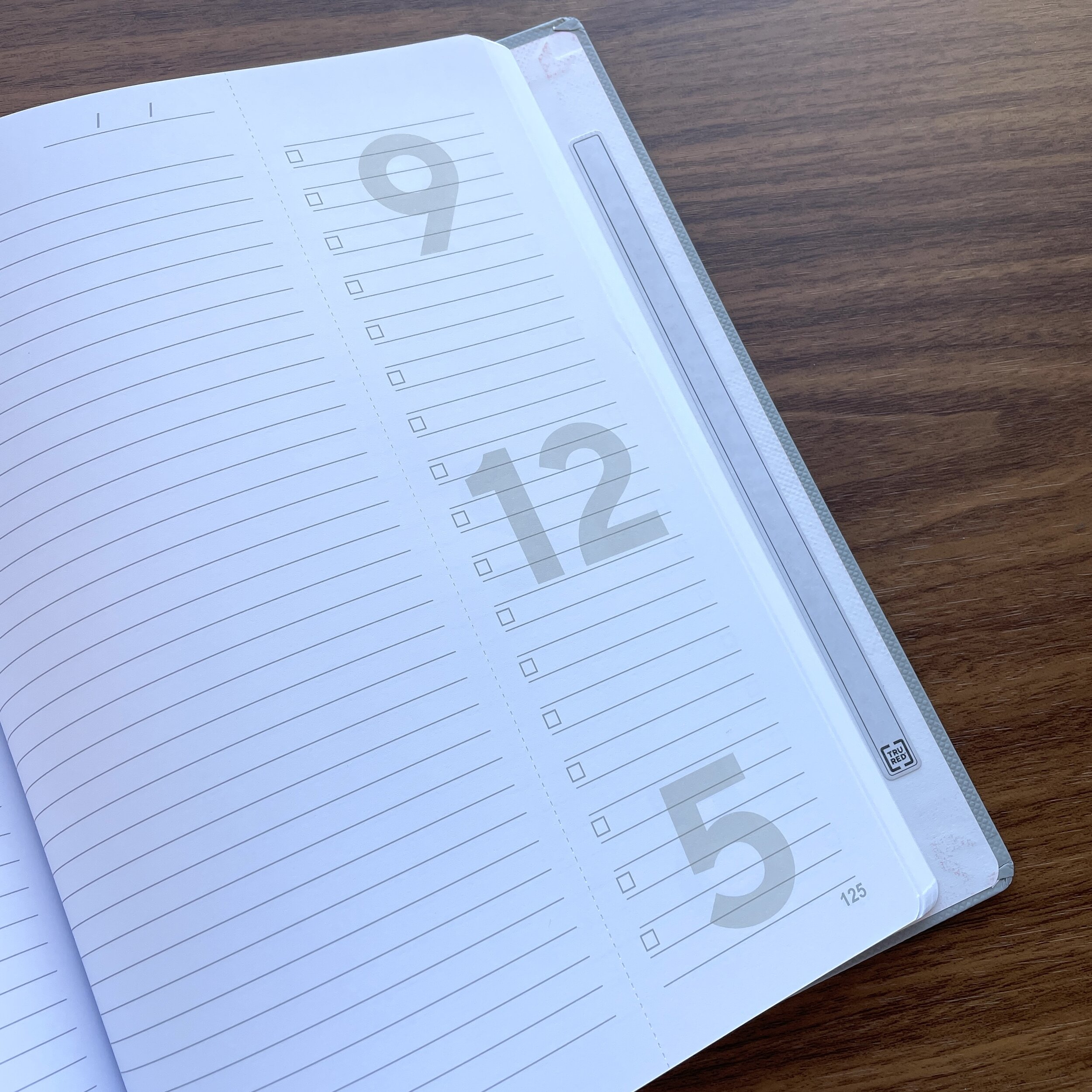
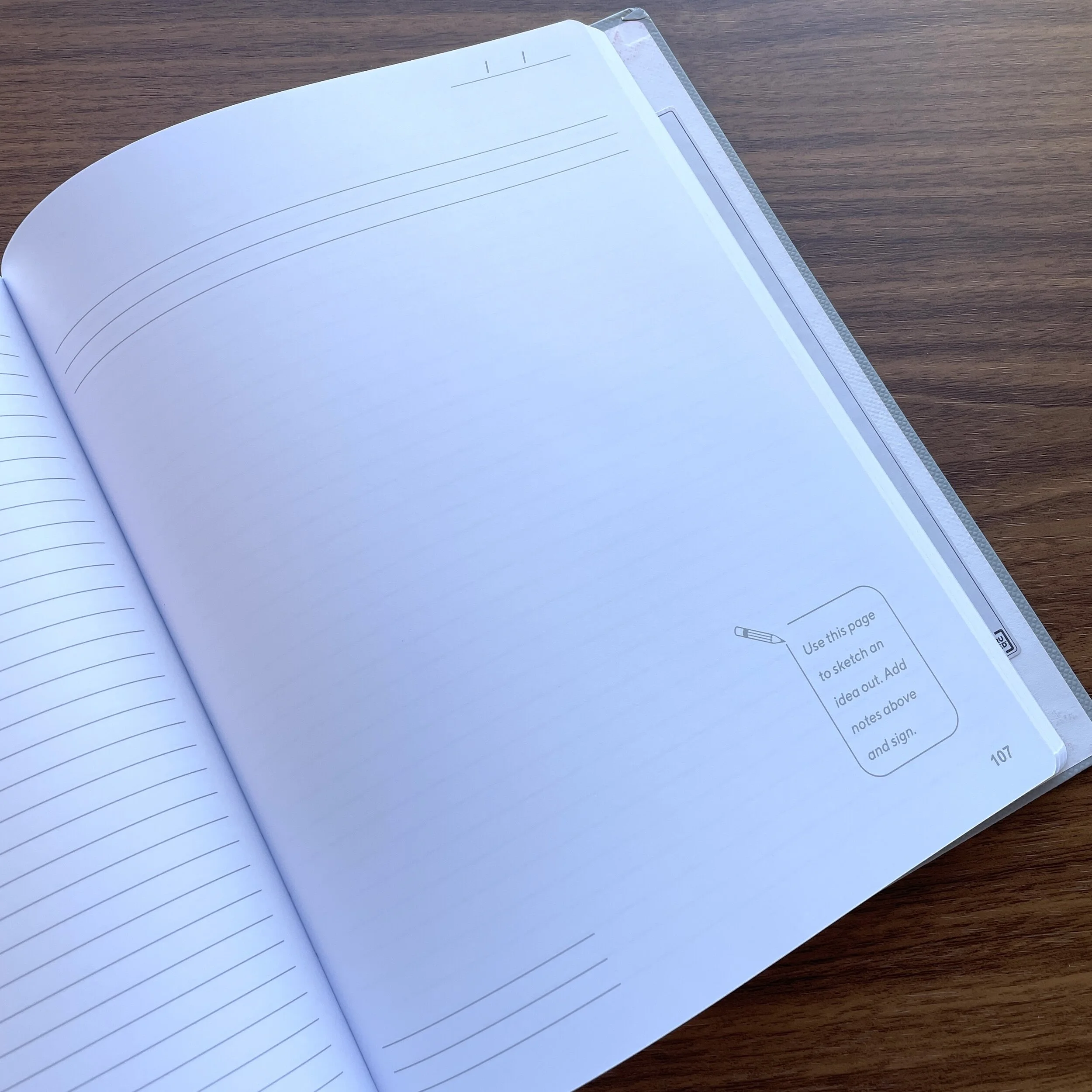
The journal/notebook itself measures 8” x 10” (in-between A5 and traditional “letter”), and the grey textured hardcover is thick and has a nice “hardback book” feel to it. The Starter Journal also includes various elastic straps to keep the journal closed in your bag and secure loose papers and a pen, and contains 192 pages of what is described as narrow-ruled “premium heavyweight paper” (more on that below) which alternates every five pages between perforated to-do lists and sketching pages. It’s a useful format that strikes a nice balance between structure and flexibility.

View fullsize TRU RED Starter Notebook Inside Front
View fullsize TRU RED Starter Notebook Inside Back Cover

It’s no secret that we at T.G.S. are big fans of notetaking, and especially enjoy getting into the nitty gritty (some would say “minutiae”) of notetaking techniques and methodologies. The promotional material provided by Staples.com alongside this review sample therefore grabbled my attention when they indicated that the team at TRU RED “spent two years studying note taking techniques of the most brilliant minds like Leonardo da Vinci and Charles Darwin and innovators like Richard Branson.” Now does this mean that the same notetaking techniques that worked for some famous person will automatically work for you? No, of course not, but I enjoy products that make an effort to teach something, or at least offer some guidance with integrated tips and tricks that might encourage more efficient and useful notetaking. In addition to the Starter Journal, the TRU RED “Expert Notetaking Collection” includes three additional styles (Pocket, Expert and Mastery) all tailored to complement different styles of note taking.

View fullsize Narrow Ruled Paper
View fullsize Perforated Schedule Card
View fullsize Areas for Sketching/Summarizing

So how about the paper? Honestly, it performed much better than I would have expected from a mainstream notebook at this price point. What TRU RED describes as “premium” paper will work best with gel and ballpoint pens, though I had absolutely no issues with TWSBI fountain pen ink, and Iroshizuku Ajisai had only some minor “pinpoint” bleed through that wouldn’t prevent me from using both sides of the page. I would offer a caveat to this evaluation: My experience has been that TRU RED paper can be inconsistent with how it handles fountain pens. One product might work fine, others not so much. That’s to be expected in a larger line where the paper is likely not obtained from a single source or milled by the company directly. In short, I wouldn’t purchase this journal/notebook expecting to be able to use it with every fountain pen ink out there - especially those that are extremely wet or super-saturated - but standard inks should be ok. (In my experience, rollerballs bleed through pretty much everything. This paper performed better than most, and while there was some slight bleed - moreso than with fountain pens - it again would not prevent me from using both sides of the page.)

Takeaways and Where to Buy

TRU RED has made a very nice hardcover journal/notebook. Though I personally would not use all of the various notetaking features, those who attend a lot of collaborative brainstorming sessions, sketch in their notebooks, and regularly have to summarize action items and talking points may find this to be a helpful addition to their workflow. I’m certainly glad to see this level of creativity coming from larger, “mainstream” office supply companies like Staples and Staples.com.

Currently priced at $17.99, the “TRU RED” Starter Journal (and all of the TRU RED products, for that matter) strike a nice balance in terms of price and quality. If you’re interested in reading further and trying out one of these notebooks, check out Staples.com. Select items from the TRU RED lineup may also be available in stores.

Disclaimer: This product was provided by Staples.com for review, free of charge. I was not otherwise compensated for this review. This post does not contain affiliate links and The Gentleman Stationer does not earn from any referrals.

In Paper Products Tags Staples, Tru Red, Notebook Review
1 Comment

What Do I Look For in a Ballpoint Refill?

May 12, 2021

OK, so I admit it’s a bit incongruous to follow up a post on the intricacies of fountain pen filling mechanisms with a discussion of ballpoint pen refills, but that’s the reality of my working life these days. I’ve never been one of those people who’s 100%-all-fountain-pens-all-the-time; rather, it’s 50/50 on most days, and as of late 30/70, in favor of ballpoints, gel pens, and even pencils.

Personally, I find Caran d’Ache pens comfortable to use due to their hexagonal shape. If you find the 849 model (shown at right) too narrow, the 888 “Infinite” (shown left) is larger and has a more rounded hex shape.

But I’m still picky. As far as writing experiences go, there’s nothing worse than a dry, skippy ballpoint pen that won’t write a solid line, especially if the pen itself is uncomfortable to hold. Fortunately, the ballpoint remains the default writing instrument for many, and it’s not difficult to find good ones. But what makes a “good one”? For me, it’s a combination of three factors:

  1. The Pen Writes a Consistently Solid Line. If you’ve ever spent much time taking notes with a poorly made ballpoint, you’ll know what I’m talking about. Bad ballpoint ink has a tendency to lay down an inconsistent line, meaning that your writing will have “skips” or “gaps” in it where the tip fails to apply a layer of ink. Because it’s oil-based, and doesn't flow as easily as gel or water-based inks found in gel pens and rollerballs, ballpoint ink is more susceptible to this sort of skipping, especially in older refills that have partially dried out. In my experience, the ballpoint pens and refills that lay down the most consistent line are the Lamy Pico, the Caran d’Ache Infinite (featuring the “Swissride” refill, which I find smoother than the still respectable “Goliath” in the 849), the medium Bic Cristal, and the Schmidt Easyflow 9000.

  2. The Pen Has a Comfortable Grip, Preferably Hexagonal. I find that ballpoint pens offer a tactile writing experience more akin to a woodcase pencil; therefore, it seems logical that my favorite ballpoints for longer writing sessions duplicate the feel of a pencil in hand. The two most famous are iconic stationery items: the Bic Cristal and the Caran d’Ache 849. I’ve also recently discovered a line of pens from Marks, Inc. that takes this a step further, using actual hexagonal wooden barrels to house a retractable ballpoint refill.

  3. The Availability of a Narrower Tip Size Without Sacrificing Legibility. Last but not least, we come to the most important attribute for those of us who write small: finding a ballpoint pen with a narrow tip size that also satisfies the previous two criteria (but mostly the first one). Lately, I’ve gravitated towards needle-tip ballpoint pens, whether it be the Bic Cristal “Xtra Precision” (which now seems to have been discontinued though I have a stash), the Traveler’s Company Brass Ballpoint, and the Marks, Inc. “Tous Les Jours” woodcase ballpoint that I mentioned above. While I love needle tips because of the precision they offer, the Uniball Jetstream SXR Parker-style refill, the Lamy M22 (Pico Refill), and the Caran d’Ache Goliath in the 849 offer reliable non-needle tip “fine” options that can get you a narrow line without sacrificing too much smoothness or legibility.

If the pen has a quality, legible refill, needle-tip ballpoints are excellent choices for those of us who like to write small and favor precise lines.

So What Ballpoint Pens Have I Been Writing With Recently?

You may have noticed that there’s not much overlap between the pens I mention in each of the three categories above. Nobody has “perfected” the ballpoint pen, so you end up with necessary trade-offs depending on what is most important to you at any particular moment (i.e., sacrificing some comfort for legibility and/or a narrow tip size, and vice-versa). For an overall combination of portability, durability, and performance, both the Lamy Pico and the Caran d’Ache 849 are excellent choices, and both come with “fine” refill options which, if not perfect, are still very good. Comfort-wise, I’ve been exceptionally impressed with the Caran d’Ache Infinite 888, though the refill is a bit on the wider side without a finer option. For annotating books or writing on the go, I’ve relied heavily on the Traveler’s Company Brass Ballpoint, since it has both a needle-tip AND a clip that can secure the pen to the front cover of a book or pocket notebook. All that aside, for its combination of value, performance, and I-just-don’t-want-to-have-to-think-about-it practicality, I still reach for the classic Bic Cristal, and these days Cristal fans can even dress the refill up in a fancy housing from Baux Pens. (I have three in rotation.)

A selection of writing samples from my current favorite ballpoints. Note that the Marks and Traveler’s Company refills easily offer the finest line.

If there’s one thing to be said for the humble ballpoint pen, you have a plethora of quality choices at very low price points, and as I explore the “higher-end offerings,” I’m increasingly convinced that ballpoints offer superior performance and versatility compared to rollerballs and even gel pens. Ballpoints tend to write more consistently at different angles, and are water-resistant. Of course, such advantages depend entirely on the context in which you use your pens - lately I’ve been focused on everyday use, and your own mileage may vary.

Do you have a favorite ballpoint? Drop me a line and let me know! For more pen recommendations and discussions of some of my personal favorites, check out my “Best Pen” Recommendations page, recently updated for 2021.

Two pocket ballpoint options: The Traveler’s Company Brass Ballpoint (left) and the Lamy Pico (right).

This post does not contain third-party affiliate links. The Gentleman Stationer is supported via pledges from the T.G.S. Patreon Program and sales through the T.G.S. Curated Shop, an authorized retailer of some, but not all, of the brands featured in this post.

In Editorial, Guide Tags Editorial, Ballpoint
2 Comments
Platinum-Curidas-Converter.jpeg

Filling Systems: Pros and Cons of Piston Fillers, Vacuum Fillers, and Cartridge/Converter Fountain Pens

May 8, 2021

Vintage vs. modern, steel nib vs. gold nib, extra-fine vs. triple-broad, Safari vs. Al-Star: the fountain pen community has always had - and always will have - various “debates” over what’s better. Of course there’s no right answer, but endlessly discussing the minutiae is part of what makes this hobby interesting, and the community so much fun. (Well, 99% of the community, setting aside the 1% that tends to take everything far too seriously.)

When it comes to my own personal collecting, my interests focus on two areas: materials (mainly celluloid) and filling systems. Acquiring pens made from rare and/or vintage celluloids, which have a depth and warmth that modern acrylics and resins lack, caters to the aesthetic/artistic interest I have in pens. On the other hand, exploring different filling systems brings out the true pen nerd in me, and is probably the reason I have an ever-expanding, wildly diverse accumulation of fountain pens. When manufacturers keep experimenting with new methods to fill fountain pens, you can’t help but try them all!

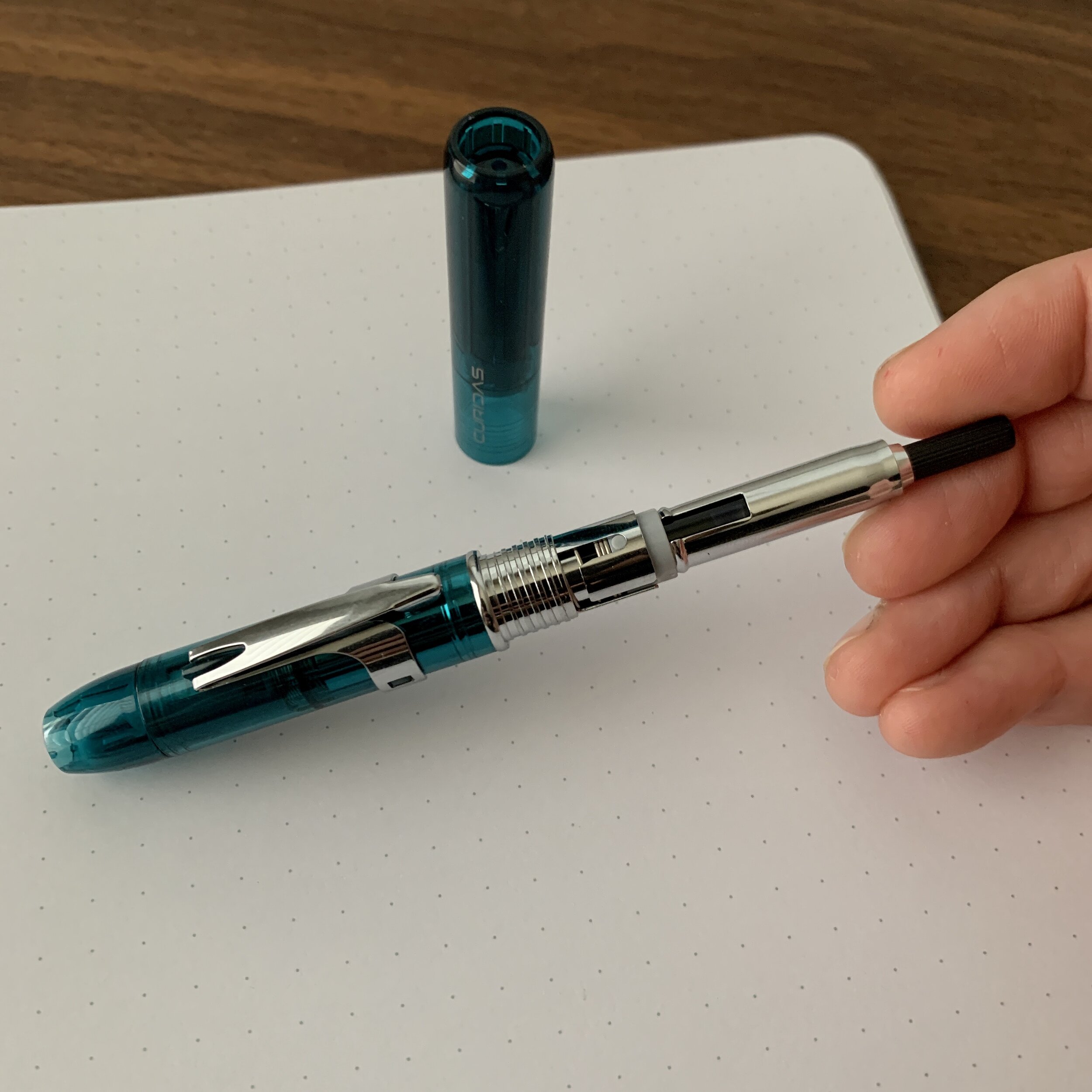
The Pilot Custom 74 fountain pen, featuring Pilot’s proprietary Con-70 Converter. While I love this particular converter, Japanese companies such as Pilot and Platinum (shown at the top) all use their own converter design, so you will need to buy separate converters fore each brand of pen.

The Pilot Custom 74 fountain pen, featuring Pilot’s proprietary Con-70 Converter. While I love this particular converter, Japanese companies such as Pilot and Platinum (shown at the top) all use their own converter design, so you will need to buy separate converters fore each brand of pen.

Cartridge-Converter: The Best Filling System for Most People

People often ask me, what’s the best filling system for the everyday user? For the casual enthusiast, this answer is clear: Cartridge/converter offers a user-friendly, versatile mechanism that’s straightforward and especially appropriate for first-timers and those who travel a lot or otherwise need to be able to refill on the go. I enjoy many cartridge/converter fountain pens myself, and I certainly won’t pass on a pen that I otherwise find interesting or attractive simply because it’s not exclusively bottle-fill. Pros and cons of cartridge-converter filling systems include:

Pros:

  • Versatility. Cartridge/converter filling systems allow you to use ink cartridges and fill from an ink bottle. It’s not just about whether you’re a beginner - I’ve been in this hobby a decade or more, and still keep cartridge/converter fountain pens in rotation because they’re great for travel. (You can read more on why I like ink cartridges here.)

  • Ease of use. If you’re new to fountain pens and simply want to get to writing without worrying about making a mess learning to fill from a bottle, just pop in a cartridge and you’re on your way.

  • Easy to Clean. Cartridge/converter pens are also exceptionally easy to clean by flushing them out with an inexpensive bulb syringe, or soaking the nib unit in water or running it through an ultrasonic cleaner. If you enjoy using highly saturated or shimmer inks that might stain or otherwise be hard to clean out of a pen, cartridge/converter pens are typically the way to go.

Cons:

  • Small Ink Capacity. Both cartridges and converters generally hold less than 1ml of ink. On a busy day, I can easily write one or more cartridge/converter pens dry. If you enjoy changing inks frequently, you might view this as a “pro,” but high-volume writers looking to go a full day or more on a single fill might prefer something with a bigger ink capacity.

  • Proprietary Cartridges and Converters. While some pen companies have moved towards a universal, standard international converter that is freely interchangeable between different pens, many major brands (including Pilot, Platinum, Sailor, Lamy, and Parker, just to name a few) use proprietary cartridges and converters that only work in their pens. To add insult to injury, many pens don’t actually ship with a converter, so it creates an added expense when you can’t use one of the dozens of converters already in your desk drawer.

  • Limited Ink Selection. If you stick to cartridges, you won’t have as many ink options. Don’t get me wrong, you’ll still have plenty, as brands like Diamine, Herbin, Sailor, and Caran d’Ache release more of their ink lines in cartridge form, but you’ll likely be excluded from most of the boutique and specialty inks unless you buy the converter and fill from a bottle.

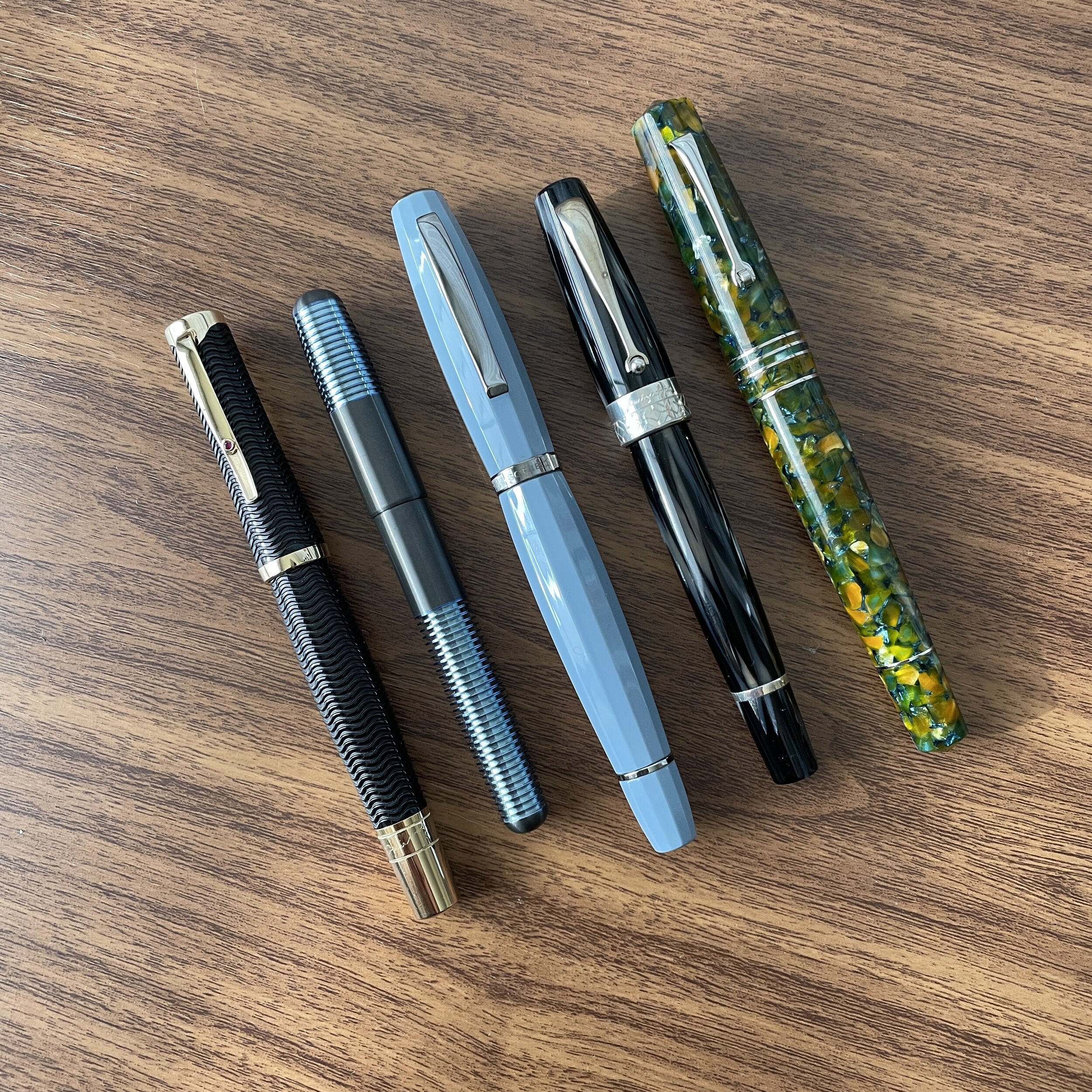
Many piston filling fountain pens are larger, to maximize ink capacity. The smaller pens, second from left and second from right, are cartridge converter, and the rest are piston-fill.

Many piston filling fountain pens are larger, to maximize ink capacity. The smaller pens, second from left and second from right, are cartridge converter, and the rest are piston-fill.

Piston Fillers and Vacuum Fillers Are More Fun

Even though I’m not a true filling-system snob, and frankly the majority of the pens I use on a daily basis are still cartridge-converter, I get the most enjoyment out of my piston and vacuum fillers. For those who may be new to fountain pens and unfamiliar with the terminology, a piston filler uses, well, a piston mechanism to draw ink into the pen when you dip the nib into an ink bottle and rotate the piston knob. A vacuum filler, such as the Pilot Custom 823 or TWSBI Vac 700R, takes in ink when you submerge the nib-end of the pen in an ink bottle and depress a plunger to create negative pressure. Both types of pens hold more ink than your typical cartridge/converter pen because the entire pen body becomes an ink reservoir, as opposed to a smaller plastic tube (i.e., a cartridge or converter) inside the barrel. In my opinion, this increased ink capacity is the primary benefit.

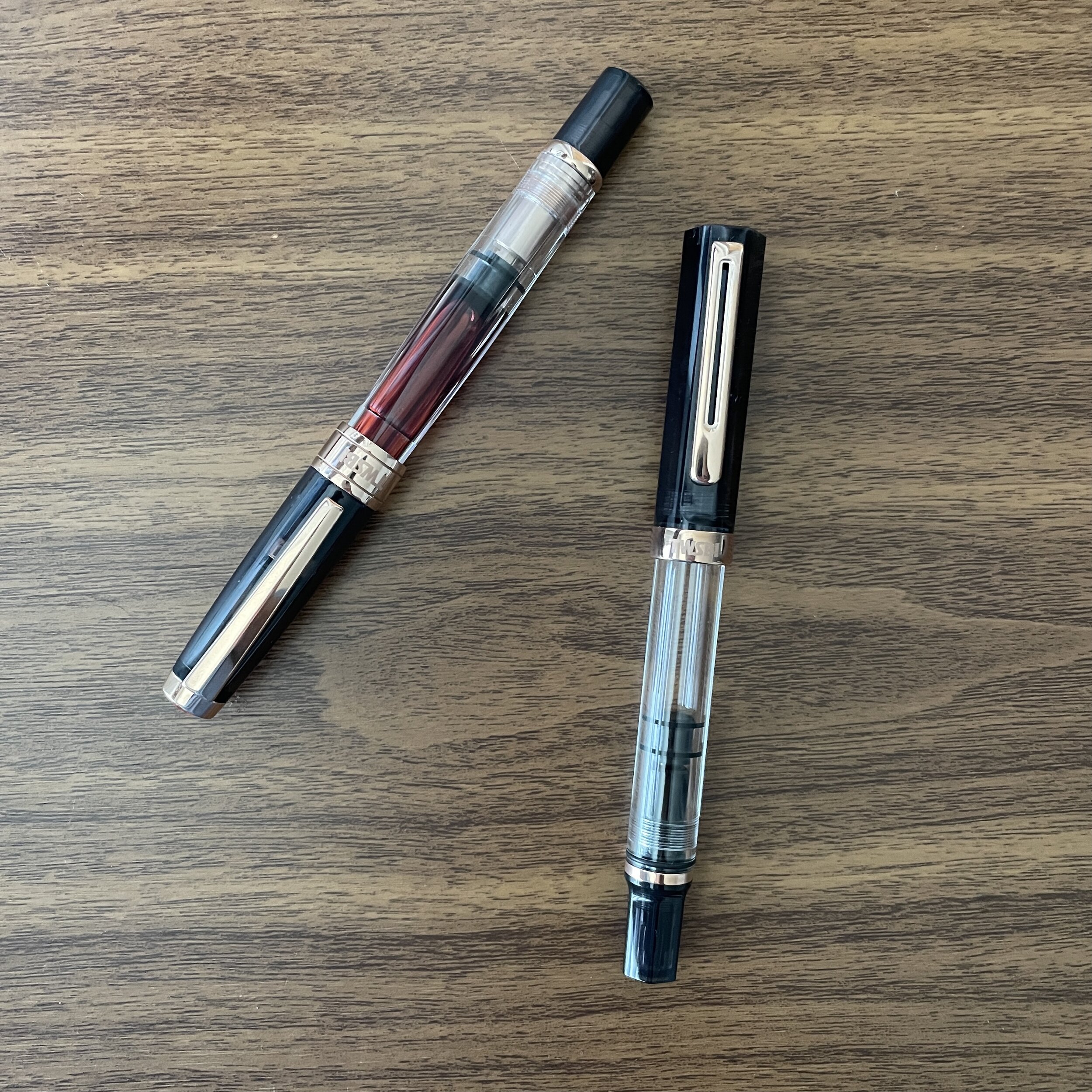
But piston fillers don’t need to be expensive. TWSBI makes a wide range of piston filling fountain pens for as little as $32.

But piston fillers don’t need to be expensive. TWSBI makes a wide range of piston filling fountain pens for as little as $32.

That said, another huge part of why I love writing with a fountain pen is a sense of not just nostalgia but continuity - there’s something inspiring and even motivating about filling a pen and writing the same way that people did nearly a hundred years ago. For this reason, after cartridge/converter, piston fillers are probably the second most-represented category of fountain pens in my own collection, and what I recommend to most people as a first “upgrade,” followed by the vacuum filler.

Pros:

  • Huge Ink Capacity. Piston fillers and vacuum filler fountain pens can easily hold up to 2ml of ink per fill, and sometimes more. For me, that means I’m good to go for at least two full days of writing. Vacuum filler pens can hold a bit more ink, but as I discuss below, sometimes these are a bit more difficult to fill to capacity.

  • Sustainability/Less Waste. Using a fountain pen that exclusively fills from an ink bottle creates less plastic waste than using a cartridge/converter system. Even if you use the converter, those don’t last forever, as I note above, requiring replacement. If you’re focused on using fountain pens because you like the idea of not contributing to the endless morass of disposable ballpoints, rollerballs, and gel pens clogging landfills, then you may want to take things a step further and forego cartridges and converters.

  • Typically Higher Quality. Because piston and vacuum filling systems take more work to build, as a general matter these filling systems are found in higher-quality pens that may or may not be a pen company’s “flagship” pen. A piston or vacuum filling system is typically built to withstand the test of time, whereas I’ve had converters wear out or break in less than a year. Again, this is a generalization - there are very high quality cartridge-converter pens out there, and some very badly made complex filling systems, but overall I find this accurate.

Cons:

  • Generally More Expensive. With greater complexity and quality often comes greater expense. TWSBI and PenBBS are the two main exceptions to this rule, with TWSBI making both high-quality piston and vacuum fillers for well under $100. While PenBBS makes an exceptional vacuum-filling fountain pen (the No. 456), their pistons leave something to be desired.

  • Only Uses Bottled Ink. If you want to be able to refill one of these pens while you’re traveling, you’ll either have to bring a bottle of ink or a traveling inkwell. That can be an inconvenience for some, myself included, and I often opt for cartridges when I travel, or I make sure to fill one of my larger vacuum filler pens to capacity before I leave.

  • Messier to Fill and More Difficult to Clean. Cartridge/converter pens are easier to clean because you can simply unscrew the nib section and flush water directly through the feed. In a piston or vacuum filler, you basically have to work the piston or plunger mechanism multiple times until the water runs clear, which can take a while. This can be a real pain, especially if you’re changing colors. Moreover, any time you fill the pen from an ink bottle, you have the risk of a spill, which doesn’t exist with a cartridge.

The Pilot Custom 823 is probably my favorite vacuum-filler.

You can see the plunger rod through the transparent barrel. For a demonstration of how to fill a vacuum-filler pen, Matt’s video over at The Pen Habit has a useful demonstration.

Yes, I Know There Are Other Options Out There

Including eyedroppers, pump/vacumatic fillers, aerometric, bulk/syringe fillers, magnet fillers, etc. But other than maybe the Opus 88 Japanese-style eyedropper system (which I very much like), the three filling systems I’ve discussed here are the ones most pen users are likely to encounter on a regular basis, especially those new to the hobby. I may even publish a follow-up post on some of the less common variants, and video demonstrations of how exactly to fill and clean each type of pen.

What are your favorite filling systems, and why? Does anyone stick to just one? I want to hear from you!

This post does not contain affiliate links. The Gentleman Stationer is supported exclusively by subscribers to the T.G.S. Patreon and via purchases from the T.G.S. Curated Shop.

In Editorial Tags Filling Systems, Editorial, Guide, Fountain Pens
12 Comments

Essential Stationery Items: Pentel PD345 Quicker Clicker

May 5, 2021

Today I’m reviewing one product in my personal collection that may actually be nearly 30 years old: the Pentel PD345 “Quicker Clicker” mechanical pencil. Those of us who came of age in the early to mid-1990s might remember this mechanical pencil as “the one with the clicker on the side that holds a ton of lead.” I constantly had two or three of these in rotation throughout my middle and high school years, and one of them seems to have survived in the back of a desk drawer. I got curious: Was this pencil still available, and was the modern version as good as the vintage?

My early 1990s-vintage Quicker Clicker (center) alongside two modern versions, which still have their plastic eraser caps. I lost the original cap long ago.

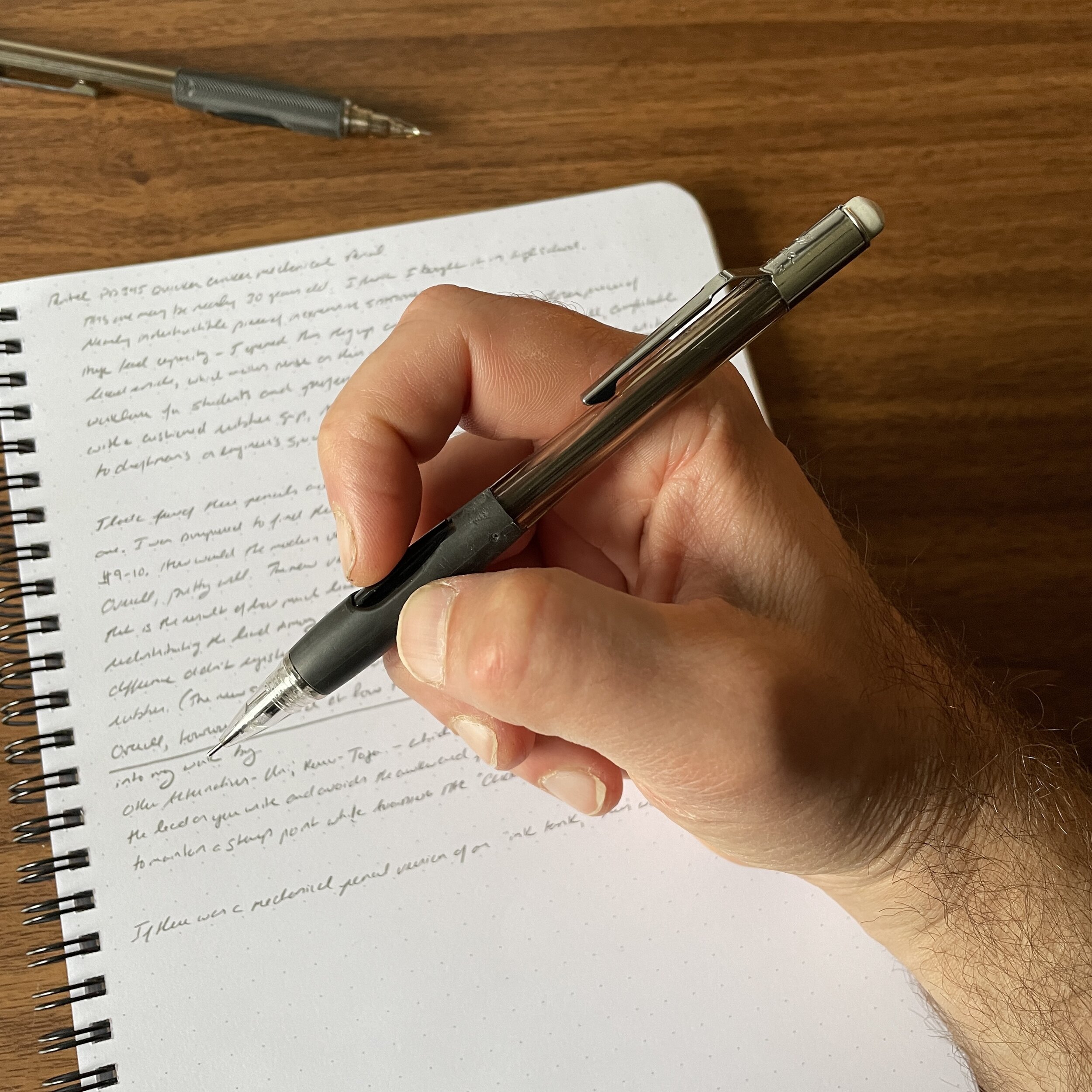
I happily discovered that you can still get the Pentel PD345 today, with the design mostly unchanged. The aspect of this pencil that I always appreciated was that it seems to be made for actual writing, as opposed to drafting or engineering like many knurled metal mechanical pencils. The “Quicker Clicker” features a round barrel with a convex grip section coated in soft rubber. Despite the tendency for the grip to accumulate lint and other backpack detritus, and get kind of grungy over time, this pencil was insanely comfortable to use for long stretches, making it a go-to for test-taking and essay writing. I distinctly recall never having to refill this thing, and true to form, when I pulled the eraser from the original pen nearly a dozen leads fell out the back, all still intact.

Unfortunately the texture on the modern version of the Quicker Clicker probably makes it more likely to accumulate dirt, lint, etc, though it might be fairly easy to clean with compressed air.

If there is one drawback with the Quicker Clicker, it’s that you have to rotate the pencil if you’re interested in keeping a uniform point on the lead, and the placement of the plastic lever on the grip may make this uncomfortable for some people. For that reason, I’m not sure it will ever replace the Uni Kuru-Toga as my go-to inexpensive mechanical pencil recommendation, but hey, some things still get points for nostalgia, and anything that’s managed to hang around in my desk for 25-30 years isn’t going to be replaced altogether.

View fullsize Pentel PD345 Quicker Clicker Grip
View fullsize Pentel PD345 "Clicker" Lever

Takeaways and Where To Buy

Few items have had as much staying power in my collection as the Pentel Quicker Clicker, and at $8 for a pack of two (or $40 for a box of 12?!?), its hard to argue that this mechanical pencil isn’t a great deal. It’s a solid Amazon or big box stationery purchase, and with the enormous lead capacity and comfortable grip, one of the relatively few mechanical pencils on the market actually intended for writing.

I purchased the pencil featured in this review from Amazon, with my own funds, for my own personal use. Last time I checked, you could still find this pencil at Staples, Office Depot, Target, etc., though Amazon seems to have the best pricing, especially if you’re looking to acquire a good, inexpensive mechanical pencil in bulk.

Disclaimer: This post does not contain affiliate links. If you’re interested in helping to support The Gentleman Stationer, consider joining our Patreon or shopping the T.G.S. Curated Shop, our related retail operation. Many thanks!

In Pencil Review Tags Mechanical Pencil, Pencil Review
Comment
← Newer Posts Older Posts →
Store Hours and Events
Shop T.G.S. Online
Updated 2026 "Best Pens" Guide
No results found
On The Paper Trail: Live In Nashville Event Tickets Now Available!
TGS_25 Roterfaden Restock Notification
Hierarchies of Fountain Pen Friendly Paper

Join Our Patreon!
Subscribe to the TGS E-mail List

Featured Posts

Featured
Everyday-Stationery-Bags
July 25, 2026
What's the Best Everyday Stationery Bag? My Own Considerations and 5 Options for Pen Show Season
July 25, 2026
Read more →
July 25, 2026
Graphilo-Kobeha-Paper.jpg
July 11, 2026
Paper Review: Graphilo by Kobeha
July 11, 2026
Read more →
July 11, 2026
Pilot-Custom-Heritage-92.jpg
June 6, 2026
Workhorse Pens: Pilot Custom Heritage 92 Fountain Pen
June 6, 2026
Read more →
June 6, 2026
The Gentleman Stationer RSS

View Cart

© Digital Divide Media, LLC, 2014-present.

All content is the exclusive property of Digital Divide Media, LLC, d/b/a The Gentleman Stationer, including “The Gentleman Stationer” website and trademark, and should not be reproduced without express written permission.  All rights reserved.

All content containing paid advertising, affiliate links, or sponsored content will be plainly disclosed by a disclaimer when/if featured.

Contact Information

Website Terms and Conditions

Store Shipping Policy and Return Policy

Privacy Policy and Cookie Policy

Accessibility Statement

Powered by Squarespace