• Blog
  • Shop
  • Podcast
  • Resources
  • About
  • Archive
  • Contact
  • Cart
  • Sign In My Account
Menu

The Gentleman Stationer

Vintage Living in the Modern World.
  • Blog
  • Shop
  • Podcast
  • Resources
  • About
  • Archive
  • Contact
  • Cart
  • Sign In My Account

First Look: Van Dieman's Ink

June 17, 2020

While it’s uncommon for me to run across “undiscovered” lines of ink, occasionally it happens. Such was the case with Van Dieman’s Ink, an Australian brand based in Launceston, Tasmania. Per the company’s website, they have 54 inks in their collection, 12 of which are shimmering, organized into five themed series: “The Original Colours of Tasmania,” “Hollywood,” “Midnight,” “Wilderness,” and “Tassie Seasons.” According to Yagan (Macchiato Man), who previously reviewed the brand, “Van Dieman’s Ink” is a reference to “Van Dieman’s Land,” the former name for Tasmania given for Anthony Van Dieman, a Dutch colonial governor and a backer of early expeditions to Tasmania. While Van Dieman’s Ink has been available to Australian fountain pen users for a while, U.S. retailers only recently have begun stocking these inks.

The box art on the “Wilderness” and “Midnight” series somewhat reminds me of Noodler’s Ink.

I ordered four bottles: Three inks from the “Wilderness” series and one ink from the Midnight Series. Of these four, I’ve spent the most time with the Wilderness Inks. “Black Tongue Spider Orchid” is a dusty purple, “Firetail Finch” is what I would characterize as a “pure red,” and “Eucalyptus Regnans” - my personal favorite - is a mid-to-dark green. The Midnight ink (“Eclipse”) is an off-black/dark gray.

Many thanks to Ana at the Well-Appointed Desk for supplying the Col-o-ring “Dipper” that I used for the ink swatches!

Van Dieman’s Ink seems to behave well on most papers. I experienced some slight feathering and bleedthrough after my first fill of the Black Tongue Spider Orchid, but I’m fairly sure that was due to the feed being oversaturated after filling and the pen (a TWSBI Eco) writing very wet for a while. The issue went away after a few lines. Firetail Finch and Eucalyptus Regnans both perform well, and while I’ve not had the chance to use Eclipse extensively, it appears to have similar properties.

The writing sample pictured here was done on a Baron Fig Mastermind Desk Pad, one of my favorite tools for everyday work.

Takeaways and Where to Buy

Given my experience (albeit limited) with these four inks, I plan to keep an eye on Van Dieman’s and try more of the colors. Personally, I always appreciate brands that not only make a good product, but embrace their origins and offer the opportunity to learn something new about another part of the world. For example, I knew little about the history of Tasmania, much less Tasmanian flora and fauna. Check out all 54 colors of Van Dieman’s Ink and you stand to learn a lot!

Van Dieman’s Ink is sold in 30ml bottles, and you can currently purchase at site sponsor Pen Chalet for $12.95 per bottle. All four series feature the same pricing.

Disclaimer: This post contains affiliate links. The inks featured in this review were acquired from Pen Chalet using store credit generated through Pen Chalet’s affiliate program, which is one way I support this site. Many thanks to Pen Chalet for making this review possible.
In Ink Reviews Tags Van Dieman's Ink, Ink Review, Australia
1 Comment

This Just In: Reading Accessories in the Curated Shop

June 16, 2020

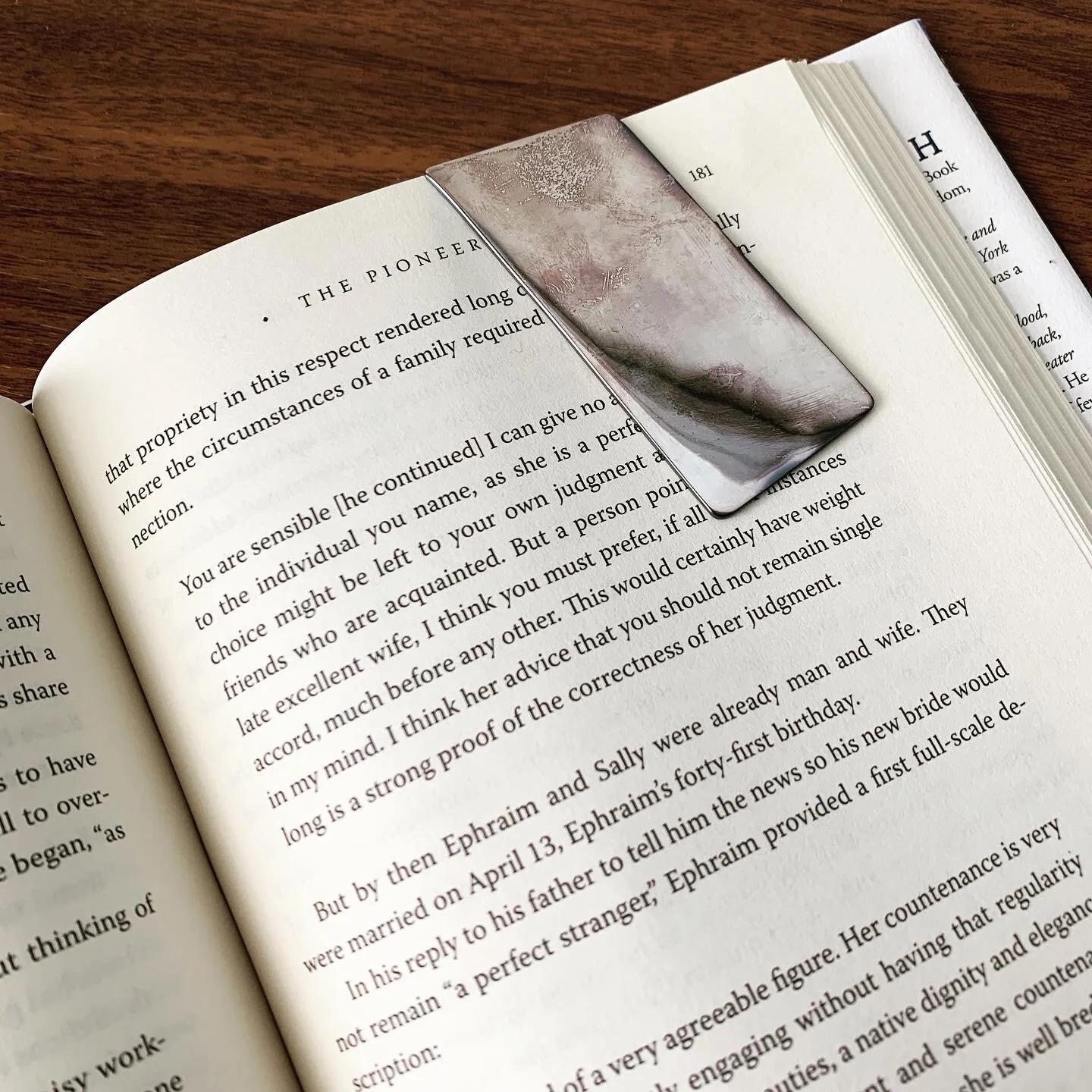
If you follow me on Instagram, you may have read a recent post in which I talk about reading, and how it’s probably my second-most obsessive hobby other than pens. In all honesty, both are better described as a lifestyle more than a hobby - you tend to embrace the analog side of things wholesale or you don’t. For example, in addition to all the pens, notebooks, and writing pads I have scattered around my house, there are also hundreds of bookmarks stuck in cups or tucked into books that I’ve either read or am in the process of reading.

WMS&Co-Folded-Book-Weights

When I first had the (admittedly crazy) idea to launch the T.G.S. Curated Shop last year, one thing I felt very strongly about was trying to merge these two passions together in some way - not to be just another pen and stationery retailer, but to offer carefully selected reading accessories and other items that would be of interest to those who maintain a strong analog presence in their life.

To this end, I’m happy to introduce the following brands to The Curated Shop: WMS & Co, who make these very nice folded metal book weights and sterling silver page points, perfect for holding your hardcover book or journal open while you read or write; and Book Darts, a longtime favorite brand of mine who were kind enough to collaborate with me on these special edition T.G.S. tins. Of course, these all pair perfectly with the Write Notepads Classic Hardcover Notebook, now back in stock in all three colors.

Many thanks for your support!

In Updates Tags TGS Curated Shop, WMS & Co, Book Darts, Write Notepads
Comment

How To Choose The Best Pen For You

June 13, 2020

By far, the most common question I receive through the website and via social media DMs is "I want to buy my first nice pen. What kind of pen should I buy?" It's also one of the most difficult question to answer, because it depends on so many variables: personal aesthetic preferences, how you plan to use the pen, and of course, your budget. I firmly believe that if you're going to buy a pen that you will use everyday, it's worth it to take some time, carefully consider the purchase, and spend what you need (and can comfortably afford) to get the right tool that actually works for you. Don't set your heart on an expensive fountain pen simply because other people think fountain pens are the only option for "real" pen enthusiasts. For many people, ballpoints, rollerballs, and gel pens are infinitely more practical solutions, and you can find great pens of all types at every price point.

When considering a purchase, I'd encourage you to ask yourself the following questions. If you choose wisely, you'll get years of enjoyment from your new companion.

What Type of Writing Do You Do?

Are you writing mostly at a desk, where ink can take time to dry and things like water resistance are less important? If so, you probably have a lot of flexibility. Or do you spend your days "in the field," jotting down notes in a pocket notebooks or otherwise writing while standing up? Then it might be hard for you to use a fountain pen, especially one that you have to cap/uncap one-handed while simultaneously holding a notebook or a clipboard. When I'm away from my desk, I find myself reaching more and more for a ballpoint pen, gel pen, or a woodcase pencil, which are not only easier to deploy but also withstand things like rain and coffee rings.

Are You Right or Left Handed?

For lefties, choosing the proper pen can be tricky, depending on how you hold the pen and whether you tend to smudge ink that doesn't dry quickly enough. Many fountain pen inks can take as long as a minute to dry, and even more if you use slick paper. I'm right-handed, but the other two members of my household are southpaws. One is an "underwriter" who can use pretty much any pen comfortably, including fountain pens. The other can't, and sticks to ballpoints and quick-drying gel pens. For lefty-related questions, I would refer you to Ana over at the Well-Appointed Desk, who has published a wealth of helpful information on considerations for left-handed writers.

Do You Have a Favorite Type of Paper?

Some people absolutely love Field Notes, Moleskines, composition books, and yellow legal pads, or want the flexibility of being able to use whatever their office stocks in the supply closet or printer. The problem is, most fountain pens and many rollerballs tend to feather and bleed through most thin or inexpensive paper, leaving you with ballpoint, gel pens, or even pencil as your most plausible "cheap paper" options.

Writing with a fountain pen or rollerball will likely force you to more carefully consider your paper choices. Clairefontaine, Rhodia, Leuchtturm, and house favorite Write Notepads all make excellent and more widely available paper that handles water-based ink quite well, but the paper may be more expensive than what you are used to. If you churn through lots of notebooks or legal pads, this is something to keep in mind.

For additional guidance on all things paper, check out my recent five part series, "The Best Paper for Everyday Writing," in which I discuss Hardcover Notebooks (Part I), Softcover Notebooks (Part II), Spiral Notebooks (Part III), Pocket Notebooks (Part IV), and other things like pads, notecards, and looseleaf paper (Part V).

A fountain pen requires more cleaning and maintenance than a rollerball, ballpoint, or gel pen, but would you really miss out on the hundreds of colors offered by brands like Diamine?

Is "Low Maintenance" Important to You? How Do You Feel About Filling a Pen from an Ink Bottle?

It doesn't get much easier than popping a new refill into a ballpoint, rollerball, or gel pen once the old one runs out of ink. If you value convenience and refill availability above all else, these are obvious choices. The downside is that you miss out on the range of colors available to fountain pen users, especially those willing to fill from an ink bottle! Sure, ink can make a mess, and I've stained my share of clothes, carpet, and desktops, but there's something timeless and almost meditative about taking the time to clean and re-ink a fountain pen that I would never give up.

Are You Prone to Losing Things?

If so, consider a nicer "disposable" pen, or, if you want to keep pens out of the landfill, an inexpensive pen that still gives you the option of refilling. Platinum's "Preppy" fountain pen is a serviceable writer that costs less than $5 and uses Platinum ink cartridges. Similarly, the Pokka Pen ballpoint was conceived after the owner tired of losing expensive Fisher Space Pen "bullet" pens. You get the same compact functionality in a disposable pen that can still be refilled if you wish. Personally, I don't worry too much about losing my nicer pens. I've always found that if I spend at least a little more money I'm more conscientious about the purchase and less likely to misplace or damage it. I've been in the pen hobby for nearly 10 years, using a LOT of pens, and I think the value of pens I've lost over that time is well under $100.

The Lamy Safari ballpoint offers an excellent (and versatile) writing experience that you can find for less than $20.

What’s Your Budget?

Of all the considerations on this list, price is the least important. Excellent pens exist at every price point, and just because you might have less than $20 to spend doesn't preclude you from getting a good pen that meets your needs, especially if you're willing to consider a ballpoint. I recently reviewed the Lamy Safari ballpoint, and Fisher Space Pen makes a wide range of products to hold their excellent pressurized refills. What I would encourage, however, is to spend as much as you can comfortably afford to get a pen that actually meets your needs. Chances are, you'll be happier with the purchase and won't be as tempted to "try more pens" to find something better.

I maintain a list of "Best Pen" recommendations that I update annually, with pen recommendations at a variety of price points. Also, TGS has more than four years of archived content, including reviews, lists, and guides focused pens and stationery for all budgets.

I hope you've enjoyed this article. If you have further questions about a pen you're considering, please don't hesitate to drop a question in the comments, using the "Contact Me" link, or directly emailing me at joe(at)gentlemanstationer.mom. Thanks for reading!

Disclaimer: Please be advised that many of the links to purchasing options here and elsewhere on the site are to paid sponsors and affiliates, and in certain cases my own Curated Shop, which is how I support the site and keep things running.

In Editorial Tags Choosing a Pen, Best Pens 2020, Editorial
3 Comments

Platinum’s “Slip & Seal” inner cap, shown here in the 3776 “Oshino” demonstrator.

Platinum Slip & Seal Cap: What Is It and Does It Work?

June 10, 2020

As Platinum pens become increasingly popular outside of Japan, I get more questions regarding this pen company’s sometimes quirky marketing. For example, Platinum emphasizes “Slip & Seal” technology that supposedly prevents ink from evaporating in a pen that sits unused for long periods of time. The claim used to be that the pen would still write after a year of sitting idle, and while Platinum seems to have walked this back to “three to six months,” you still see “Slip & Seal” mentioned everywhere, including in Platinum’s new mid-range Procyon that I reviewed back in January.

Two pens that feature Slip & Seal technology: The Platinum 3776 (shown on the left in the “Oshino” demonstrator model), and the Procyon (right).

How Does Platinum’s Slip & Seal Technology Work?

For a detailed, illustrated explanation, check out the Luxury Brands USA website. (Luxury Brands is Platinum’s U.S. distributor, and their website contains a wealth of information regarding the various Platinum models). The short version is that the Slip & Seal mechanism uses a spring-loaded inner cap that seals against the body when the pen is capped, creating an “airtight” seal. Platinum incorporates the Slip & Seal technology into both the Procyon and the 3776, both of which are screw-cap pens.

Pens from left: Platinum Procyon, Preppy, and Plaisir. Writing samples in this review done on Write Notepads Copper Anniversary Edition Pocket Notebooks.

As I mentioned in my Procyon review, I’ve never paid much attention to the “Slip & Seal” claims. I don’t ink pens and leave them unused for months, at least not intentionally. But I was curious. So I decided to set the Procyon aside for a while and compare any ink evaporation to a Preppy and Plaisir that I keep inked on my desk, neither of which feature the screw-cap Slip & Seal technology. As it turns out, the mechanism definitely works. After six months of non-use, the ink cartridge in the Procyon showed little, if any, evaporation, and the pen wrote perfectly. Compared against the Preppy and Plaisir, the difference was notable.

After 8 months to a year (not sure exactly when I last inked these pens), the Platinum Preppy and Plaisir both showed greater signs of ink evaporation. While these two pens don’t have the exact same mechanism as the 3776 or the Procyon, they still utilize an inner cap system that does an excellent job of keeping the pens functional.

The cartridge in the Procyon, on the other hand, had little to no ink evaporation after six months. Nearly all of this ink was spent writing.

All three pens wrote immediately, though the ink in the Preppy and Plaisir was definitely more concentrated from evaporation and had a bit of a “gummy” feel to it.

The Big Question: Does Slip & Seal Add Value?

Who should care about Slip & Seal? Obviously, if you have a pen that you only use infrequently, such as a music nib used for signatures on documents, or a ultra-extra-fine (UEF) nib that you use to make very small annotations and takes forever to go through ink, something like this could be quite helpful. Also, if you use iron gall and pigmented inks, which can clog and even corrode nibs and feeds if left in pens for long periods of time, you want to minimize the potential for evaporation that would cause these inks to become overly concentrated. (Note: Platinum sells both iron gall and pigmented inks in their lineup. I have no idea whether this had anything to do with the development of Slip & Seal, but it’s a fair question.) One thing I don’t know is whether the Slip & Seal technology is equally as effective with converters as it is with Platinum’s cartridges. While the cartridge is a solid piece of plastic, the converter is not, and creates multiple opportunities for air to enter and accelerate evaporation.

Overall, I’m not sure whether Slip & Seal adds value to the pen for the majority of people, but given how it performed in my Procyon, I’m glad it’s there. While Platinum has long marketed the Slip & Seal technology with their flagship 3776 line, I personally find it most useful in a less expensive pen like the Procyon, which I would be more inclined to ink with a cartridge and leave at the office or in a place where I might need to make quick notes from time to time and not use on a daily basis. At the end of the day, Slip-and-Seal may not be a feature that would specifically draw me to Platinum and cause me to purchase a 3776 or Procyon over a pen from another brand, but I do like having the feature and would characterize it as a “plus.”

All Platinum Pens pictured in this review can be purchased at most Platinum retailers, including site sponsors Pen Chalet, Vanness Pens, and Goldspot.

In Pens Tags Platinum Pens, Platinum Procyon, Slip & Seal, Fountain Pen
3 Comments

This Just In: CW&T Pen Type-A and Pen Type-B in The Curated Shop!

June 9, 2020

I mentioned that I would be receiving additional stock for The Gentleman Stationer Curated Shop, and it all arrived at once! Currently in the shop are the CW&T Pen Type-A and Pen Type-B, both of which feature a minimally machined design - no visible branding - plus a completely “over-engineered” pneumatic-fit sleeve. Best part? Both pens are designed to hold the Pilot Hi-Tec-C, and each pen ships with a black .3mm needle tip gel refill. Pricing starts at $160 for the Brass+Stainless Steel Pen Type-B and the bead-blasted stainless Pen Type-A, with titanium pens (including a sweet Black Cerakote version) priced slightly higher. The fit and finish on these pens look outstanding.

The pneumatic-fit sleeve on the Pen Type-A doubles as a ruler/straightedge, while the Pen Type-B is a cylinder intended for pocket carry.

As you may have seen on Instagram, I’m also stocking select Field Notes editions, as well as the Field Notes Archival Wooden Box. After 48 hours, I only have one of these boxes left before I’ll need to restock. You all are awesome, and I really appreciate your support and patronage!

Remember: Get free shipping on domestic orders over $75, and on international orders over $250, no coupon code necessary!

In TGS Curated Shop Tags TGS Curated Shop, Field Notes, CW&T
Comment
← Newer Posts Older Posts →
Store Hours and Events
Shop T.G.S. Online
Updated 2026 "Best Pens" Guide
No results found
On The Paper Trail: Live In Nashville Event Tickets Now Available!
TGS_25 Roterfaden Restock Notification
Hierarchies of Fountain Pen Friendly Paper

Join Our Patreon!
Subscribe to the TGS E-mail List

Featured Posts

Featured
Everyday-Stationery-Bags
July 25, 2026
What's the Best Everyday Stationery Bag? My Own Considerations and 5 Options for Pen Show Season
July 25, 2026
Read more →
July 25, 2026
Graphilo-Kobeha-Paper.jpg
July 11, 2026
Paper Review: Graphilo by Kobeha
July 11, 2026
Read more →
July 11, 2026
Pilot-Custom-Heritage-92.jpg
June 6, 2026
Workhorse Pens: Pilot Custom Heritage 92 Fountain Pen
June 6, 2026
Read more →
June 6, 2026
The Gentleman Stationer RSS

View Cart

© Digital Divide Media, LLC, 2014-present.

All content is the exclusive property of Digital Divide Media, LLC, d/b/a The Gentleman Stationer, including “The Gentleman Stationer” website and trademark, and should not be reproduced without express written permission.  All rights reserved.

All content containing paid advertising, affiliate links, or sponsored content will be plainly disclosed by a disclaimer when/if featured.

Contact Information

Website Terms and Conditions

Store Shipping Policy and Return Policy

Privacy Policy and Cookie Policy

Accessibility Statement

Powered by Squarespace