• Blog
  • Shop
  • Podcast
  • Resources
  • Archive
  • FAQ
  • About
  • Contact
  • Sign In My Account
Menu

The Gentleman Stationer

  • Blog
  • Shop
  • Podcast
  • Resources
  • Archive
  • FAQ
  • About
  • Contact
  • Sign In My Account

Platinum’s “Slip & Seal” inner cap, shown here in the 3776 “Oshino” demonstrator.

Platinum Slip & Seal Cap: What Is It and Does It Work?

June 10, 2020

As Platinum pens become increasingly popular outside of Japan, I get more questions regarding this pen company’s sometimes quirky marketing. For example, Platinum emphasizes “Slip & Seal” technology that supposedly prevents ink from evaporating in a pen that sits unused for long periods of time. The claim used to be that the pen would still write after a year of sitting idle, and while Platinum seems to have walked this back to “three to six months,” you still see “Slip & Seal” mentioned everywhere, including in Platinum’s new mid-range Procyon that I reviewed back in January.

Two pens that feature Slip & Seal technology: The Platinum 3776 (shown on the left in the “Oshino” demonstrator model), and the Procyon (right).

How Does Platinum’s Slip & Seal Technology Work?

For a detailed, illustrated explanation, check out the Luxury Brands USA website. (Luxury Brands is Platinum’s U.S. distributor, and their website contains a wealth of information regarding the various Platinum models). The short version is that the Slip & Seal mechanism uses a spring-loaded inner cap that seals against the body when the pen is capped, creating an “airtight” seal. Platinum incorporates the Slip & Seal technology into both the Procyon and the 3776, both of which are screw-cap pens.

Pens from left: Platinum Procyon, Preppy, and Plaisir. Writing samples in this review done on Write Notepads Copper Anniversary Edition Pocket Notebooks.

As I mentioned in my Procyon review, I’ve never paid much attention to the “Slip & Seal” claims. I don’t ink pens and leave them unused for months, at least not intentionally. But I was curious. So I decided to set the Procyon aside for a while and compare any ink evaporation to a Preppy and Plaisir that I keep inked on my desk, neither of which feature the screw-cap Slip & Seal technology. As it turns out, the mechanism definitely works. After six months of non-use, the ink cartridge in the Procyon showed little, if any, evaporation, and the pen wrote perfectly. Compared against the Preppy and Plaisir, the difference was notable.

After 8 months to a year (not sure exactly when I last inked these pens), the Platinum Preppy and Plaisir both showed greater signs of ink evaporation. While these two pens don’t have the exact same mechanism as the 3776 or the Procyon, they still utilize an inner cap system that does an excellent job of keeping the pens functional.

The cartridge in the Procyon, on the other hand, had little to no ink evaporation after six months. Nearly all of this ink was spent writing.

All three pens wrote immediately, though the ink in the Preppy and Plaisir was definitely more concentrated from evaporation and had a bit of a “gummy” feel to it.

The Big Question: Does Slip & Seal Add Value?

Who should care about Slip & Seal? Obviously, if you have a pen that you only use infrequently, such as a music nib used for signatures on documents, or a ultra-extra-fine (UEF) nib that you use to make very small annotations and takes forever to go through ink, something like this could be quite helpful. Also, if you use iron gall and pigmented inks, which can clog and even corrode nibs and feeds if left in pens for long periods of time, you want to minimize the potential for evaporation that would cause these inks to become overly concentrated. (Note: Platinum sells both iron gall and pigmented inks in their lineup. I have no idea whether this had anything to do with the development of Slip & Seal, but it’s a fair question.) One thing I don’t know is whether the Slip & Seal technology is equally as effective with converters as it is with Platinum’s cartridges. While the cartridge is a solid piece of plastic, the converter is not, and creates multiple opportunities for air to enter and accelerate evaporation.

Overall, I’m not sure whether Slip & Seal adds value to the pen for the majority of people, but given how it performed in my Procyon, I’m glad it’s there. While Platinum has long marketed the Slip & Seal technology with their flagship 3776 line, I personally find it most useful in a less expensive pen like the Procyon, which I would be more inclined to ink with a cartridge and leave at the office or in a place where I might need to make quick notes from time to time and not use on a daily basis. At the end of the day, Slip-and-Seal may not be a feature that would specifically draw me to Platinum and cause me to purchase a 3776 or Procyon over a pen from another brand, but I do like having the feature and would characterize it as a “plus.”

All Platinum Pens pictured in this review can be purchased at most Platinum retailers, including site sponsors Pen Chalet, Vanness Pens, and Goldspot.

In Pens Tags Platinum Pens, Platinum Procyon, Slip & Seal, Fountain Pen
3 Comments

This Just In: CW&T Pen Type-A and Pen Type-B in The Curated Shop!

June 9, 2020

I mentioned that I would be receiving additional stock for The Gentleman Stationer Curated Shop, and it all arrived at once! Currently in the shop are the CW&T Pen Type-A and Pen Type-B, both of which feature a minimally machined design - no visible branding - plus a completely “over-engineered” pneumatic-fit sleeve. Best part? Both pens are designed to hold the Pilot Hi-Tec-C, and each pen ships with a black .3mm needle tip gel refill. Pricing starts at $160 for the Brass+Stainless Steel Pen Type-B and the bead-blasted stainless Pen Type-A, with titanium pens (including a sweet Black Cerakote version) priced slightly higher. The fit and finish on these pens look outstanding.

The pneumatic-fit sleeve on the Pen Type-A doubles as a ruler/straightedge, while the Pen Type-B is a cylinder intended for pocket carry.

As you may have seen on Instagram, I’m also stocking select Field Notes editions, as well as the Field Notes Archival Wooden Box. After 48 hours, I only have one of these boxes left before I’ll need to restock. You all are awesome, and I really appreciate your support and patronage!

Remember: Get free shipping on domestic orders over $75, and on international orders over $250, no coupon code necessary!

In TGS Curated Shop Tags TGS Curated Shop, Field Notes, CW&T
Comment

First Impressions: Montblanc 149 Fountain Pen

May 31, 2020

I debated whether to frame this post as a “First Impressions” piece or a full review. In the end, I went with “First Impressions,” because the Montblanc 149 is such an iconic pen that I inevitably will revisit it at some point in the future. I’ve used a Montblanc 146 for years, and while that pen now maintains a perpetual spot in my rotation as a true “workhorse” fountain pen, my appreciation for it has certainly grown over time.

Initial Impressions

What strikes everyone at first is the size of the Montblanc 149. You ask yourself, “Can I actually use this pen as an everyday writer?” I’ve written with large fountain pens before, but the Montblanc 149 takes things to another level, at least visually. While the size can be intimidating, you’re also struck by the pen’s beautiful design and proportionality. Though large, it doesn’t appear awkward, like many of the giant oversized fountain pens other pen companies have released in recent years. As I’ll discuss in further detail below, it’s actually quite a comfortable writer.

IMHO, the “Snowcap” looks best on the 149’s oversized cap.

Here, I also opted for Montblanc’s rose gold trim, for the first time ever. I’ve recently written on how pens with rose gold hardware (clips, cap bands, and even nibs) are a new thing for me, and this particular pen was the one that started the trend back in January. The rose gold that Montblanc uses has much more of a reddish hue, as opposed to the pinkish tint you often see, and the effect is subtle. In certain lighting you may have a hard time distinguishing this trim from the standard Montblanc gold trim, but the difference is definitely there.

The Nib and Overall Writing Experience

I noted above how some oversized fountain pens are truly sold as nothing more than objets d’art or status symbols, meaning they are so (comically?) large that unless you have Hulk hands, you’re not going to be using them for actual writing. The Montblanc 149 is not one of those pens. Though initially skeptical, I’m now convinced that the 149 may actually be one of the better pens available for longer writing sessions. That doesn’t mean if you’re accustomed to writing with slimmer writing instruments there won’t be an adjustment period.

Don’t knock it ‘til you’ve tried it: the larger nibs on bigger fountain pens like the Montblanc 149, Montegrappa Extra 1930, and from what I’ve heard, the Sailor King of Pen, all offer a uniquely smooth writing experience.

While I haven’t been able to locate confirmation on its exact size, this handmade 18k gold nib appears to be a No. 8 on par with those fitted to larger flagship pens from Pelikan and Montegrappa. It’s a beautiful piece of work. As I noted in a recent article on stubbish stock nibs, I opted for a broad, which I consider effectively a stub. The nib writes a smooth, wet line with plenty of variation, and isn’t so broad that it can’t be used for regular writing. You may not be able to use this nib to write in your calendar, but at least in my experience, it’s glorious for journaling and perfectly adept at notetaking.

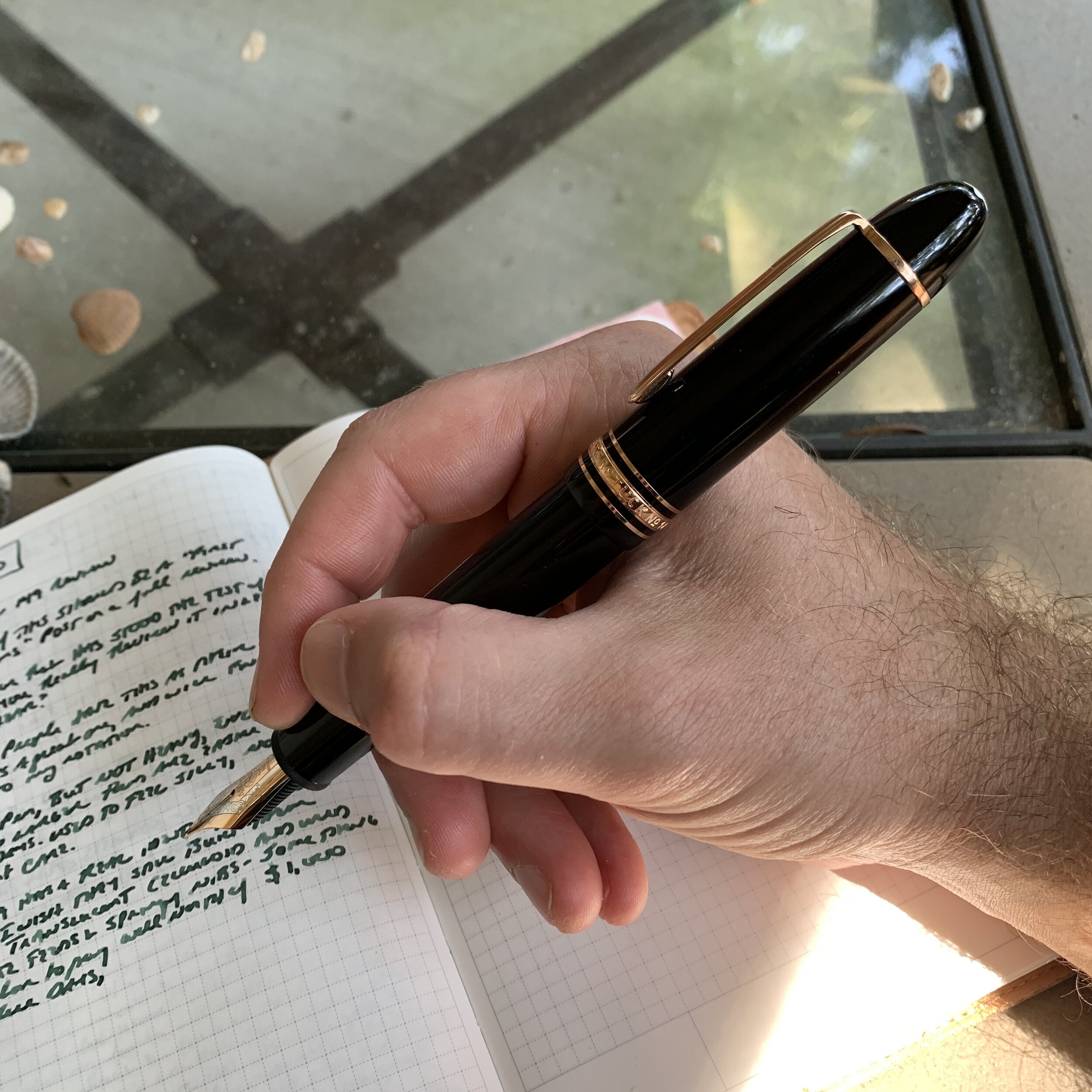
View fullsize Montblanc 149 Unposted
View fullsize Montblanc 149 Posted

First impressions aside, the Montblanc 149 turned out to be surprisingly lightweight for its size. Though the body contains a high-capacity piston filler, the filling system doesn’t add much weight and I can easily use this pen posted or unposted. One thing I’m learning is that after a period of adjustment in which I sometimes have to alter my grip, larger pens are quite comfortable to write with for long periods of time, provided the weight of the pen doesn’t sit too far back. The balance on the 149 is perfect for me, to the point where I can easily post this pen. As you write with it, your (or at least my) hand quickly becomes accustomed to the size, something I’ve struggled with on the larger Pelikan models (M800 and M1000) which incorporate what feels like a heavier piston.

Takeaways and Where to Buy

Though I haven’t owned this pen for longer than a few months, I’m confident the Montblanc 149 will find a place alongside its sibling, the 146, in my core rotation. The 149 is a luxury icon that represents the best of what Montblanc has to offer, if you can afford the steep price. Fortunately, Montblanc pens can be found on the secondary market, often in like new or barely used condition, for a significant discount, and I typically hunt for Montblancs at pen shows, in retailers’ “gently used” sections, or during Fountain Pen Day or “Black Friday” promotions.

I placed an order for this pen during Fontoplumo’s Black Friday sales event, and while the pen took a while to arrive, I’m loving the purchase. Currently, Fontoplumo retails this pen for 810 Euros, which roughly equates to $900 US, though after VAT the European retail price ends up being lower than what you would pay at a Montblanc boutique in the States. Taking advantage of a promotion can knock a bit more off the price, and I’ve seen secondhand 149 fountain pens in very good condition priced as low as $500-600. In any event, I think Montblanc gets a bad rap for its pricing structure, and much of the snide commentary about the brand is better directed at Montblanc’s ubiquitous - and sometimes annoying - lifestyle marketing rather than the value proposition of its pens. Even at full retail, the pricing on the 149 is comparable to that on a Sailor King of Pen and Pelikan M800, and less than the pricing on a Montegrappa Extra 1930 or Pelikan M1000.

Disclaimer: I purchased this pen with my own funds, for my own personal collection. I was not compensated in any way for this post, and did not receive a discount on the pen other than what was available via standard promotions at the time of purchase.

In Pens Tags Montblanc 149, Montblanc, Fountain Pen, Pen Review
11 Comments

Updating Prior Reviews: Platinum Curidas Feed Issues and the Diamine Music Set

May 28, 2020

In light of recent news surrounding what sounds like a design flaw with the Platinum Curidas, it’s appropriate for me to take a minute and update my recent review. For those who have not heard, there have been numerous reports of the feeds on the Curidas cracking, and apparently the problem is pervasive enough that Platinum has stopped shipping the pen to retailers while they figure things out. Brad provides a good update on Episode #411: Curious Case of the Curidas Cracking.

What about my Curidas pens? After learning of the issue with the feeds, I closely inspected both of my pens and was pleased to discover the feeds intact, with no signs of cracking. That was Monday morning. Yesterday morning (Wednesday), I checked again, and noticed that the feed on my red pen was split down the middle.

The cracked feed on my red Curidas (right), compared against the normal feed on my green Curidas.

So far, this has not caused any performance issues with the pen. It doesn’t leak, burp ink, hard-start, or show any symptoms that you might typically find in a fountain pen with a damaged feed. Will that change? Who knows. I plan to keep using this pen until it starts causing problems, and hope that Platinum comes up with a fix. I can only assume that some part of the mechanism is too tight, generating pressure on the feed and causing it to crack over time. While design issues are inevitable in a pen this complex, it surprises me that something this basic didn’t show up in Platinum’s prototypes, especially given how prevalent the cracking issue seems to be. It’s a shame, because otherwise I’m really starting to enjoy the Curidas as a daily writer. I’ve kept my two pens inked up since writing my review, and for my grip and writing style, it’s an extremely comfortable pen to use.

Meanwhile, on a Happier Note…

In March I reviewed inks from the Diamine Music Set, which contains 10 inks all “themed” around a different composer. At the time of my initial review, I had used two of the ten: Strauss and Vivaldi. I’ve since inked pens with three more, all of which are excellent. Tchaikovsky (a rich royal blue) and Chopin (a dark grey with blue undertones) easily could serve as daily drivers. Schubert (a darker teal green) has had less time in the pen, but I’m enjoying this color that I wouldn’t typically pick for myself. You can read my full review of the Music Set and see a full set of swabs here.

In News, Pens Tags Platinum Curidas, Fountain Pen, Fountain Pen Inks, Diamine Music Set, Follow-Up
Comment

This Just In: Write Notepads Hardcover Notebooks Available in the Curated Shop!

May 25, 2020

If you’re anything like me, you save your notebooks and journals after filling them up. What if you could have a fountain pen friendly journal that not only handles whatever ink you can throw at it, but looks amazing on the shelf when you’re done? Enter the Write Notepads Classic Hardcover Notebook! This notebook packs 160 pages of premium Write Notepads lined paper into a hardcover format that remains slim and portable.

I currently have a handful of these notebooks in Slate (dark gray), and will restock quickly if they sell well. As a “Memorial Day Special,” orders over $50 from the TGS Curated Shop will not only ship free, but will also include a free pack of TGS buttons and stickers as well as one of each of the great Write Notepads freebies pictured below. Promotion is good for today only and while supplies last! Use the coupon code “FREESHIP” at checkout. Many thanks for your support, and enjoy the long weekend!

UPDATE: You guys are awesome! These are nearly sold out, so it looks like I’ll be reordering after the holiday. In the meantime, the promotion remains good on all other items in the TGS Store, and I forgot to mention that I am also carrying the standard Write Notepads Spiral Notebook with lined paper, in addition to the dot grid version.

These will ship with any Write Notepads Order while supplies last.

In TGS Curated Shop Tags Write Notepads, TGS Curated Shop
1 Comment
← Newer Posts Older Posts →
Check Out Our New Online Shop!
Store Hours and Events
Updated 2026 "Best Pens" Guide
No results found
On The Paper Trail: Live In Nashville Event Tickets Now Available!
TGS_25 Roterfaden Restock Notification
Hierarchies of Fountain Pen Friendly Paper

Join Our Patreon!
Subscribe to the TGS E-mail List

Featured Posts

Featured
10-Fountain-Pens-Favorite-Inks
August 22, 2026
Three Keeper Inks: Choosing Inks for 10 Fountain Pens
August 22, 2026
Read more →
August 22, 2026
Everyday-Stationery-Bags
July 25, 2026
What's the Best Everyday Stationery Bag? My Own Considerations and 5 Options for Pen Show Season
July 25, 2026
Read more →
July 25, 2026
Graphilo-Kobeha-Paper.jpg
July 11, 2026
Paper Review: Graphilo by Kobeha
July 11, 2026
Read more →
July 11, 2026
The Gentleman Stationer RSS

© Digital Divide Media, LLC, 2014-present.

All content is the exclusive property of Digital Divide Media, LLC, d/b/a The Gentleman Stationer, including “The Gentleman Stationer” website and trademark, and should not be reproduced without express written permission.  All rights reserved.

All content containing paid advertising, affiliate links, or sponsored content will be plainly disclosed by a disclaimer when/if featured.

Contact Information

Website Terms and Conditions

Privacy Policy and Cookie Policy

Accessibility Statement

Legacy Account Login

Powered by Squarespace