• Blog
  • Shop
  • Podcast
  • Resources
  • Archive
  • FAQ
  • About
  • Contact
  • Sign In My Account
Menu

The Gentleman Stationer

  • Blog
  • Shop
  • Podcast
  • Resources
  • Archive
  • FAQ
  • About
  • Contact
  • Sign In My Account

The Best Paper For Everyday Writing, Part IV: How Do People Actually Use Pocket Notebooks?

April 19, 2020

As I’m writing this, I realize that I’ve been working from home for more than a month now. The change has been easier on me than some, I imagine, because I tend to work remotely 2-3 days a week under normal circumstances, and of course nearly all of the work I do on TGS happens in my home office. But moving between workspaces regularly can be disruptive, and what happens, in my experience, is that I end up with notebooks, loose notes, electronic documents, books, and other project materials scattered in different locations. What I’ve enjoyed, for a change, is having a single location with a single set of tools that allows me to get a sense of what I’m using, what I’m not, and to further refine preferences. What’s the one thing that’s fallen by the wayside? Pocket notebooks.

The two closest things to true “pocket notebooks” that I’ve been using regularly are the Write Notepads PUR-bound pocket notebooks and the Kunisawa “Find” hardcover notebooks, which I strongly suspect are white-labeled Kokuyo Sketch notebooks. The paper and covers (other than the colors) are nearly identical.

I’ve never been a heavy user of pocket notebooks - at least, I’ve never been able to justify having a subscription. I might go through 3-4 per year. While I always have a pocket notebook on hand, it’s mainly used to keep track of lists, expenses, and random thoughts I have when I’m out running errands or commuting. Now that I’m not doing those things regularly, I lean much more heavily on hardcover or spiral-bound notebooks, as well as reporter-style notebooks for list-making. While I’m sure that I’ll eventually go back to pocket notebooks at some point, the traditional Field Notes-style three-staple notebook will probably never form a core part of my workflow, mainly because I don’t find them durable enough to survive for 3-6 months in pockets, bags, car glove boxes, etc., which is about how long it takes me to use one. Instead, I suspect that I’ll gravitate more towards different forms of stationery that are still portable, but perhaps a bit more versatile in layout and certainly longer-lasting. Here are five pieces of “pocketable” or “portable” stationery that I’ve been using recently, and likely will continue to use going forward.

It’s surprising that what I’ve enjoyed more than anything are reporter-style notebooks, which I find draw on the best of pocket notebook portability and combine it with just the right amount of space to make the format useful for everyday work.

  1. Kokuyo Sketch Hardcover Notebook. I’ve actually been using what looks like a white-labeled version of this notebook from Kunisawa, but I LOVE the long and narrow format, to the point where it might be one of the best pure “utility” notebooks I’ve ever used. Not only is the hardcover extremely durable, but the paper works extremely well with most pens and inks, the grid ruling is versatile, and the longer format perfect for logging things and listmaking.

  2. Write Notepads Reporter Notebook. I’ve become such a huge fan of Write Notepads paper that I’ve basically made it my default “house paper” and even started selling it in the TGS Curated Shop. Their Reporter Notebook has become my default “desk jotter,” sitting to the side of my keyboard when I’m working on the computer and often accompanying me around the house or out on the porch when I need a change of scenery. Reporter’s notebooks are designed to be used standing up, and the sturdy chipboard covers offers more support for actual writing than your standard pocket notebook.

  3. Field Notes “Front Page” Reporter Notebook. Field Notes took one of their limited edition releases, “Byline,” and turned it into a standard item, now called the “Front Page." In terms of reporter notebooks currently on the market, the Field Notes “Frontpage” is well-designed with decent paper, though if you’re a heavy fountain pen user you’ll probably prefer the Write Notepads version.

  4. Write Notepads Pocket Notebook. If I do reach for something that could reasonably be called a true “pocket notebook,” it would be one of the Write Notepads PUR-bound notebooks. The covers tend to hold up better over time than Field Notes, and the binding holds more pages than your typical three-staple variety. The current “Copper Anniversary Edition” contains exceptional fountain pen friendly paper. Less than $12 for a three-pack of notebooks of this quality make these a steal, IMHO.

  5. Nock Co. DotDash Spiral Pad / Write Notepads Dot Grid Steno Pad. If you need more space for writing than a pocket or reporter’s notebook can offer, consider a steno pad. Both Nock Co. and Write Notepads offer quality, durable steno pads containing good paper with a versatile ruling. While I wouldn’t stay that I use steno pads regularly, I keep a stash of them on hand because they make excellent notebooks for thinking and doodling.

When you need more space to work than what a pocket or reporter’s notebook can offer, but still need to maximize portability, consider a steno pad (shown here compared against a Write Notepads reporter notebook on the left).

Takeaways and Further Reading

Going forward, the bulk of my “portable writing” will likely take place in some combination of the Kokuyo Sketch and the Write Notepads Reporter Notebook, though I’ll maintain at least one traditional pocket notebook to carry in my pocket or glove box once things return to a semblance of normalcy. While the first two items on this list represent my own personal preference, any of the five featured here will serve you well in getting actual work done in your day-to-day routine.

Those interested in reading further on the different types of paper I recommend should check out the previous installments of my “Everyday Writers: Best Paper” series, Part I: Best Hardcover Notebooks, Part II: Top Five Slim Softcover Notebooks, and Part III: The Best Spiral Notebooks. I envision this as a five-part series, so stay tuned for the next installment in which I’ll look at legal pads, looseleaf, and other miscellaneous stationery.
Tags Everyday Writers, Best Paper, Top 5, Pocket Notebook
Comment

The Best Paper for Everyday Writing, Part III: The Best Spiral Notebooks

April 16, 2020

Welcome to Part III of my ongoing series, "Everyday Writers: The Best Paper for Everyday Writing," in which I've been taking an extended look at the different types of paper I use in my daily life, with a focus on work. When it comes to office supplies - as in, supplies that actually get used in the office - the traits I value most are (1) versatility and (2) cost effectiveness. You can't get much more versatile or cost effective than the traditional spiral notebook.

Some people love spiral bindings and others hate them. Lefties complain about how the binding gets in the way and hurts their hand, and even righties aren't immune to this problem if, like me, you always write on both sides of the page and wind up with a right-sided binding when you flip the notebook. Personally, the ability to fold the notebook over and easily tear sheets out even if the pages aren't perforated outweighs any inconvenience. I also appreciate the fact that a spiral notebook lays flat and, now that companies have started to make notebooks in "landscape" orientation, can fit perfectly underneath the keyboards most of us use for our daily work.

I use both the A4 and A5 Clairefontaine notebooks, which feature a sturdy wire binding and relatively durable covers. Clairefontaine’s thicker paper also stands up better to the wear and tear of a spiral binding, and I’ve noticed fewer sheets coming loose over time.

Because they aren't designed to look nice on a bookshelf, spiral notebooks also tend to cost less than hardcovers (though decent paper will still be much more expensive than the $0.25 drugstore notebooks we used in school). While you do sacrifice durability and a nicer appearance, I tend to use my spiral notebooks for tasks that require “disposable” paper: brainstorming, testing pens, jotting review notes, and - for the day job - notes that may need to be torn out and shredded for confidentiality purposes. If you use your notebooks in the same way I do, this paper doesn't need to be the most fountain-pen friendly, further helping to reduce cost, and both Doane Paper and Studio Neat make excellent spiral notebook options if you can tolerate a little bit of bleedthrough with wider nibs and/or wetter inks.

  1. Clairefontaine Side Wirebound Notebooks. In terms of versatility, my longtime favorite spiral notebook comes from French paper company Clairefontaine. Before they were widely available in the United States, I used to lug suitcases full of these notebooks back from France whenever I visited, which would be enough to get me through the year or two between trips. These spiral notebooks are available in A4, A5, and B6 sizes, as well as in single or 4-subject format. While I prefer the Seyes or "French" ruling, Clairefontaine also makes graph and lined paper. Those looking for dot grid will have to go with Write Notepads or Rhodia.

  2. Write Notepads Spiral Notebooks. Last year, Write Notepads revamped their spiral bound notebook offerings to include more fountain pen friendly paper, which is among some of the best I've used. I also appreciate the more subdued cover design, which not only makes these exceptional notebooks to use at the office but strongly resembles something you would see in a midcentury office supply closet - and that's a good thing! Write Notepads makes a dot grid version, and also added a lined "Landscape" notebook that fits well in the space on your desk below the keyboard.

  3. Rhodia Spiral Notebooks. Over the years, Rhodia seemingly has replaced Clairefontaine as the "standard" fountain pen friendly paper recommendation. And the brand has a lot to offer: It's widely available (often found in local art supply stores), relatively inexpensive, and high quality. Personally, while I don't dislike Rhodia, and use their A5 and A4 pads extensively, I find Clairefontaine and Write Notepads paper to be more consistent. I do love that Rhodia makes spiral notebooks with microperforated sheets that can easily be removed.

  4. Doane Paper Idea Journal. Of all the notebooks on this list, the Doane Paper Idea Journal offers the best value proposition, with 100 sheets/200 pages of Doane's signature "Grid+Lines" paper. As remarked above, Doane Paper isn't as suitable for fountain pens as some of the other options on this list, but generally handles fine and extra-fine nibs well enough. The bigger question for many people is whether the somewhat quirky paper ruling meets their needs. Personally, I love it, especially for sketching out flow charts or detailed lists where I want the option to write very small.

  5. Studio Neat Panobook. Finally, this last entry is perhaps the most specialized. Specifically designed to fit beneath an Apple keyboard, Studio Neat’s “Panobook” is a landscape or "panoramic" notebook that's a bit narrower than the Write Notepads version. Since it also features dot grid paper, you can change the orientation of the Panobook and use the notebook vertically, transforming it into an extra-large steno pad or reporter's notebook. Like Doane Paper, the Studio Neat Panobook isn't the most fountain-pen friendly option out there, but if you're judicious with the nibs and ink you use, it should be workable.

I really wish every notebook came with the option of French or Seyes-ruled paper. You can check out my full review here.

Takeaways and Further Reading

If I had to stock my office with two choices, they would be the A5 Clairefontaine French-ruled notebook and the Write Notepads dot grid spiral, because the paper works the best for my style of writing. I love these two versatile rulings, and not only does the paper in both notebooks handle pretty much any fountain pen nib or ink, but it also works well with rollerballs, gel pens, ballpoints, and, of course, pencils. With perforated pages, they would be absolutely perfect, but I guess you can't have it all.

If you haven’t already, don’t miss the first two installments of my “Everyday Writers: Best Paper” series, Part I: Best Hardcover Notebooks, and Part II: Top Five Slim Softcover Notebooks.

In Top 5, Notebook Review Tags Everyday Writers, Paper, Spiral Notebook, Write Notepads, Clairefontaine, Rhodia, Doane
3 Comments

My Diamine Flowers Ink Set arrived this week!

Sunday Reading for April 12, 2020

April 12, 2020
  1. Simple Pleasures (via UK Fountain Pens). Great post from Anthony, who is still managing to put out thoughtful content despite his blog being “dormant.” You don’t need to post every day, or even every week, to be successful at this stuff, IMHO, and UK Fountain Pens is a prime example of that. I’ve also been struggling a bit, not only balancing time online and offline, but with finding time to enjoy this community (as well as writing this blog) since it now involves even more screen time.

  2. Re-thinking Ink Samples: The Col-o-ring “Dipper” (via Inkpothesis). Ana come up with yet another way to quickly and easily sample inks! Check out this review of the latest Col-o-ring release.

  3. A Few Analog Collections (via C.W. Pencil Enterprise). What are some of your non-pen analog collections? My big ones are books and analog music (CDs and Vinyl Records, mainly) but I also have a think for bookmarks, which I started collecting unintentionally. I was cleaning/inventorying my office for the first time in years and I think I have over a hundred.

  4. Small Business Saturday (via Mountain of Ink). I wholeheartedly endorse this effort. If your current situation allows, it’s more important than ever to support the small businesses in our community.

  5. Curidas.3.Analysis (via Cronicas Estilograficas). Now that the Curidas has finally shipped, reviews are starting to trickle out. I have a couple of Curidas pens on the way and look forward to actually seeing these in person.

  6. Springtime for Van Gogh: Visconti Van Gogh Orchard in Blossom Fountain Pen and Rollerball (via Penquisition). The Van Gogh Series has long been among my favorite releases from Visconti, probably because the Van Gogh pens are among the least “over the top” designs in the company’s lineup. It also helps that I like Van Gogh’s work, and rose gold trim.

  7. Diamine Inkvent Blue Edition (via Writing at Large). Many were speculating that Diamine would release the inks from their “Inkvent” calendar as stand-alone editions, and here they are! I need to be sure to get in on the Inkvent calendar next year - fingers crossed they’ll do it again - because it turned out to be quite a good idea.

  8. Forever Inks (via UK Fountain Pens). Another awesome idea from Anthony. Most of us probably have quite a stash, but what are your “Forever Inks”?

  9. What’s the Best Eraser? CWPE Investigates - Round 2 (via C.W. Pencils). Ok, I might have an unintentional eraser collection as well. Though the C.W. Pencils shop is currently closed (both brick-and-mortar and online), they are releasing some great online content.

  10. Postcards from the Edge (via From the Pen Cup). It’s hilarious how so many of us have the same habits. I do the exact same thing with postcards. As did my Dad. I still have his collection of unused postcards dating back to the 60s.

In Case You Missed It…

This week on the blog I published a follow-up where I swatched the entire Diamine Music and Diamine Flower ink sets. I also wrote a short piece about a question that’s been bugging me - the speculated replacement of the TWSBI 580 in favor of TWSBI’s ever-expanding ECO lineup, and whether it would be a good idea for TWSBI to phase out its original flagship pen. Of course, I think that would be a bad idea as I love the 580, as do many of you who have reacted to the post. Finally, this week’s Deals & Drops highlights a new series of “Office” inks from Colorverse, the Platinum Star Wars pens, and some great Nuuna notebooks from Vanness, among other things.

Don’t forget, yellow and midnight blue Pokka Pens are back in stock in the TGS Curated Shop, along with the Pokka Pen Clip. I also have a wider range of Write Notepads paper than I had available for purchase at the Baltimore Pen Show, and still have a handful of “Everyday Writers” Ink Sample Packs, and of course TGS Swag Packs and Sticker Packs.

Please Visit and Support My Sponsors and Affiliates!

Please take a moment to visit my sponsors and affiliates, who help keep the blog going. It's next to impossible to maintain a steady stream of fresh review content without some form of sponsorship or affiliate relationship, especially with a passion like pens that can easily empty your wallet. When you shop these links and support TGS sponsors and affiliates, you support the blog, and I appreciate all the help I can get! As a bonus, you will be aiding these businesses during what is sure to be a difficult time in the coming weeks and months.

Consider Joining the TGS Patreon Program!

For those of you interested in supporting the site and gaining access to some supplemental content and offers, check out the link to the Patreon page above and on the sidebar. Benefits of Patreon membership include early access to the “Gently Used” sale, a progressive discount code for any items sold through TGS (depending on your tier of support), and access to exclusive discounts and special offers through my sponsors. The current quarterly sale is ongoing, and there are still pens, inks, and pen cases available. The sale will open up to non-Patreon members at the end of the month.

Happy Sunday, and as always, thanks for reading!

Disclaimer: This post contains links to paid sponsors and affiliates.

In LInks Tags Links
Comment

Workhorse Pens: The Case for the TWSBI 580 and the TWSBI 580AL/ALR

April 11, 2020

For a reliable, low cost workhorse fountain pen, you can’t go wrong with any TWSBI. From the original TWSBI 530 to the modern 580, 580AL or 580ALR, ECO, Mini, Vac, Vac Mini, and GO, TWSBI has seemingly perfected the art of making interesting pens with different filling mechanisms at a wide range of price points. I’ve long been a fan of the brand. Even years ago, when TWSBI still suffered from periodic quality control issues, I was willing to give them multiple chances because I believed in their goal: to create a well-made piston filler that could be sold at an accessible price well below $100. Though it took several years of experimenting, the company eventually struck the right balance between cost and quality before finalizing the design of the current model 580, which has not changed in recent years other than to add anodized aluminum accents (i.e., the TWSBI 580AL and 580ALR).

But then came the ECO, an even less expensive piston filling fountain pen with a new rounded barrel that not only decreased manufacturing cost but also eliminated what many suspect were the culprits that caused stress cracking on early renditions of the 580: the “diamond” facets. At only $30, it’s indisputable (to me at least) that the TWSBI ECO is the best “pound-for-pound” piston filler on the market, earning the top spot on my list of Best Fountain Pens for Beginners. While TWSBI originally released the ECO only in black or white, you can now purchase a clear demonstrator, a version with a triangular Safari-like grip (the TWSBI ECO-T), as well as limited edition colors that rotate throughout the year. TWSBI clearly has invested in expanding the ECO segment of its business.

What Does the ECO Mean for the TWSBI 580?

I’ve read and heard a lot of commentary about how TWSBI’s recent focus on the “ECO” line of fountain pens threatens to cannibalize - if it hasn’t already - the market for its original pen. What does the ECO mean for the future of the TWSBI 580? Should anyone still buy the pen? Is the $25 markup over the ECO justified? My answer to those questions is yes.

TWSBI nibs write a true medium, shown here with TWSBI Blue-Black Ink in a Write Notepads Dot Grid Notebook.

The main feature that the TWSBI 580 offers, which the ECO does not, is an interchangeable nib unit. (Perhaps I should say “easily interchangeable nib,” since technically you can swap the nib on an ECO, you just have to pull the nib manually as opposed to unscrewing a nib unit, and you cannot purchase ECO nibs separately.) If you like to use different nib sizes, and don’t want to own five or six different pens, you can purchase a single TWSBI 580 and an handful of individual nib units. This ability to swap nibs also comes in handy if you want to keep a stock of custom nib grinds, such as cursive italics or architects, and rotate them in and out of the same pen.

There are additional functional and aesthetic differences between the 580 and the ECO. While I’m an ECO fan, I prefer the feel of the original 580. The 580 has the heft of a Pelikan piston filler, and although you can’t post the pen, it has excellent balance and a massive ink capacity, suitable for an all-day (or all-week) marathon writing session. If the ability to post a pen is important to you, consider the TWSBI Mini, which has a smaller ink capacity but actually extends to a slightly longer writing length than the standard 580.

Of all TWSBI pens, the Diamond Mini is my favorite to use posted.

Aesthetically speaking, I also prefer the look of the 580 over the ECO. While I don’t dislike the ECO, the oversized, faceted cap will certainly stand out more in a professional environment, which I sometimes have to consider. The standard TWSBI 580 demonstrator, or the TWSBI 580ALR in Nickel, makes for a better “office pen”, at least for my particular workplace.

As much as the ECO’s funky looking cap has grown on me, it’s still a touch “out there” for the office, and the pen itself is a bit long posted.

Takeaways and Final Thoughts

I don’t subscribe to the idea that TWSBI should replace the 580 with the ECO. While the ECO is an excellent pen in its own right, it is a different pen, both in terms of design and functionality, and to be honest, the 580 offers the look and feel a much “higher-end” fountain pen at a mere $25 markup over the ECO. Combined with the 580’s interchangeable nib, that is more than enough justification to keep both pens in TWSBI’s lineup.

At the same time, I do wonder whether there is a rationale for discontinuing the TWSBI 580ALR limited editions. I don’t know how many of these pens TWSBI makes in each run, but with interchangeable nibs, it’s harder to justify owning more than one 580, and at $30 the ECO makes for an easier “catch ‘em all” purchase. Since we’re seeing more of a focus on ECO variants and limited editions, this may be where things are headed.

I’ve written full reviews of both the TWSBI 580 and the TWSBI Eco over the years, and both are fixtures on my “best pens” recommendations lists. Check out those reviews for a more in-depth discussion of specs and details of each pen. UPDATE: As of April 2021, TWSBI pens can be purchased directly from me in the T.G.S. Curated Shop.

Don’t forget to check out TWSBI’s excellent line of inks, especially the standard colors such as Blue and Blue-Black (pictured above). Look for a full review soon.

In Workhorse Pens Series Tags TWSBI, TWSBI Diamond Mini, TWSBI Eco, TWSBI 580, TWSBI Ink, Workhorse Pens
5 Comments

Follow Up: Diamine Music and Flower Ink Sets

April 8, 2020

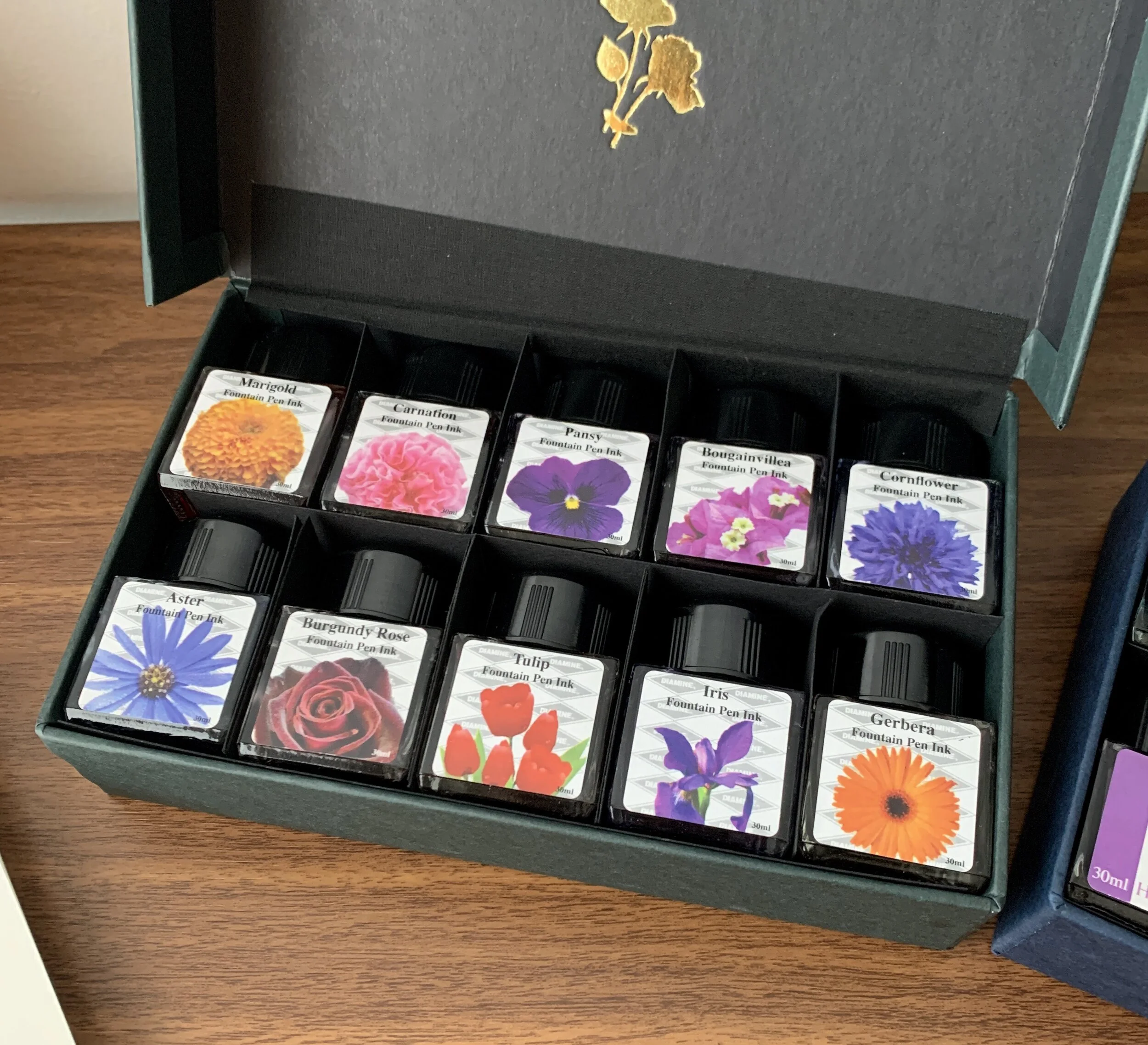
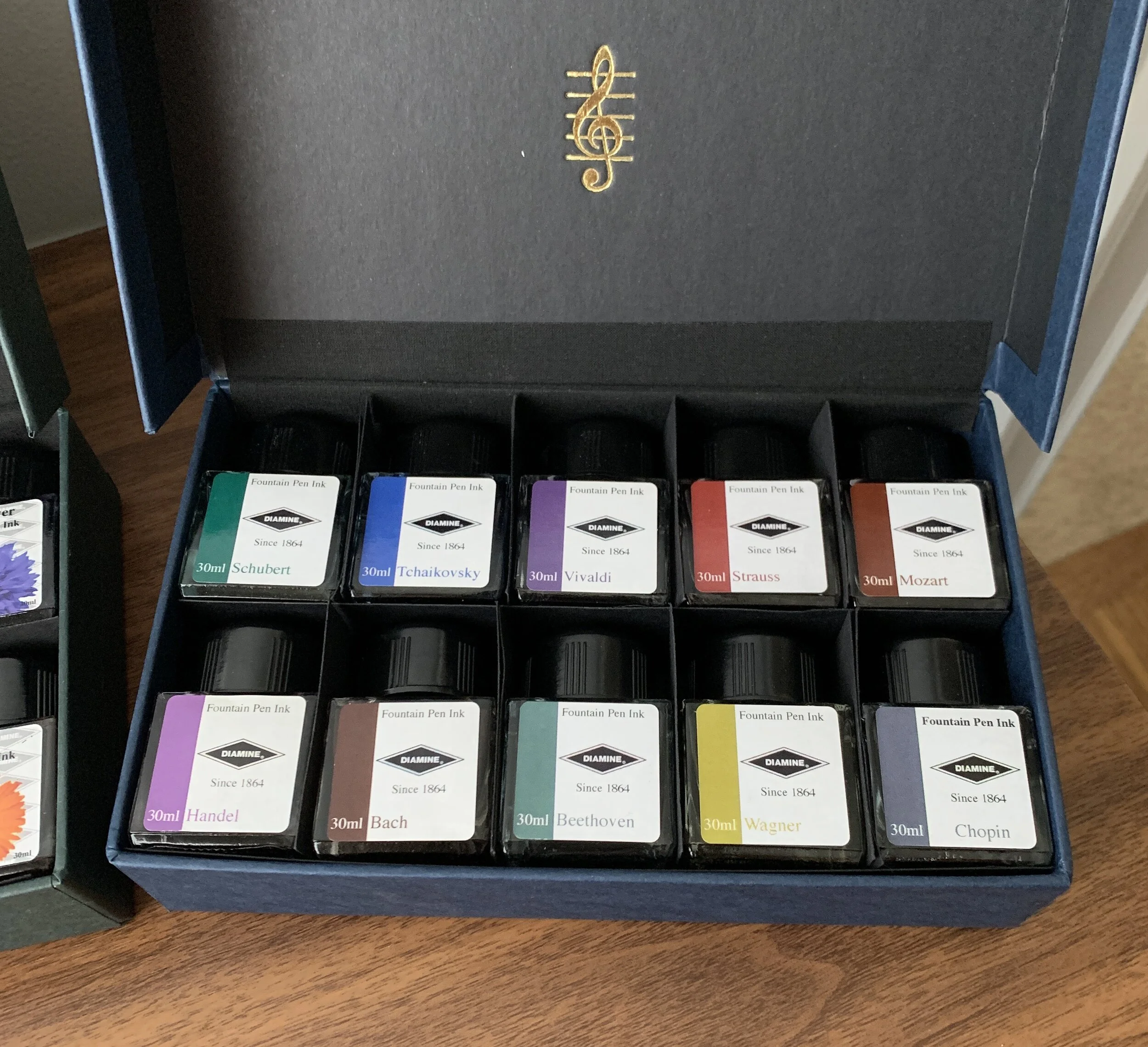
A couple of weeks ago I posted a review of “Vivaldi” and “Strauss,” two inks from Diamine’s ten-bottle Music Set. Since then, I’ve had a chance to sample and swatch the other eight Music inks, each of which is themed around a different composer, as well as the ten inks from Diamine’s other ink set, Flowers. I’m pleased with both purchases - for years I held off ordering these sets because I thought the colors would appear boring, or possibly duplicative of Diamine inks I already owned. Not so - especially Music. I think I’m going to enjoy using these darkly muted colors, especially at work and in other professional settings.

Chopin (a dark blue-grey) and Tchaikovsky (a rich blue) are the two inks from the Music Set that I have lined up to use next, once my fills of Strauss and Vivaldi run out.

Marigold and Cornflower both caught my eye, as did Bougainvillea.

Takeaways and Where to Buy

As I mentioned in my review of “Vivaldi” and “Strauss,” Diamine inks are generally regarded as safe inks that don’t cost a lot of money and behave well on the page in terms of feathering and bleed-through. I’ve not had any issues with Diamine in this regard. The one quibble I do have with Diamine inks is a tendency for some colors to precipitate out on the nib in the form of “nib crud,” which appears as a crust around the tines of the nib that you need to periodically clean. It’s not dangerous - it’s just precipitate from certain dyes used in the ink - and it happens to me most often with oranges and greens if I let the pen sit unused for a few days. So far I’ve not noticed it with any inks in either of these two sets, but I’ve also not used these inks extensively.

View fullsize Diamine Flower Ink Set
View fullsize Diamine Music Ink Set

I purchased both sets pictured here from site sponsor Appelboom. The Diamine Music Ink Set and Flower Ink Set are priced at just under 50 Euros, which comes to around 5 Euros per 30ml bottle. Given that I generally like all of the colors in both sets, it worked out to a pretty good deal for me. I’ve heard anecdotally that you can purchase refills of the individual inks directly from Diamine, but I’ve been unable to find a link on their site and suspect you would need to reach out to them directly.

Disclaimer: I purchased the inks featured in this review from site sponsor Appelboom, using store credit generated through the Appelboom affiliate program, which is one way I support the site and obtain new products for review. This post contains affiliate links.

In Ink Reviews Tags Diamine Music Set, Diamine Flower Set, Diamine Ink, Ink Review
3 Comments
← Newer Posts Older Posts →
Check Out Our New Online Shop!
Store Hours and Events
Updated 2026 "Best Pens" Guide
No results found
On The Paper Trail: Live In Nashville Event Tickets Now Available!
TGS_25 Roterfaden Restock Notification
Hierarchies of Fountain Pen Friendly Paper

Join Our Patreon!
Subscribe to the TGS E-mail List

Featured Posts

Featured
10-Fountain-Pens-Favorite-Inks
August 22, 2026
Three Keeper Inks: Choosing Inks for 10 Fountain Pens
August 22, 2026
Read more →
August 22, 2026
Everyday-Stationery-Bags
July 25, 2026
What's the Best Everyday Stationery Bag? My Own Considerations and 5 Options for Pen Show Season
July 25, 2026
Read more →
July 25, 2026
Graphilo-Kobeha-Paper.jpg
July 11, 2026
Paper Review: Graphilo by Kobeha
July 11, 2026
Read more →
July 11, 2026
The Gentleman Stationer RSS

© Digital Divide Media, LLC, 2014-present.

All content is the exclusive property of Digital Divide Media, LLC, d/b/a The Gentleman Stationer, including “The Gentleman Stationer” website and trademark, and should not be reproduced without express written permission.  All rights reserved.

All content containing paid advertising, affiliate links, or sponsored content will be plainly disclosed by a disclaimer when/if featured.

Contact Information

Website Terms and Conditions

Privacy Policy and Cookie Policy

Accessibility Statement

Legacy Account Login

Powered by Squarespace