• Blog
  • Shop
  • Podcast
  • Resources
  • About
  • Archive
  • Contact
  • Cart
  • Sign In My Account
Menu

The Gentleman Stationer

Vintage Living in the Modern World.
  • Blog
  • Shop
  • Podcast
  • Resources
  • About
  • Archive
  • Contact
  • Cart
  • Sign In My Account

The Ten Most Influential Stationery Products of the Past Decade

January 1, 2020

Notice that I’m not framing today’s post as another “best of” list, but rather something different. Here I’ve tried to identify those stationery products that have most influenced what is currently on the market today, which necessarily may include some products that either weren’t good to begin with or haven’t held up over time as the stationery market has evolved. This list may also include products which weren’t released in the 2010s, but still established their popularity and influence during the past decade. This New Year’s is bittersweet for me. My foray into pen collection (let’s just call it “pen enthusiasm”) really started up again in early 2010, so it’s hard to believe that ten years has passed. Writing this list brought up a lot of feels. I hope it does for you as well. Happy reading!

  1. Field Notes. To me, naming the Field Notes pocket notebook, and the brand as a whole, as the most influential stationery product of the past 10 years is something of a no-brainer. I wasn’t going to do a ranked list, but after evaluating my top five, I’m pretty comfortable with the order, and leaving Field Notes as the undisputed No. 1. The Field Notes quarterly edition subscription program has taken on a life of its own, with certain coveted past editions arguably qualifying as design icons. Absent the success of Field Notes and Moleskine (see below), I have a hard time seeing many notebook-focused companies enjoying the level of success they are seeing today. While Field Notes have fallen out of rotation for me personally, that’s more a function of my own needs than anything else.

  2. Moleskine. I debated whether to include Moleskine on this list, as the brand launched in the late 1990s and expanded throughout the 2000s, which is when the “black Moleskine” notebook first became synonymous with hipster stationery, and later, omnipresent. Why did I ultimately include it? Because Moleskine inspired countless companies to attempt to “build a better Moleskine” - a black everyday carry notebook that contained consistently decent paper and held up over time. Without Moleskine, would the Leuchtturm 1917 or the Rhodia Webnotebook be as popular as they are, or would brands such as the Dingbats notebook or Endless Recorder even exist?

  3. Blackwing 602. Am I talking about the vintage pencil or the modern pencil? How about both? At the beginning of the decade, as the stationery-obsessed began to “rediscover” pencils (or at least talk about them on the internet), you could still find lots of original Blackwings at what would now be considered reasonable prices on eBay. Then CalCedar, maker of the popular Palomino pencil - may it rest in peace - announced that it had acquired the right to the Blackwing and would begin making a modern version of this classic pencil. Today, Blackwing is on its way to becoming a brand to rival Moleskine.

  4. Noodler’s Ink. I’ve mentioned numerous times how, ten years ago, Noodler’s Ink was one of the only options if you wanted “boutique” inks in colors other than the standard black-blue-blue/black-red, green, and purple. Five different shades of each color? Now, boutique ink manufacturers such as Robert Oster Signature, KWZ, and Colorverse are the norm, and even old-line pen companies like Pilot and Sailor have vastly expanded their ink lineups to include dozens of colors.

  5. Pilot Hi-Tec-C Gel Pen. The so-called “refill that launched a thousand Kickstarters,” and arguably the entire modern machined pen industry. JetPens even built a business around sourcing Japanese gel pen refills that are difficult to find in the U.S. I’ve fallen away from the Hi-Tec-C in recent years, but for those who love needle-tip gel pens and write small, it still has enduring popularity. I still field weekly questions about whether this or that machined pen is compatible with the Hi-Tec-C.

  6. Montblanc Alfred Hitchcock Limited Edition Ink. Did this 2012 ink launch the “limited edition” ink craze? In my mind, it did, since it’s definitely the first ink I can remember people purchasing in lots of up to a dozen bottles to hoard, back in the days when there weren’t so many inks that you could find a similar shade elsewhere. Of course, that doesn’t keep people from trying to duplicate what some consider the best red ink ever made….

  7. Edison Pens. Brian Gray of Edison Pens was the first to truly take the “custom fountain pen” industry into the mainstream, offering not only custom designs but unique filling systems, including modern recreations of vintage-style filling systems such as the pump (vacumatic) and pneumatic fillers, as well as his own innovations like the “Draw Filler”. Today, those looking to design their own ideal fountain pen can also choose to work with Shawn Newton, Renee Meeks (Scriptorium Pens), Jonathan Brooks, and many others, but Edison Pens kicked off the trend!

  8. TWSBI 530/540/580. In addition to custom-designed fountain pens, which can cost hundreds of dollars or more, the 2010s were notable for the reintroduction of mid-range and entry-level writing instruments of a quality unavailable since the so-called “golden age” of fountain pens decades earlier. Leading the pack was Taiwanese company TWSBI, which has now introduced several iterations of its 5XX series fountain pens, in addition to the acclaimed TWSBI Eco. TWSBI designed its initial release, the TWSBI 530, with input from the fountain pen community (making it sort-of-crowdsourced-but-not-really), and tweaked the design throughout the decade in response to customer feedback and quality control issues. Now, TWSBIs are regarded as some of the most reliable low-cost fountain pens available, and their accessible price point has served to keep other companies (relatively) honest.

  9. Nanami Seven Seas Notebooks. This entry on the list could easily be “Tomoe River Paper,” but I decided to go with Nanami Paper, which was one of the first companies to offer an accessible fountain pen friendly notebook stuffed with hundreds of pages of excellent ultra-thin Japanese paper. For a while, Nanami couldn’t make enough of their Seven Seas Writer and Crossfield. Though today there are plenty of other companies offering similar notebooks, it’s still hard to match Nanami’s quality.

  10. Hobonichi Planner. Perhaps as part of the greater rebellion against digitizing anything and everything, the paper planner has made a comeback. While the planner resurgence could justify it’s own stand-alone article, the Hobonichi Techo makes this list as the first insanely popular fountain pen friendly Japanese planner that is now available in an English-language version. Whether people love the Tomoe River paper or the flexible format, the Hobonichi looks like it’s here to stay, and has driven the popularity of other Japanese planner systems like Kokuyo’s Jibun Techo, my own planner of choice.

A lot on this list is, of course, affected by my own personal experience and preference, and you can argue about the “Top 10” anything, but I don’t think there can be much dispute that all of these were influential. Stay tuned for more year-end recap content over the next couple of weeks! Happy New Year to everyone, and know that I appreciate your readership and support.

Disclaimer: Wherever possible I’ve tried to link to a past post of mine reviewing or discussing the items listed here. Otherwise, I’ve linked to sponsors or the companies themselves.

In Editorial Tags Editorial, Year-End Review, 2010s Summary
2 Comments

When something is an edition of 15, and speaks to you, feel free to go ahead and jump on that without hesitation.

Thoughts on Purchasing Expensive Pens (or Any Luxury Item)

December 21, 2019

I’ve been collecting notes and thoughts on this topic for a while now, as I’ve noticed my own acquisitions starting to trend in the direction of purchasing fewer-but-nicer pens, and as more brands seem to be directing significant manufacturing and marketing efforts towards high-end pens and limited editions. Honestly, there are now so many limited/special/store editions on the market that it’s easy to get confused and caught up in FOMO, spend a lot of money, and wind up with an extremely expensive pen that doesn’t meet your needs or isn’t as great as the “hype” made it seem. Believe me, I’ve been there. So I thought it might be helpful to write a piece on my own thought process when acquiring pens - especially expensive high-end pens - and the various considerations and questions that I ask myself as I evaluate whether a prospective purchase is “worth it.”

Before we start, I need to preface this discussion with an acknowledgement that what constitutes an “expensive” or “high-end” pen is subjective, and necessarily changes from person to person. A $50 pen is extremely expensive to some people, and I’m not necessarily talking about financial means. Some people simply prefer a functional daily writer and don’t want to have any more money than absolutely necessary locked up in a writing instrument they might lose. With that understood, I don’t think the analysis changes significantly based on where you draw the line on what’s “expensive” or “high-end.” Hopefully this article has something helpful for everyone.

My own baseline for what I consider a “very expensive” pen is roughly $500. Some might set the baseline even lower, and there’s definitely an argument for that. I chose $500 because this price point captures most brands’ non-limited or standard edition “workhorse” pens such as the Pelikan M800/M600, Aurora 88, Montblanc 146, Sailor Professional Gear, Pilot Custom 823, and even some Conids. (While the MSRP on some of these pens may be greater than $500, you can usually find them below that, either by purchasing on sale or with a discount code, or by acquiring them secondhand in barely used, or even mint, condition.) Once you get past this baseline price point, in my opinion you are definitely paying for more than functional hardware - i.e., a gold nib, build quality, filling system - and get into more subjective forms of “value” like artistry and branding. I think hard before purchasing above this baseline price point, and if I do, there has to be a compelling case. I use my pens, so I’m not a pure collector in the sense that my primary focus is on making sure the pens do not depreciate in value for later appraisal or resale. I may buy something because I view it as a “work of art,” but it’s a functional piece of art that I still intend to put to good use as a writing instrument.

Leonardo Officina Italiana makes some of my favorite limited and special edition pens currently on the market. They’re all handmade, and the runs truly are limited - especially those in rare celluloids.

Leonardo Officina Italiana makes some of my favorite limited and special edition pens currently on the market. They’re all handmade, and the runs truly are limited - especially those in rare celluloids.

First Consideration: What Exactly Am I Paying For, and Why Am I Spending this Money?

I firmly believe that you don’t need to spend more than $65, tops, to get a reliable fountain pen to use as a daily writer. For $200 or less, you can purchase what I consider one of the best-designed fountain pens ever made, the Lamy 2000, which is my own “desert island” writing instrument. As I mentioned above, once you pass a certain price point, you stop paying for additional functionality and get into things like design, artistry, and, yes, branding and hype. There’s absolutely nothing wrong with that. But one thing I do try to do when contemplating an expensive acquisition is figure out exactly what I’m paying for and why I’m fine with paying it. For example, a $600 Nakaya is not $600 because it’s a “better” pen than a $150 Platinum 3776 in terms of functionality. For the most part, they write similarly because they feature the same nib, and the Platinum might actually be a “better” choice for most people to take to work everyday because it posts and the pen is lightweight. The Nakaya, however, is a vehicle to showcase artistry, namely the Japanese tradition of Urushi lacquer work and other traditional pen designs. Do I really like the design of this particular Nakaya, or is this a FOMO-driven acquisition influenced by online discussions and/or podcasts? Put another way, do I like this pen and want one because “other people” are telling me I should have one in my collection?

Two limited edition fountain pens that I’m glad I purchased. On the left is my Delta Fusion 82 in “Pompeii” celluloid, and on the right is the Leonardo Momento Zero “Maestro” in discontinued Omas Burkina celluloid. I grabbed both of these immediately, knowing they really were limited and won’t last.

Second Consideration: Is this “Limited” or “Special” Edition Really That Unique?

When considering the purchase of a “limited” pen, I try to remember to ask myself how “limited” or “special” the pen actually is. In my opinion, these two marketing taglines are overused. Case-in-point: I own a couple of Montblanc Writers Edition fountain pens, which retail for nearly $1000. I’m a Montblanc fan, and generally appreciate the brand’s design and build quality, but is a run of 16,000 fountain pens really limited enough to qualify for the “limited edition” designation, and command the sort of price being asked?

In my opinion, probably not. Older Writers Edition fountain pens, like the Hemingway and Agatha Christie, command higher prices on the secondary market because Montblanc made fewer of these pens, and they’re difficult to locate. That’s exactly what some pure collectors want to see - appreciation in the value of the pen due to scarcity. But it’s hard to see a run of 16,000+ pens that cost $1000 apiece appreciating in value anytime soon, which is why you can find later Writers Editions like Virginia Woolf, Charles Dickens, Friedrich Schiller, etc. for much less than the original retail, sometimes still NIB (“New in Box”). If you’re a user, like me, that’s not a bad thing at all, which brings me to the third consideration….

On the other hand, Pelikan limited and special edition fountain pens tend to linger, like the M101N pictured here, and you can get extremely good deals towards the end of the year….

Third Consideration: How Badly Do I Want This Pen Now, and Should I Wait for a Price Drop?

For the past couple of years, I have made 90% of my pen acquisitions in November, December, and January, which is when most retailers run inventory clearance sales and holiday promotions, starting with Fountain Pen Day sales and running through the post-New Year’s clearance events. At the top of the list for retailers to clear out are those “limited” and “special” edition pens that haven’t sold over the past year or two - after all, they need to make room for the next year’s releases that start shipping in February and March - and if you wait patiently enough you can often find the “older” pens discounted as much as 60%, or even more once you factor in holiday coupon codes that are always floating around. With respect to the Montblanc Writers edition pens noted above, I found two of them at around 70% of what they originally cost, and was able to use a 20% off Black Friday coupon to get the price down even further. In short, if you can resist the FOMO, patience can pay off. If a limited edition isn’t really “limited,” just wait for a while, and I suspect you’ll enjoy that pen all the more having paid half the original purchase price.

Aurora limited and special editions typically remain available for at least a year or so. I waited a year for the Aurora 88 Sigaro Blu to go on sale and got a slightly better price than I would have had I purchased it upon release.

Final Thoughts

Choosing a pen is a uniquely personal experience, and as you gain experience, you’ll develop your own set of considerations, or even rules, that you take into account when building your collection or accumulation. I do hope this piece is helpful. I’ve made my share of mistakes in my decade or so in the pen hobby, and the ones that always burn the most are when I gave into the FOMO and purchased something expensive that I either didn’t really like it or could have purchased a year later for half the money. On the flip side, I’ve also missed out on some truly limited releases because I dawdled, but I tend to regret those instances less because there is always going to be something else to take its place. Trust me on this one.

Happy holidays, everyone! After tomorrow’s “Links” post, I’m signing off until after the New Year, when I’ll be back with all sorts of new things in store for 2020 and the next decade!

In Editorial Tags Editorial, Expensive Pens, Collecting
Comment

Notebook Review: Oxford USA Hardcover Journal

December 18, 2019

Those of you who spent your youth (and let’s be honest, still spend their adulthood) stalking the aisles of stationery stores will probably be familiar with Oxford, a brand with a reputation for making high-quality stationery that’s attractively priced and widely available. A representative for Oxford’s parent company reached out several weeks ago to ask whether I’d be interested in reviewing their new hardcover notebook/journal. Oxford has partnered with Monadnock, one of the oldest family owned and operated paper mills in the U.S. According to the contact who sent me the journal, this book is entirely sourced, printed, and bound in the U.S.A.

Since this journal is bound like a regular hardcover book, it won’t lay flat, but it’s sturdy and will last for quite some time.

The Oxford USA Journal contains 192 pages of the aforementioned Monadnock paper, in a Smyth-sewn binding with a charcoal grey, hardback linen cover embossed with an American flag logo. It has a sturdy, well-made feel to it, and the super-picky among us will be glad to know that the end of the ribbon bookmark appears to be heat-fused to reduce fraying. It’s a tastefully designed notebook/journal that I would have no problem carrying anywhere, including at work.

A bit more background information is included inside the back cover.

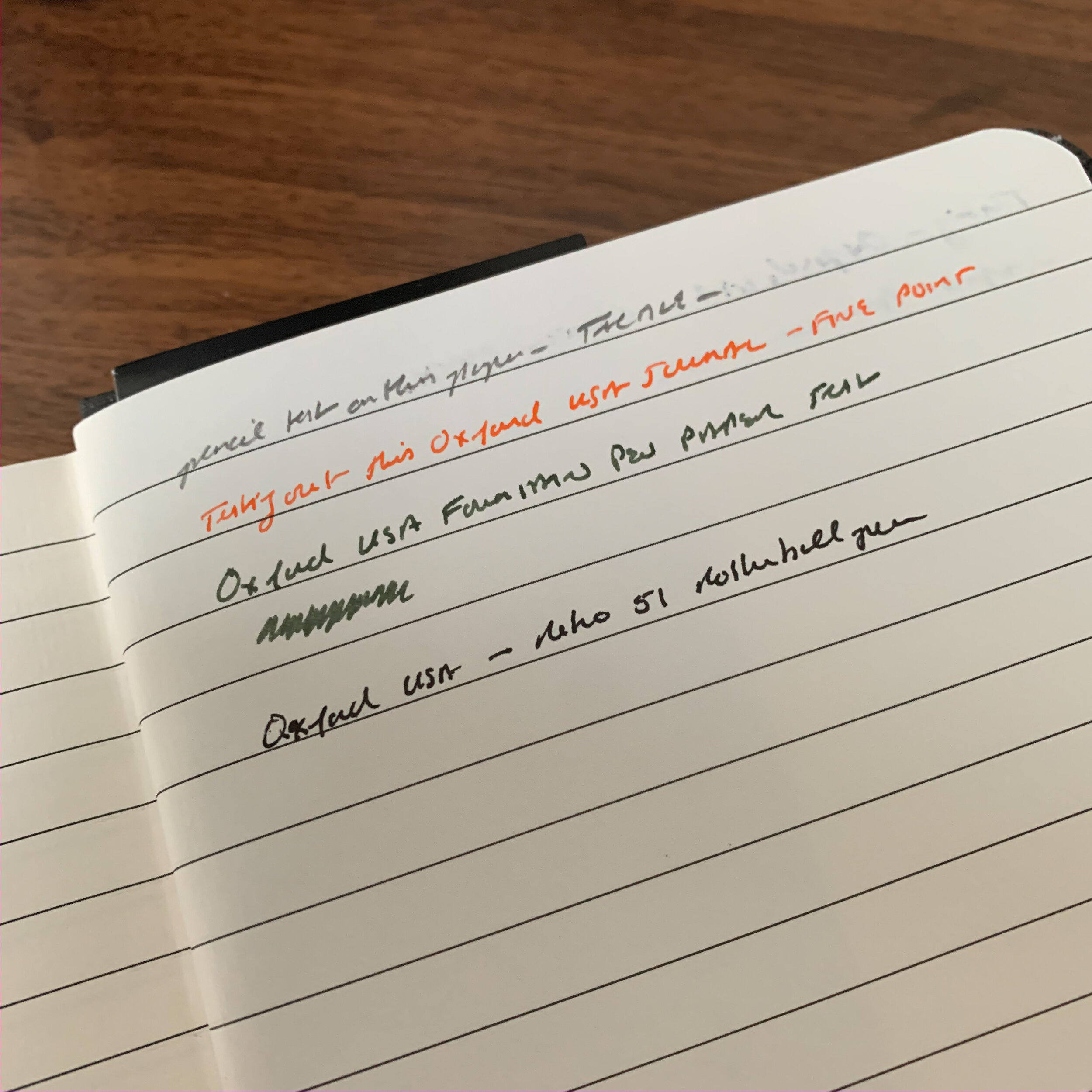
But of course, as with any higher-end notebook, what everyone wants to know about is how the paper performs with various inks and fountain pen nibs. The answer: Surprisingly well, and better than expected. I tested the paper with a Retro 51 rollerball (.7mm Schmidt refill), a Lamy 2000 EF nib, and a Sailor fine nib, and while there was some show-through with very minor bleed-through, I could still use both sides of a page. A wet Graf von Faber-Castell medium nib pushed the paper a bit too far, and feathering/bleed-through became an issue. If I had to make a comparison, I would equate the performance to the heavier-grade paper used in certain Field Notes editions like “Lunacy” or “America the Beautiful.”

View fullsize Writing Sample
View fullsize Writing Sample: Reverse Side

Takeaways and Where to Buy

Oxford apparently shares common ownership with TOPS stationery (maker of the famed “Double Docket” legal pad), which makes me hopeful that this notebook will receive a wide release. If this journal were to appear at Staples, Target, etc., I’d venture that it would do really well. The cover feels solid and the paper will meet the needs of the overwhelming majority of people. I do wish the ruling were slightly narrower and not quite as dark, but that’s a personal preference.

Currently the only place I’ve been able to locate these notebooks for sale is Amazon, and even there they appear to be sold through third-party office supply wholesalers. Priced at just under $20 (shipping included), this seems reasonable for a quality hardbound notebook. I plan to keep my eye out for this notebook in stores in the coming year. Curiously, these books are not yet featured on the TOPS website, which leads me to believe that they have not yet officially launched. Many thanks to Oxford for sending me this product and making this review possible!

Disclaimer: Oxford USA sent me this journal for review purposes, free of charge. This post contains affiliate links.

In Notebook Review Tags Notebooks, Oxford USA
1 Comment

Last Chance to Grab One: Aurora 88 Sigaro Blu

December 14, 2019

I’m in a strange place with my fountain pen hobby and with this blog. Though I’ve certainly not reviewed everything thoroughly, I’ve had the opportunity to at least write with most of the major pen brands’ flagship models. If I’m honest with myself, this realization take a little bit of the fun out of the whole experience. Things don’t feel as new, and I have to work harder to get interested in new releases, and rarely get excited about yet another Sailor Pro Gear or Aurora 88 special edition. It takes something pretty special.

These days, many so-called limited editions are basically “skins” - the exact same pen with a different barrel color or material. Sure, changing up the acrylic and trim can drastically alter the look of the pen, but it rarely changes my overall opinion on the usability or functionality of the pen. That’s why it’s uncommon for me to re-review pens based solely on changes in appearance, unless I really didn’t like the look of the pen the first time around or the company makes a particularly drastic change. For example, I recently re-reviewed the Pelikan M101N because this year’s edition spoke to me while none of the prior releases did.

In addition to a couple of modern Aurora 88s, I have one vintage pen in the black/”Nikargenta” (nickel alloy) combination.

The Aurora 88 “Sigaro Blu” represents a similar situation. I’ve reviewed the Aurora 88 in two different formats: the limited edition “Minerali” demonstrator and the blacked out “Unica Nera.” The 88 is a great pen with a classic streamlined shape that’s comfortable to use. In its current form, the Aurora 88 has been around since the 1990s, but the pen’s heritage stretches all the way back to 1947 when Aurora introduced a hooded-nib pen to compete with the Parker 51. Today the Aurora 88 is available not only in standard black and silver/gold configurations, but in a wide array of limited editions and special releases. Currently, Dan Smith has at least a dozen different versions of the Aurora 88 available for purchase.

Prior to purchasing this pen, I already knew that I liked Aurora nibs and the overall form factor of the pen, but I hadn’t found a version of the Aurora 88 that was compelling enough to boost the pen into the “daily user” category. So what drove this purchase? The lacquer finish. With the Sigaro Blu, Aurora has layered light blue streaks in a webbed pattern over black lacquer, giving the pen a blue-black or navy appearance. It’s truly distinctive, and understated in a way that’s similar to Japanese Urushi lacquerwork while still maintaining its own identity. I first had the chance to see this release in person at the 2018 Atlanta Pen Show, and since this one was an expensive purchase, I had some saving to do. Fortunately I was able to snag one at a slight discount during a year-end clearance sale at The Nibsmith.

View fullsize Aurora 88 Sigaro Blu Unposted
View fullsize Aurora 88 Sigaro Blu Posted

The “Sigaro” series of lacquer pens offers a different writing experience from the standard Aurora 88. The combination of lacquer and a metal section makes for a heavier, more front-weighted pen, and the balance feels somewhat akin to the Sailor 1911 Black Luster. It’s not a perfect comparison - the 88 is a is a piston filler, making this a more substantial, heavier pen overall, but I still have no issues using this pen all day. It will post, and since the cap has a plastic insert, I’ve not had any issues with the cap threads scratching the lacquer. (Lacquer in general is pretty durable, and I don’t worry about these things anyway. I use my pens how I want to use them, and if they start showing signs of wear that’s just part of the deal.)

The fine 18k gold nib wrote perfectly out of the box, and is paired with an ebonite feed that provides generous ink flow. Aurora nibs are made in-house, and the vast majority of my experience with the brand has been positive. These nibs aren’t glassy smooth, but they’re not scratchy either (at least to me). I enjoy the tactile feel, and by not over-smoothing Aurora tends to avoid the problems other brands have with skipping and hard-starting.

I would call this a true “Western Fine.” Ink shown here is Lamy Blue-Black, a favorite workhorse.

Takeaways and Where to Buy

I love this pen, to the point where I can say that the Aurora 88 Sigaro Blu is a “Top 5” pen for me. The pen has the perfect weight and balance for my hand, and I can comfortably use this pen posted or unposted for hours. This Aurora fine nib writes the perfect line for my daily needs in terms of width and wetness.

As I mentioned earlier, I acquired this pen from Dan Smith over at The Nibsmith, who still has Sigaro Blu pens in stock. Pricing on the Aurora 88 ranges from $495 to $905, and the Sigaro Blu sits at the highest price point. You’re paying an extra $200-300 for the lacquer work, so if the look does not appeal to you and your interest in the Aurora 88 lies elsewhere, there are plenty of lower-cost options to choose from.

Disclaimer: I purchased this pen with my own funds, for my own collection. The Nibsmith is a paid sponsor of this blog.

In Pens Tags Pen Review, Aurora, Aurora 88
Comment

Notebook Review: Filofax Notebook and Clipbook

December 11, 2019

Last week I reviewed some new products from Letts of London, and in that same shipment I received a couple of samples from Filofax, Letts’ sibling brand. I’ve been a regular Filofax user over the years - their A5 organizer was my go-to organization system through college, law school, and for the first few years of work after graduation. I fell away from the Filofax as most of my professional calendaring went digital, and my binder-style paper planner was replaced by books like the Hobonichi Techo, which I would use more as a journal.

Filofax Notebook in “Architexture” cover, A5 size.

Presumably sending shifting trends, Filofax has evolved as a company over the past decade. In addition to their classic organizers, they have launched a series of notebooks that not only feature extremely high-quality paper but are flexible in how you can use them. Taking a cue from disc-bound notebook systems such as Levenger Circa or Staples Arc, the Filofax notebooks feature “movable” pages that can be rearranged within a sturdy wire binding. The 100gsm paper feels and performs similar to Rhodia, and is available in blank, dot grid, lined, and graph rulings. The key selling point of this notebook system is its flexibility over the traditional Filofax organizer: you can certainly use it as a dated planner if you want (Filofax sells “Diary” refills), but I would envision using the included dividers as a way to organize research notes for a work project or a longer piece of writing. Since the notebook is a standard A5 size, you can use Filofax’s proprietary punch to clip in notes from your own A5 notepad. (Other sizes are available, though you’ll have to purchase A4 from Europe as it appears the U.S. store doesn’t carry it.)

For those who prefer the traditional Filofax six-ring binding, Filofax also sells the “Clipbook,” a similar product with a flexible structure but only 80gsm paper, which won’t work as well for my own personal use. While liquid ink pens such as fountain pens and rollerballs work ok, you will see some minor bleedthrough and feathering. That said, if you already have a Filofax Organizer and the “punch” accessory, you know that you can create your own paper refills using whatever paper you prefer.

Filofax Clipbook in A5. While some people might be sold on the ringed-binder system, I definitely prefer the more streamlined look of the Notebook.

The Clipbook binding will look familiar to devoted Filofax users.

While I found the 100gsm Filofax Notebook paper superb, the standard 80gsm paper in the Clipbook does not hold up as well to fountain pens.

Takeaways and Where to Buy

Of these two products, the Notebook is the clear winner for me. The 100gsm paper handles fountain pen ink quite well, and Filofax’s “movable” page system is more convenient than disc-bound notebooks, since the Filofax binding covers the back of the binding and you don’t have the discs sticking out and at risk of coming loose in your bag. Though the Filofax Notebook does not allow you to upgrade the size of the notebook by substituting in a higher-capacity binding, in my experience these sort of moveable-page notebooks become unwieldy to the point of being unusable once you pass a certain point. (It becomes nearly impossible to flip through the notebook without pages falling out.) Thus, I don’t feel that I would be losing anything by moving to the Filofax Notebooks over a Circa or an Arc, which do let you substitute in bigger discs if you need them to hold more paper.

Filofax Notebooks are available in A4, A5, Executive, Letter, and Pocket sizes, ranging from roughly $14-26, depending on size and design. The “Architexture” A5 Notebook pictured here is priced at $23.95 and comes with 56 sheets of ruled paper, four dividers and a ruler included. The Clipbook is more expensive, with the A5 version shown here priced at $29.99 and larger sizes priced at $49.99 or more. All products can be purchased directly from Filofax. For whatever reason, the 100gsm Notebook paper is less expensive than the 80gsm paper sold for the Clipbook: A5 notebook refills cost $4.99 for 32 sheets, whereas the A5 Clipbook refill costs $5.39 for 30 sheets. If you’re planning to invest in this system for the long run, however, by far the most economical choice would be to purchase a Filofax notebook punch and make your own refills.

Disclaimer: Filofax sent me the two notebooks featured in this review free of charge, for review purposes. I was not otherwise compensated for this review. Many thanks to Filofax for making this review possible.

In Notebook Review Tags Notebooks, Discbound Notebooks, Filofax, Notebook Review
Comment
← Newer Posts Older Posts →
Store Hours and Events
Shop T.G.S. Online
Updated 2026 "Best Pens" Guide
No results found
On The Paper Trail: Live In Nashville Event Tickets Now Available!
TGS_25 Roterfaden Restock Notification
Hierarchies of Fountain Pen Friendly Paper

Join Our Patreon!
Subscribe to the TGS E-mail List

Featured Posts

Featured
Everyday-Stationery-Bags
July 25, 2026
What's the Best Everyday Stationery Bag? My Own Considerations and 5 Options for Pen Show Season
July 25, 2026
Read more →
July 25, 2026
Graphilo-Kobeha-Paper.jpg
July 11, 2026
Paper Review: Graphilo by Kobeha
July 11, 2026
Read more →
July 11, 2026
Pilot-Custom-Heritage-92.jpg
June 6, 2026
Workhorse Pens: Pilot Custom Heritage 92 Fountain Pen
June 6, 2026
Read more →
June 6, 2026
The Gentleman Stationer RSS

View Cart

© Digital Divide Media, LLC, 2014-present.

All content is the exclusive property of Digital Divide Media, LLC, d/b/a The Gentleman Stationer, including “The Gentleman Stationer” website and trademark, and should not be reproduced without express written permission.  All rights reserved.

All content containing paid advertising, affiliate links, or sponsored content will be plainly disclosed by a disclaimer when/if featured.

Contact Information

Website Terms and Conditions

Store Shipping Policy and Return Policy

Privacy Policy and Cookie Policy

Accessibility Statement

Powered by Squarespace