• Blog
  • Shop
  • Podcast
  • Resources
  • About
  • Archive
  • Contact
  • Cart
  • Sign In My Account
Menu

The Gentleman Stationer

Vintage Living in the Modern World.
  • Blog
  • Shop
  • Podcast
  • Resources
  • About
  • Archive
  • Contact
  • Cart
  • Sign In My Account

Platinum 3776 Revisited: My Thoughts 2+ Years Later

September 26, 2018

Now that this blog is more than four years old, I’ve come to a point where I can start revisiting pens I reviewed in the “early days,” such as the Platinum 3776 “Century”. I previously reviewed the standard models of the Platinum 3776 Century back in 2016, and my overall impressions from that review still hold true. Moreover, Platinum has dropped the U.S. price of the standard 3776 to a more competitive price point that hovers in the $150 range, depending on where you shop and the availability of store-specific discount codes.

The Shungyo limited edition in my favorite color (red!) on the left, and the crystal clear Oshino demonstrator on the right.

Since that review, however, my personal collecting has focused more on the special and limited edition 3776 models, particularly the “Mt. Fuji” series of limited editions. I have two of these pens, pictured here: The “Shungyo” Limited Edition, which is part of the "Fuji Shunkei” (seasonal) series where the pens are inspired by seasonal views of Mt. Fuji; and the “Oshino” Limited Edition, named for the Oshino Hakkai spring under Mount Fuji. (You may have also seen pictures of the recent Kumpoo (“Balmy Breeze”) model, which I passed on because the color just isn’t my thing - not necessarily because of the somewhat cringe-inducing name.

Unlike the standard Mt. Fuji special editions, the Fuji Shunkei editions have added texture on the body. While my Oshino demonstrator is completely smooth, the Shungyo pictured here features lightly etched lines, which I find relatively subtle. The texture on the recent Kumpoo limited edition is more pronounced.

So why do I enjoy this pen so much? Like other favorites such as the Parker Sonnet, the Pelikan M400/M600, and the Montblanc Meisterstuck Classique, the 3776 Century is a perfect size for me, especially when posted. It’s a touch larger than the Sonnet, but smaller than the Montblanc 146. And the fact that the Platinum 3776 features a cartridge-converter filling system means that it’s extremely lightweight. These pens are made to write, and perfect for long workdays.

The Platinum 3776 is an ideal size and weight for me posted. I rarely use this pen unposted, but I’ve added a picture below to give a sense of the size.

Note: Though not something I focus on, since I tend to use my pens pretty extensively and it would be nearly impossible for me to let a pen sit this long, all Platinum 3776 “Century” pens feature Platinum’s “Slip and Seal” cap, which supposedly prevents the ink from drying out in the nib for 24 months. (I say “supposedly” only because I’ve never tested it nor do I have any intention of doing so - I have no reason to believe that Platinum’s claim is inaccurate.)
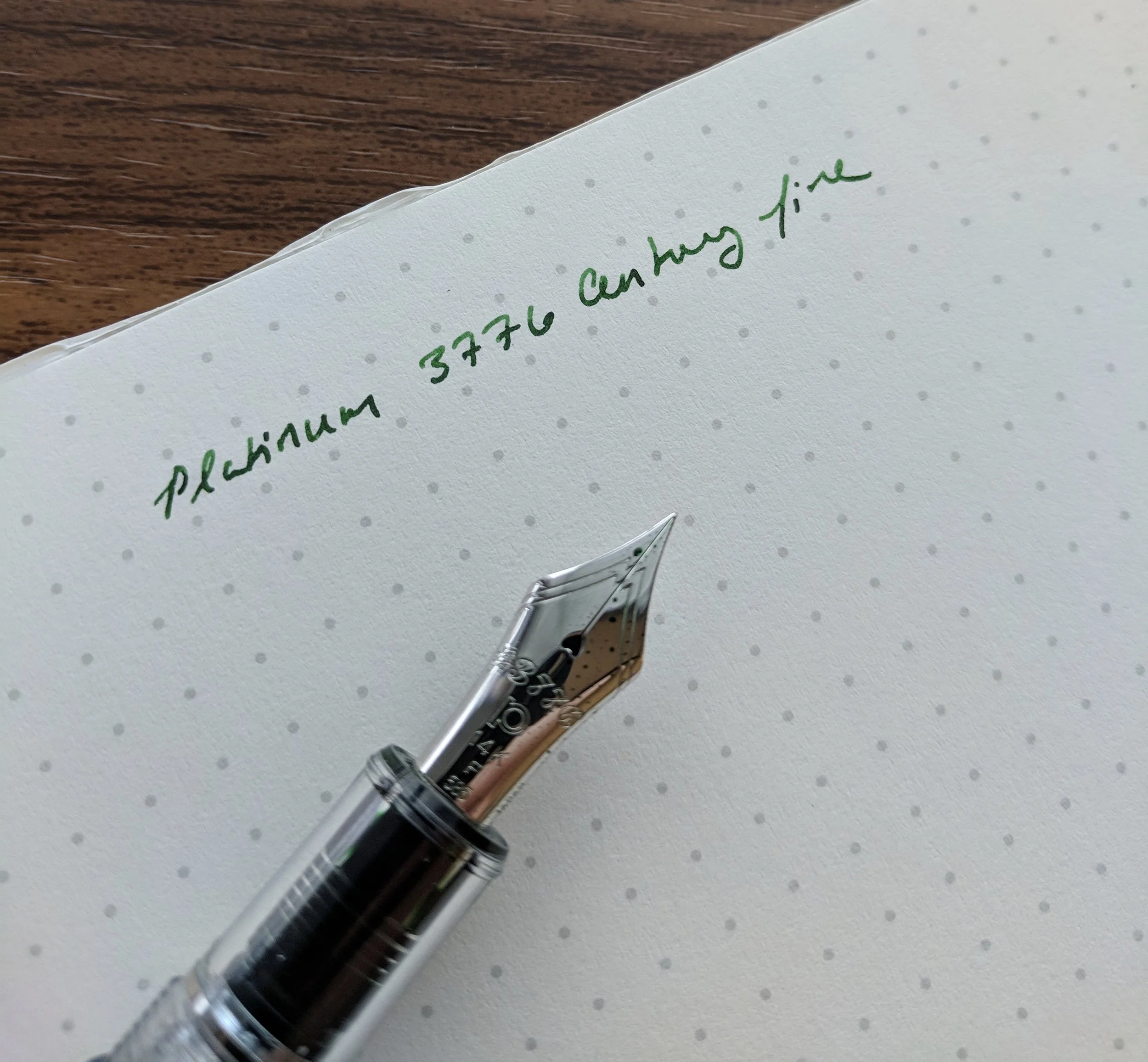
View fullsize Platinum 3776 Fine Nib Writing Sample
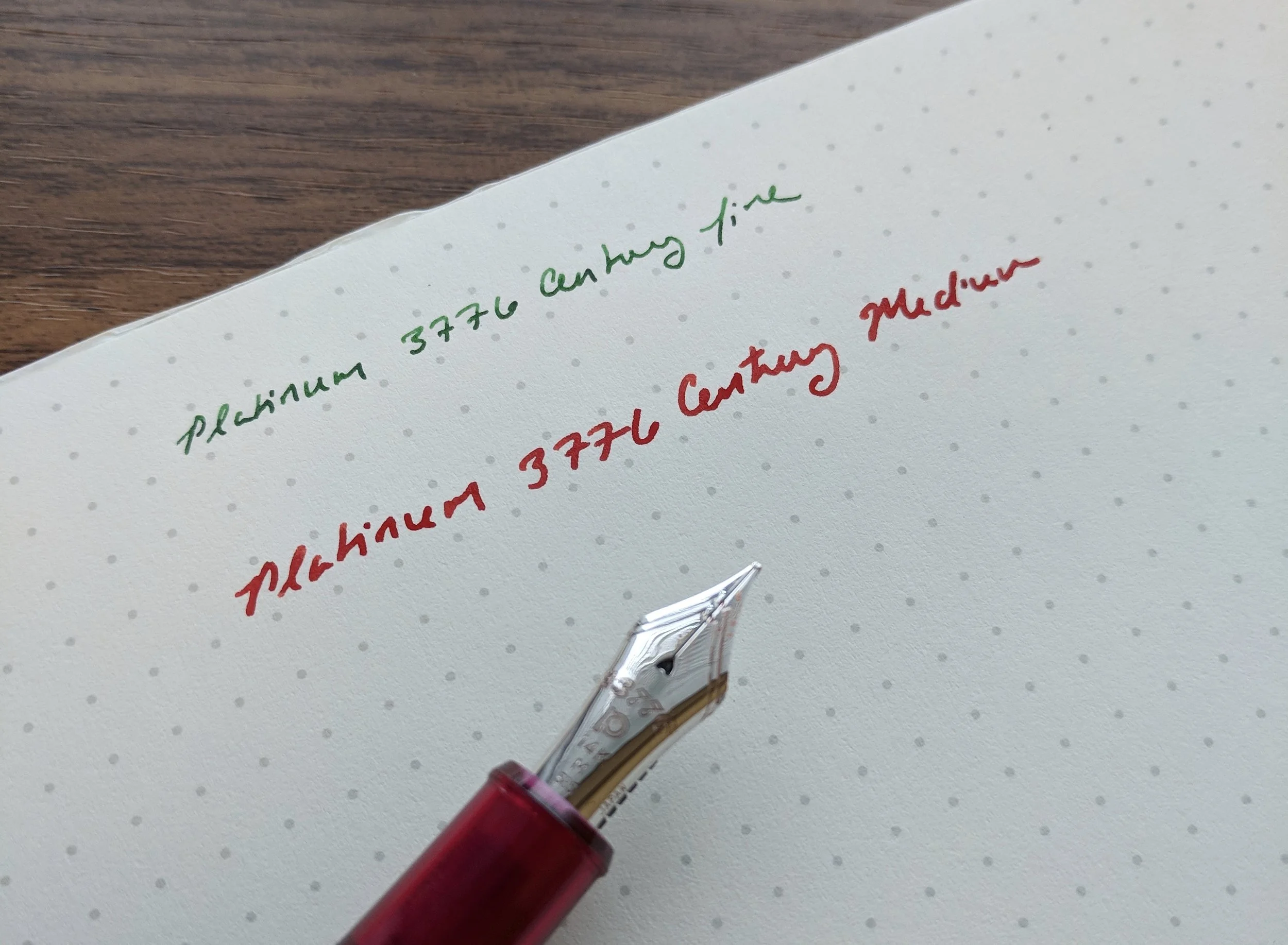
View fullsize Platinum 3776 Medium Nib Writing Sample

Oddly enough, the only problems I’ve experienced have been with the nibs - supposedly Platinum’s strong point. Both the UEF (“ultra extra fine”) nib on my Chartres Blue demonstrator and the fine nib on my Oshino wrote extremely dry out of the box, and needed to be adjusted. I’ve heard mixed reports from other people. Some nibs apparently write perfectly, others have the same issue that I did. I’m not sure whether it’s a quality control problem, or that my writing style might be incompatible with how Platinum’s standard fine nibs are tuned. On the other hand, the medium nib on my Shungyo wrote flawlessly out of the box.

Takeaways and Where to Buy

Though Platinum still receives less acclaim in the broader pen community than its “sibling brand” Nakaya, Platinum pens feature essentially the same nibs and offer a compelling value proposition on both their standard and “special edition” pens. They’ve also become more widely available in recent years, with most major pen retailers stocking Platinum and receiving an allocation of the latest limited and special editions. I purchased both pens pictured here from site sponsor Pen Chalet.

The Oshino demonstrator is still available, and currently on sale at a very attractive price. The Shungyo Pen, however, has been sold out for quite some time in regular retail channels, but they still come up occasionally on Amazon. They are starting to appear less frequently as several new models have come and gone since the Shungyo’s original release.

Disclaimer: This post contains links to paid sponsors and affiliates. I purchased both pens featured in this review using store credit from Pen Chalet that I earned through their affiliate program.
In Pencil Review Tags Pen Review, Platinum, Platinum 3776
5 Comments
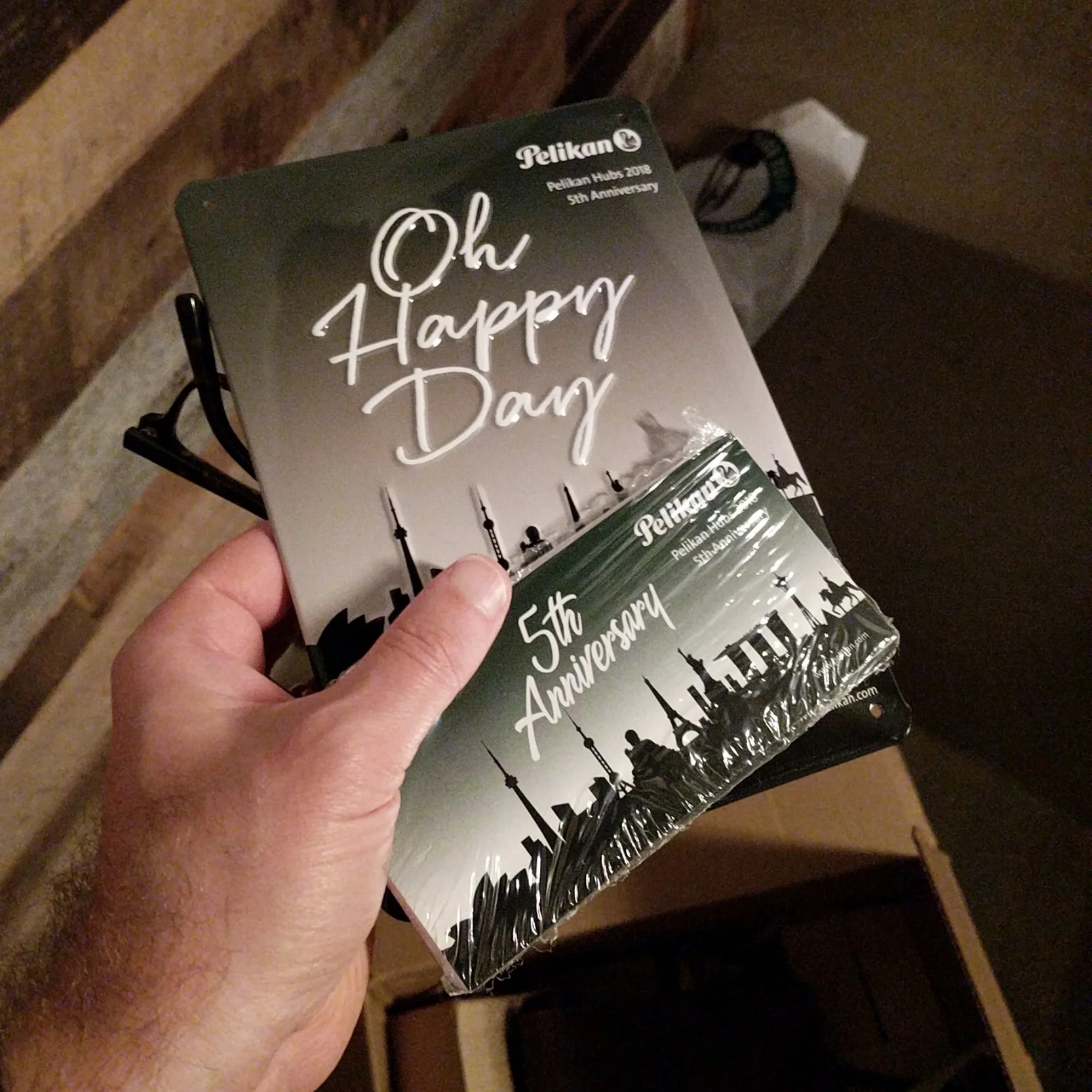
A selection of Pelikan Hubs Swag sent over from Hanover, including some ink testing cards and a metal plaque that were given away to a lucky winner!

A selection of Pelikan Hubs Swag sent over from Hanover, including some ink testing cards and a metal plaque that were given away to a lucky winner!

Thanks to Everyone Who Made It To Pelikan Hubs Nashville 2018!

September 22, 2018

Yesterday, at 6:30 p.m. in various locations around the world, Pelikan enthusiasts around the world met for the fifth year in a row to share their love for fountain pens, and the Pelikan brand in particular. The Nashville hub met at the excellent Stout’s Burgers & Beers in Brentwood, where we had the back room reserved and were joined by Lisa Vanness from Vanness Pens, who drove over from Little Rock for the event! Follow the hashtags #pelikanhubs and #pelikanhubs2018 on social media (including my Instagram @gentlemanstationer) for additional pics from the Nashville hub and other events around the world.

All Pelikan Hubs attendees receive a bottle of the Pelikan Edelstein “Ink of the Year,” which this year is Olivine, a very nice dark green that I’m looking forward to using.

Don’t forget, as part of a special Pelikan Hubs weekend “bonus,” Vanness Pens is staying in the Nashville area for a meet-and-greet on Saturday from 1-4 p.m. at the Homewood Suites, 5107 Peter Taylor Park Drive, Brentwood, TN 37027. There’s a huge common area in the hotel and Vanness will have plenty of pens, inks, and paper to test, so if you’re in the Nashville area please stop by!

Finally, steps have been taken to formalize a Nashville-area pen club using Meetup.com. Sign up here to receive notifications of upcoming gatherings and events.

In Events, Pen Store Tags Pelikan Hubs, Vanness, Pelikan Hubs 2018
Comment

Pen Review: Montblanc M Ultra Black Fountain Pen

September 19, 2018

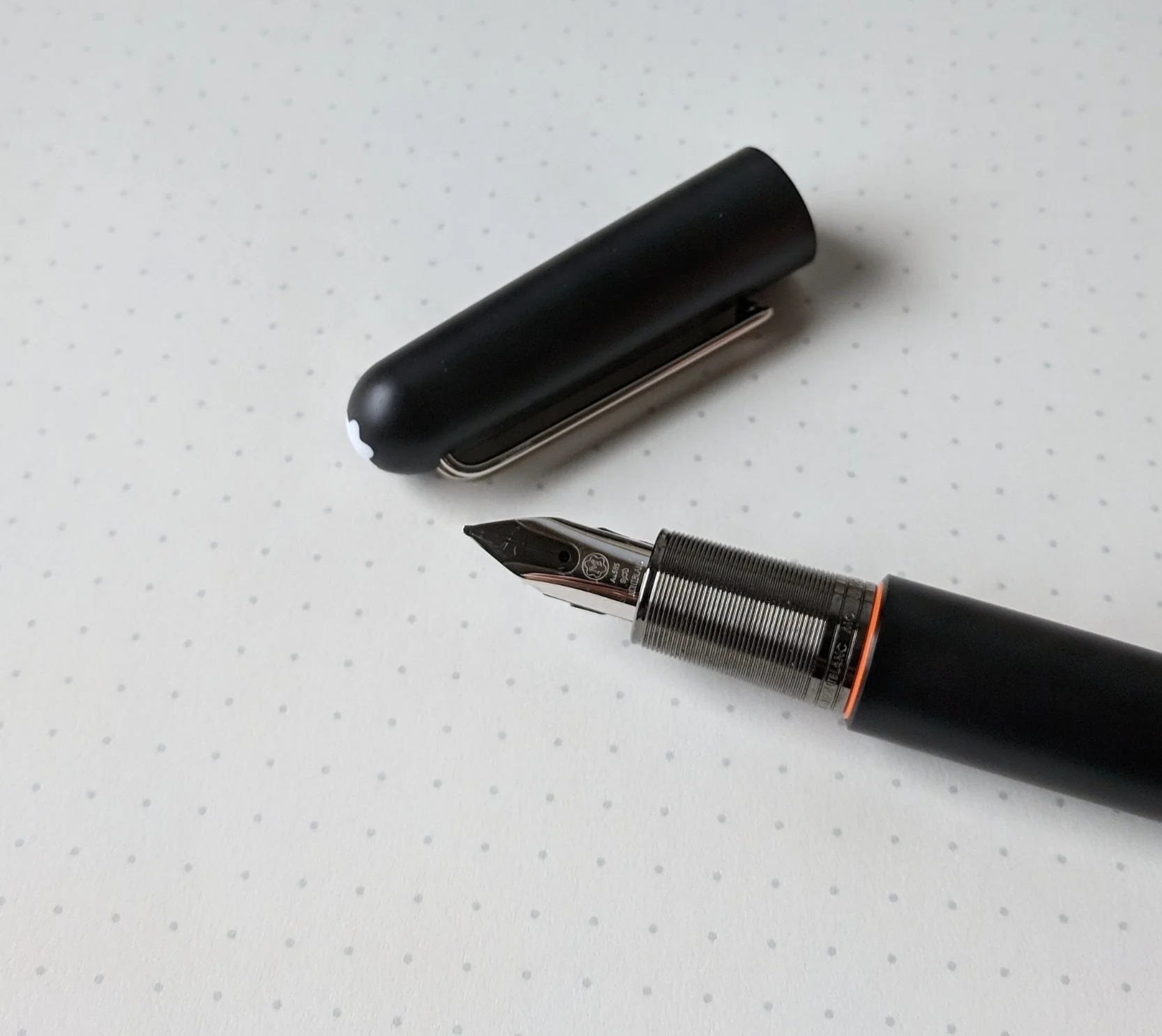
Once again, I’m a bit late to the party here in reviewing a pen that’s been out for a while - the Montblanc M by Marc Newson, a collaboration between the venerable (and somewhat staid) German brand and the industrial designer, most recently known for his status as a senior member of Apple’s design team. The version featured here is from Montblanc’s “Ultra Black” series, which means matte black resin and ruthenium trim - a combination that’s a personal favorite of mine. (This isn’t the first “Ultra Black” pen I’ve reviewed. You can check out some shots of my 146 Ultra Black here.)

Montblanc-M-Ultra-Black-Nib

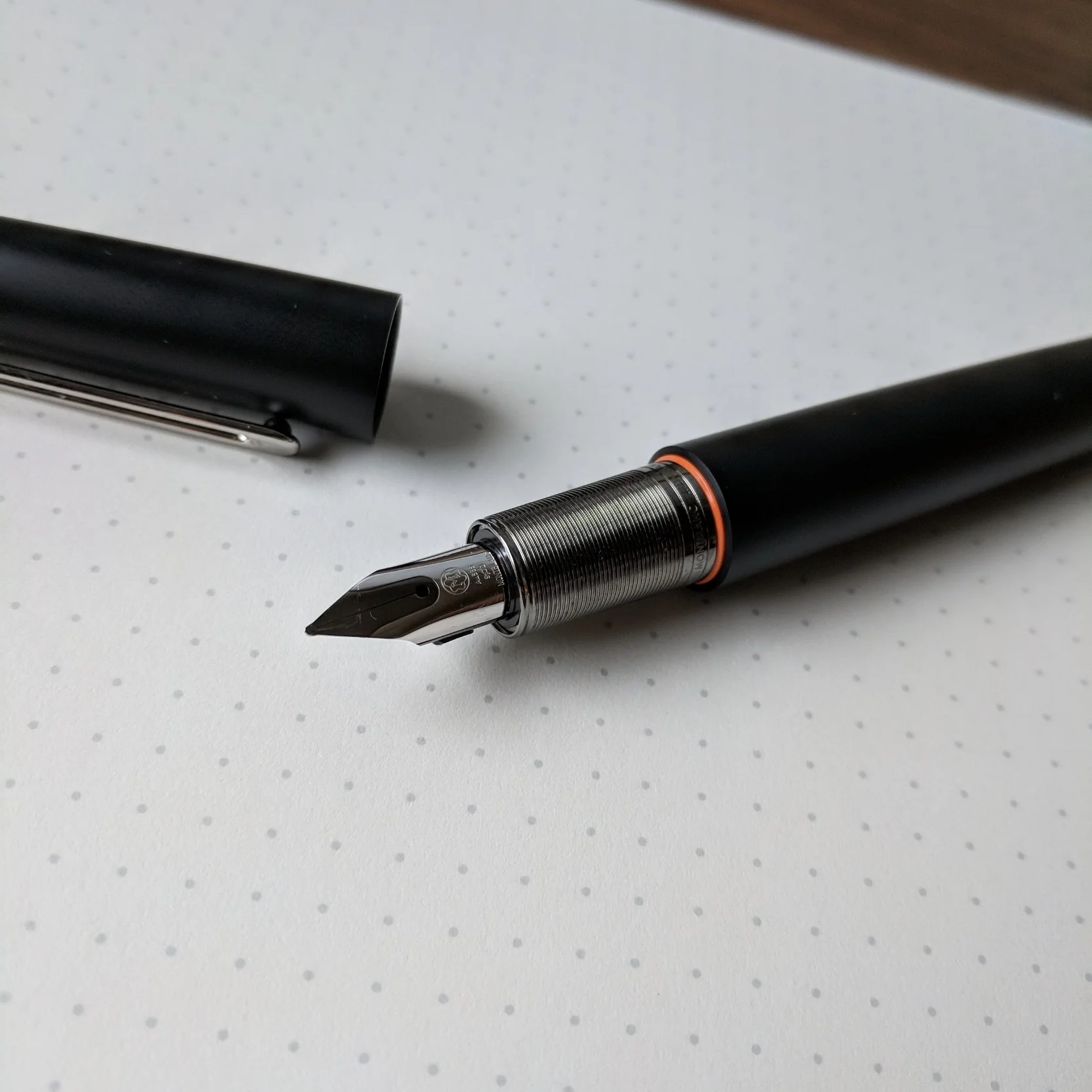
As one would expect from the “Ultra Black” designation, this pen features a ruthenium/rhodium plated, two-toned 14k gold nib, available in fine or medium. The particular pen I’m reviewing here has a fine nib, which writes a relatively wet line with just a touch of tooth. I wouldn’t call it scratchy, just tactile. The textured ruthenium-plated section is comfortable to hold, and the metal ridges offer a nice gripping surface. The balance and overall ergonomics are also nice, though as I’ll discuss further below, you can’t post the cap.  

There is a fairly significant step-down from the barrel of the pen to the grip section, which isn’t sharp, but I can still feel it when writing. Note the orange highlight, which adds a pop of color and stands out nicely on the otherwise dark design.

There is a fairly significant step-down from the barrel of the pen to the grip section, which isn’t sharp, but I can still feel it when writing. Note the orange highlight, which adds a pop of color and stands out nicely on the otherwise dark design.

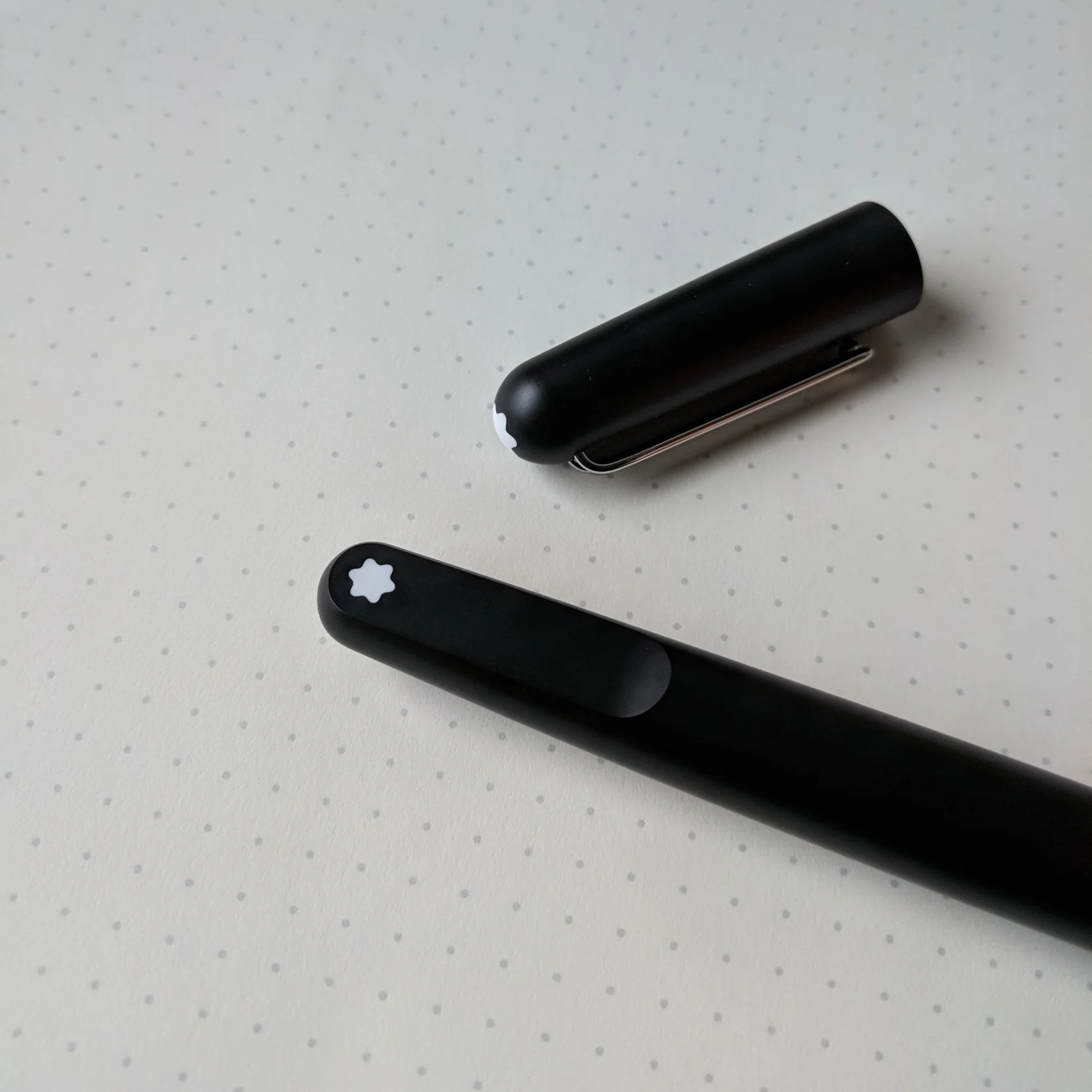
Two aspects of the pen’s design might make this one a no-go for many people.  First, the Montblanc “M” Series is a cartridge-only fountain pen. While you may be able to find a shorter converter that fits the barrel, no converter ships with this pen and Montblanc markets this pen as cartridge-only. Second, there is absolutely no ability to post this pen due to the placement of the signature feature, the “plateau” on the back of the barrel emblazoned with the snowflake.

Montblanc-M-Ultra-Black-Plateau

Where Montblanc has excelled, however, is the magnetic cap, which automatically aligns the clip with the “snowflake” logo on the “plateau.” It’s quite accurate, and fun to play with. The platinum-plated clip is different from what Montblanc normally uses on their pens, adds a modern, clean look, and has great tension so that it clips easily to a shirt pocket.   

A shot of the split-pronged clip and the two snowflakes. Design-wise, this is certainly a pen that’s grown on me.

Takeaways and Where to Buy

The Montblanc “M” series draws strong opinions - people tend to love this pen or actively dislike it. I think part of that is the fact that it’s such a departure from Montblanc’s standard line that the pen doesn’t appeal to the “purists” - those drawn to the more traditional Meisterstuck pens and the special and limited editions based off the Classique, 146, and 149 models.  On the whole, I like this pen, but it’s probably not one that will end up in my collection in fountain pen form. The step from the body to the section bothers me a little bit, and something about the form factor seems to lend itself more to a ballpoint/rollerball than a fountain pen. For longer writing sessions, I’m not sure that this pen would be my choice, but for short jottings at work with Montblanc’s excellent ballpoint and rollerball refills, I’m still considering picking one up.

Many thanks to site sponsor Appelboom for loaning me the pen featured in this review. The Montblanc “M” series currently retails at $540 for the fountain pen version, or $400 for the ballpoint and rollerball version.  Prices listed here are approximations and subject to change due to the EUR/USD exchange rate.  

Disclaimer: This post contains affiliate links, as TGS is a member of Appelboom’s Affiliate Network. For more information, please see our privacy and cookie policies.

A size comparison shot, from left: Franklin-Christoph Model 20, Montblanc M Ultra Black Fountain Pen, Montblanc 146 Ultra Black, and Platinum 3776 Oshino Demonstrator.

In Pens Tags Montblanc, Montblanc M, Montblanc M Ultra Black, Marc Newson
Comment

Testing Out "Tester Pens": What's the Role of the "Cheap" Fountain Pen?

September 15, 2018

You may have noticed that I’ve been trying to reintroduce ink reviews on the site by - well, reviewing more inks. A couple things make this a challenge for me. First, I do use my pens regularly outside of the work I do here on this blog. I have a writing-intensive job with an output that regularly exceeds 20 (typed) pages per day, and the way I work/think involves a lot of longhand note-taking and sketching out ideas before I even start on the computer. These notes are frequently shared among colleagues, and handwritten markups of documents scanned and e-mailed to clients. That’s a long way of saying that whatever ink I use in my daily writers needs to be something that I know is reliable and works well on cheap recycled copy paper, which limits my opportunities to experiment with new inks that I don’t know much about, not to mention properties like sheen and shimmer.

Wing Sung 3001 Demonstrators

At the same time, I don’t like to write ink reviews based on a swab and a couple lines of writing with a dip pen. That doesn’t give me any sense of how the ink truly “performs,” and whether it’s something I could legitimately recommend for daily use - which is what I try to keep the focus on here. But I also don’t want to ink one of my favorite writers up with an “unknown” ink and just have it sit indefinitely (or stain, clog, melt, etc. if the ink turns out to be not-so-nice). So what to do? Enter the low-cost tester pen.

Wing Sung 3010 Demonstrators

Earlier this year I discovered Wing Sung demonstrators. These inexpensive Chinese piston fillers were some of the best cheap pens that I’d used to date, and that impression has not changed. Even better, Wing Sung continues to release a steady stream of new models, often sold in packs of four or five pens that gets the price down to a few dollars per unit. This eliminates any risk of testing out “higher maintenance” inks in my nice pens.

Wing Sung 3008 Demonstrators, which I first learned about at this year’s DC Pen Show.

So right now I have a dozen or so Wing Sung demonstrators inked up with an equal number of inks I’m testing, sitting in a cup on my desk at home. Four of them are loaded up with various Colorverse “glistening” inks (Ham, Hayabusa, Brane, and Gluon).  The rest contain various Noodler’s permanent and quick-drying inks and some highly saturated Private Reserve Colors. Surprisingly, the extra fine nibs on all of these pens are good writers, and I’ve found myself reaching for them at home quite a bit when I’m working at my desk there. If the inks turn out to be serviceable, I’ll slip one of the tester pens into my pen case and take it to work for the day, giving it a more extended “audition.” If I don’t like it, and it sits so long that it clogs or stains, so what? I’m liking my new system.

So Which Pens Am I Talking About, Exactly?

I’ve purchased all of my Wing Sung pens via Amazon, and the Sellers don’t always make the model number clear, so it can be difficult to know exactly which pen you’re buying.  The piston fillers that hold the glistening inks are the Wing Sung 3008, which are sold in packs of four and feature different colored aluminum caps and trim. (I first learned about these because Ana had them at the 2018 DC Pen Show.) The rest of the pens are Wing Sung 3010 and Wing Sung 3001 demonstrators, which are cartridge-converter pens that feature a surprisingly good converter. (So good, in fact, that I’m going to see if this converter fits other pens. It seals really well, and includes a small spring in the barrel which breaks surface tension, ensuring good ink flow.)

So far, I’ve been pleased with all of these pens. Of course, at this price point I don’t expect them to last forever. In particular, the pistons and converters will eventually wear out, or the plastic will crack after repeated capping/uncapping. But in the meantime, enjoy them for what they are: fun demonstrator fountain pens that you can fill up with the craziest of inks, safe in the knowledge that if things don’t work out, at most, you’re out a couple bucks.  

Disclaimer: This post contains links to paid sponsors and affiliates.

In Pens Tags Wing Sung, Chinese Pens, Pens, Wing Sung 3008, Wing Sung 3010, Wing Sung 3001
Comment

Two TWSBI Go pens compared against the TWSBI 580ALR (far left) and the TWSBI Eco (second from right).

So Ugly It's Cute? My Thoughts on the TWSBI Go

September 12, 2018

So TWSBI recently launched a curveball into the market for inexpensive pens, releasing the TWSBI “Go” after what seems like not-a-lot-of-hype, at least compared to past TWSBI product launches. Reaction from the pen blogosphere has been … interesting … to say the least. Some people love it, others have referred to it as the “acid-washed jeans” of the pen world. What’s my personal take? I think it’s a great addition to TWSBI’s lineup, and could cause some upheaval in my recommendations at the $20 price point.

View fullsize TWSBI Go Unposted
View fullsize TWSBI Go Posted

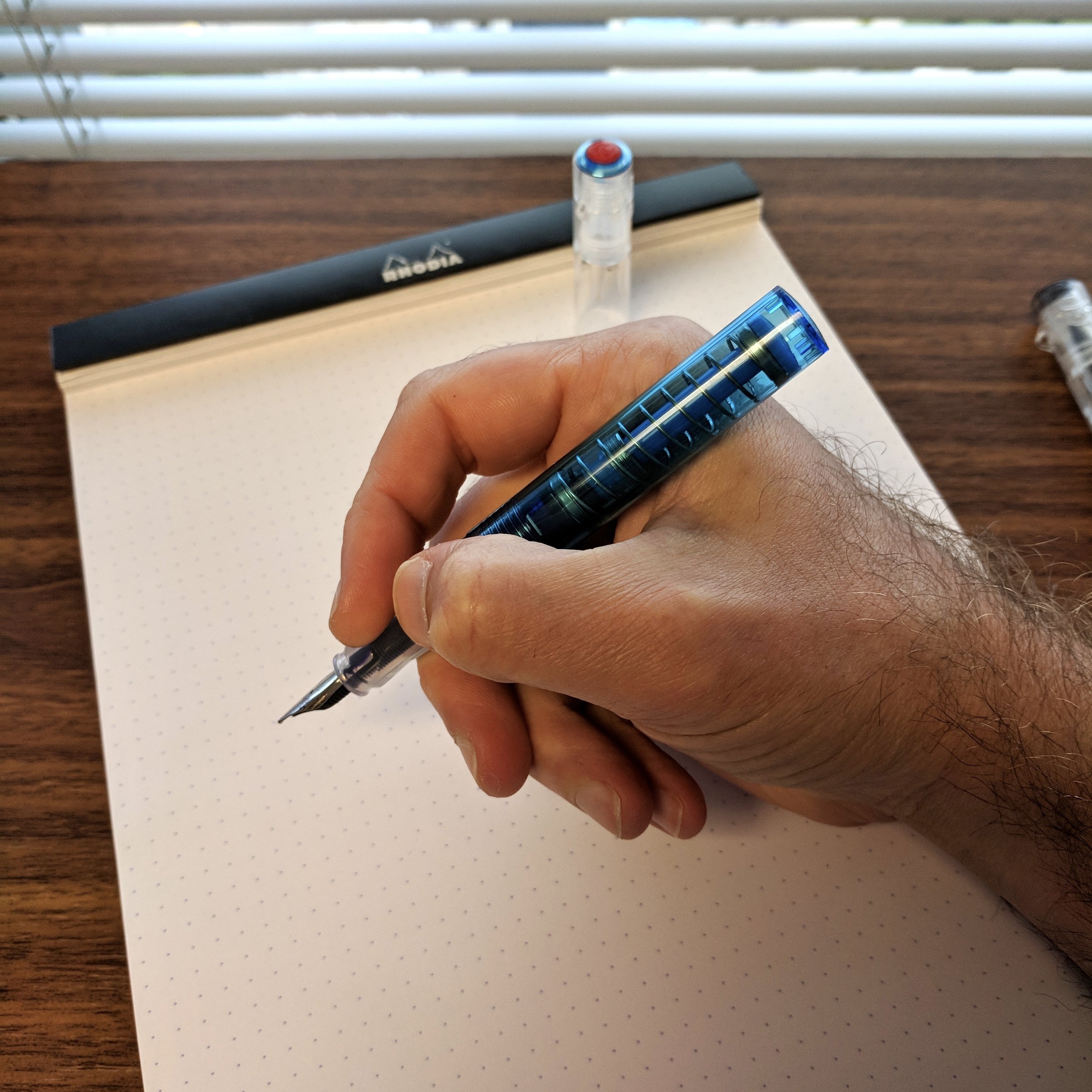
As you can see from the pictures above, the Go is a chunky pen, slightly shorter than the TWSBI 580 and the TWSBI Eco, but with more girth. Without the piston mechanism or any metal trim, the TWSBI Go is also much lighter than either of those pens, making it a comfortable pen for long writing sessions. It’s a longer pen when posted, but the cap hardly weighs anything so it didn’t throw the balance off for me.

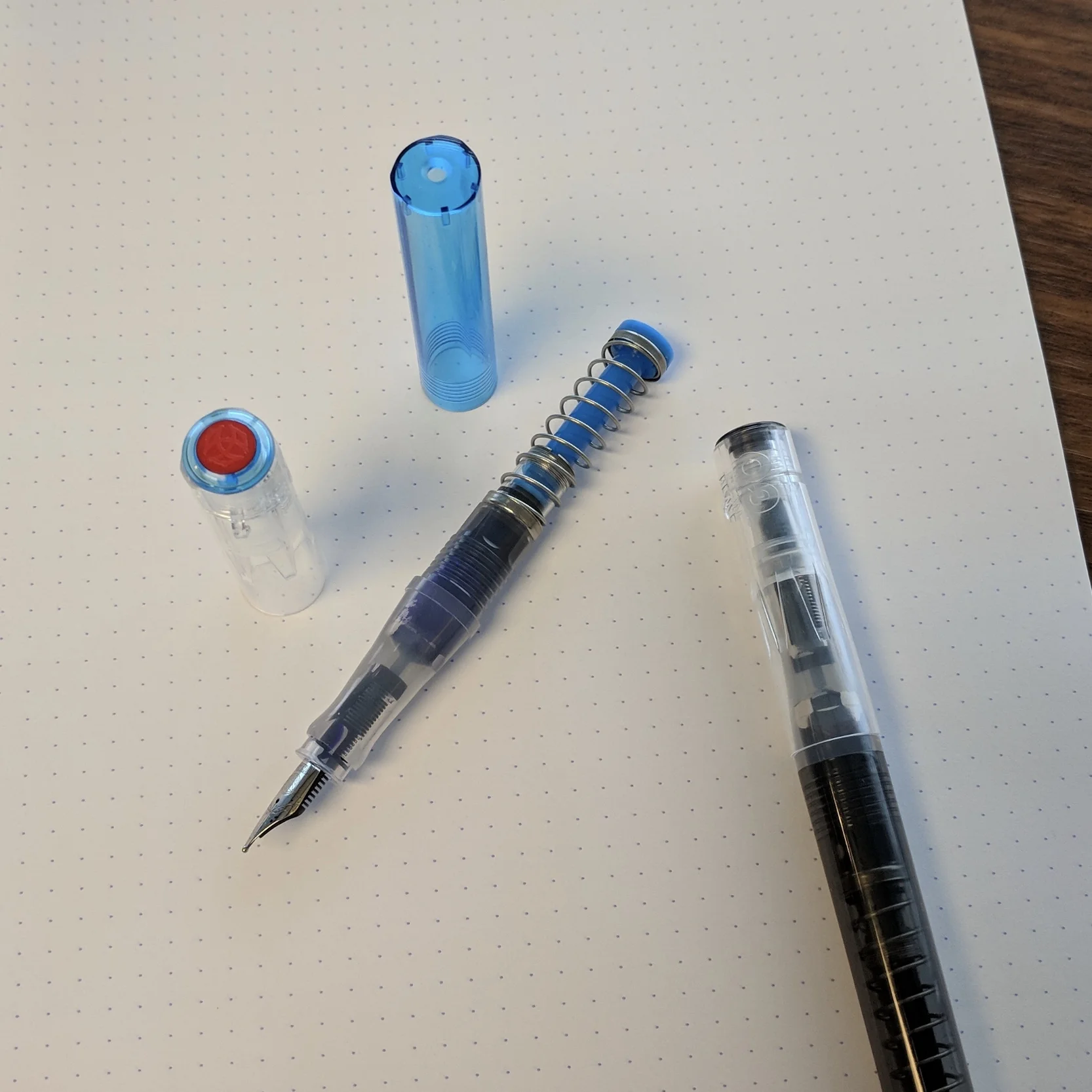
The only metal used in the pen is the spring around the plunger.

The only metal used in the pen is the spring around the plunger.

TWSBI really innovated here with the filling system on the Go. While TWSBI refers to it as a “spring loaded piston filling mechanism,” I’d characterize this pen as a plunger filler. Plunger fillers, of course, are not a new concept, but they are uncommon in less expensive pens. The main selling point with TWSBI’s take on things is ease of filling: TWSBI claims that you just need to press down once, release “and you’re ready to GO!” It is indeed very easy to fill this pen (and presumably to flush it out), making the Go not only an excellent pen for beginners but also a great pen to use for ink testing. [Edit: See the comments below for some discussion of the proper terminology that should be used here. My point is that this pen fills differently from your typical “Piston filler” fountain pen.]

A size comparison with some similar non-TWSBI pens. From left: Faggionato Petrarque; Franklin-Christoph Model 20; TWSBI Go in Sapphire; TWSBI Go in Smoke; and last but not least, another great inexpensive demonstrator pen, the Wing Sung 3010. (Look for a writeup on that last one sometime soon).

And, last but not least, I’m going to talk about the aesthetics of this pen, which have prompted more discussion than the new filling system or the overall quality of the pen itself. The TWSBI Go is not “attractive” in the traditional sense - it’s neither streamlined nor shiny, it’s made entirely of plastic, and the filling system looks like some sort of steampunk Rube Goldberg machine. But somehow the look works for me. It’s fun. Don’t think too hard on it.

There’s no clip, but the cap does have a loop, presumably for a lanyard. Please don’t go there.

I do have some concern about the long-term strength of the plastic. The TWSBI Go has a “snap” cap that isn’t internally reinforced in any way, leading me to wonder whether or not it might be prone to cracking over the long term. That said, given the price point, I’m not going to worry too much about this. The TWSBI Go isn’t intended to be a “last-pen-you’ll-ever-need” product.

The Go looks like it uses the same nib as the TWSBI Vac Mini, but the nibs are friction-fit, not the standard TWSBI interchangeable nib unit. I wonder if anyone has done any experimenting to see what non-TWSBI nibs might be able to fit in the Go?

The Go looks like it uses the same nib as the TWSBI Vac Mini, but the nibs are friction-fit, not the standard TWSBI interchangeable nib unit. I wonder if anyone has done any experimenting to see what non-TWSBI nibs might be able to fit in the Go?

Takeaways and Where to Buy

If you’re just testing the waters with fountain pens in general, have been looking to try out a non-cartridge/converter fountain pen, or just want something different for a change, there’s not much risk in giving the TWSBI Go a try. The filling system is easy to master, the pen holds a decent amount of ink, and TWSBI offers a lot of quality nib options. I do hope that TWSBI introduces the Go in some different colors - this format presents an opportunity for the brand to step outside their clear/blue/gray demonstrator comfort zone - the “Sapphire” and “Smoke” motifs are getting a little tired as they’ve been launch colors for most of TWSBI’s models.

The TWSBI Go is available for purchase from most TWSBI retailers, and is available in both Sapphire and Smoke versions. While we don’t currently stock the TWSBI Go (we may in the future if the demand is there), the T.G.S. Curated Shop offers a large selection of TWSBI fountain pens and other inks and accessories.

Disclaimer: I purchased the pens featured in this review with my own funds, for my own use.

In Pens Tags Pen Review, TWSBI Go, TWSBI
6 Comments
← Newer Posts Older Posts →
Store Hours and Events
Shop T.G.S. Online
Updated 2026 "Best Pens" Guide
No results found
On The Paper Trail: Live In Nashville Event Tickets Now Available!
TGS_25 Roterfaden Restock Notification
Hierarchies of Fountain Pen Friendly Paper

Join Our Patreon!
Subscribe to the TGS E-mail List

Featured Posts

Featured
Everyday-Stationery-Bags
July 25, 2026
What's the Best Everyday Stationery Bag? My Own Considerations and 5 Options for Pen Show Season
July 25, 2026
Read more →
July 25, 2026
Graphilo-Kobeha-Paper.jpg
July 11, 2026
Paper Review: Graphilo by Kobeha
July 11, 2026
Read more →
July 11, 2026
Pilot-Custom-Heritage-92.jpg
June 6, 2026
Workhorse Pens: Pilot Custom Heritage 92 Fountain Pen
June 6, 2026
Read more →
June 6, 2026
The Gentleman Stationer RSS

View Cart

© Digital Divide Media, LLC, 2014-present.

All content is the exclusive property of Digital Divide Media, LLC, d/b/a The Gentleman Stationer, including “The Gentleman Stationer” website and trademark, and should not be reproduced without express written permission.  All rights reserved.

All content containing paid advertising, affiliate links, or sponsored content will be plainly disclosed by a disclaimer when/if featured.

Contact Information

Website Terms and Conditions

Store Shipping Policy and Return Policy

Privacy Policy and Cookie Policy

Accessibility Statement

Powered by Squarespace